


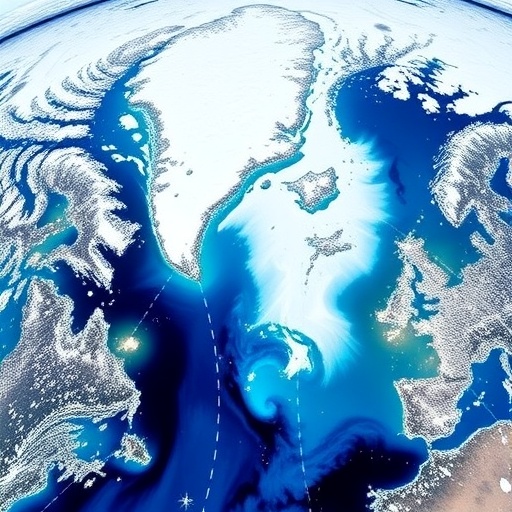
Iceland’s ice sheet may have repeatedly rewritten the chemical signature of the North Atlantic, according to a new study that traces ocean changes across the past 230,000 years. Researchers from Heidelberg University analyzed rare-earth element neodymium preserved in deep-sea sediments from the Rockall Plateau, a region of the northeastern Atlantic. Their results indicate that the isotopic composition of North Atlantic seawater shifted substantially between glacial and interglacial periods, tracking the growth and retreat of Iceland’s ice sheet with striking precision.
The discovery challenges one of the most widely used assumptions in paleoceanography. Scientists commonly rely on neodymium isotopes to reconstruct the movement of ancient water masses and determine how ocean circulation changed during past climate transitions. The method assumes that each major water mass carries a relatively stable isotopic “fingerprint” through time. If that fingerprint changes at its source, however, researchers may mistake chemical evolution for a change in circulation. The Heidelberg study suggests that this problem may be especially important in the North Atlantic during glacial periods, when Iceland’s expanding ice sheet dramatically altered the delivery of rock-derived material to the ocean.
Neodymium occurs naturally in continental and volcanic rocks, and its isotopic composition varies according to the geological history of those rocks. The ratio between neodymium-143 and neodymium-144 is particularly useful because it reflects the source material from which dissolved neodymium was released. Scientists often express this relationship as a radiogenic signature: material enriched in neodymium-143 has a more radiogenic composition, while material with relatively less neodymium-143 has a less radiogenic one. Once dissolved in seawater, neodymium can be transported with ocean currents and incorporated into marine sediments, preserving a chemical record of changing environmental conditions.
Iceland provides an unusually powerful natural laboratory for studying this process. Much of the island is built from young basaltic rocks formed by volcanic activity along the Mid-Atlantic Ridge. During an ice age, the Icelandic ice sheet advances across this bedrock, grinding it beneath enormous quantities of moving ice. Glacial erosion produces vast amounts of extremely fine rock flour. Because the particles are small and chemically reactive, they can weather rapidly when exposed to seawater. The process releases elements, including neodymium, into the surrounding North Atlantic. According to the new study, this volcanic and glacial material carried a distinct, neodymium-143-enriched signature into the ocean.
The evidence comes from sediment recovered at Ocean Drilling Program Site 982 on the Rockall Plateau. Layers in the core accumulated over hundreds of thousands of years, creating a chronological archive of conditions in the North Atlantic. By measuring neodymium isotopes in different sections of the sediment, the researchers reconstructed how the chemical composition of upper North Atlantic waters changed through successive climate cycles. The most radiogenic signals appeared during glacial maxima, when the Icelandic ice sheet was at or near its greatest extent. During warmer interglacial periods, the signal became consistently less radiogenic.
The timing of these variations is central to the study’s conclusion. The neodymium record did not simply rise and fall in a smooth, linear response to global cooling and warming. Instead, the strongest chemical changes occurred in association with the dynamics of the Icelandic ice sheet, particularly during phases of rapid glaciation. As the ice advanced and intensified its erosion of basaltic terrain, the supply of reactive volcanic rock dust to the ocean increased. When the ice retreated, that source weakened. The result was a repeating chemical rhythm that closely followed the waxing and waning of the ice ages.
To test whether this mechanism could explain the sediment record, the Heidelberg team developed a box model representing the movement and mixing of neodymium between key environmental reservoirs. Such models simplify the ocean into interconnected compartments, allowing researchers to estimate how much material must enter or leave each one to produce the observed signal. The model showed that the changes in North Atlantic seawater chemistry could be reproduced when the input of Icelandic glacially produced material varied with ice-sheet behavior. The results support the interpretation that Iceland’s ice sheet was not merely responding to climate change but was actively modifying the chemical environment of the surrounding ocean.
The consequences may extend beyond the interpretation of ocean circulation records. Glacially generated rock dust also contains micronutrients such as iron, an element that can limit the growth of marine phytoplankton across large areas of the ocean. When Icelandic erosion delivered additional dust and dissolved material to the North Atlantic, it may have altered the availability of these nutrients. That could have influenced marine ecosystems, biological productivity and the oceanic carbon cycle during glacial periods. Phytoplankton absorb carbon dioxide through photosynthesis, and changes in their productivity can affect how much carbon is transferred from the atmosphere into the deep ocean. The study does not establish the full size of this effect, but it identifies a potentially important connection between ice, volcanic landscapes and marine carbon chemistry.
The findings also highlight how closely the cryosphere and the ocean are linked. Ice sheets are often treated as passive indicators of climate, expanding when temperatures fall and shrinking when they rise. The new research presents them as active geological agents capable of grinding continents, mobilizing elements and reshaping seawater chemistry on timescales relevant to climate change. It also warns that chemical tracers used to reconstruct the past may not be as stable as previously believed. A changing neodymium signature can reflect not only the arrival of a different water mass, but also a transformation in the material entering the ocean at its source.
The study, led by scientists including Norbert Frank and Antao Xu, was carried out within a German Research Foundation-funded project examining ocean circulation and geochemical cycles during major climate transitions. The sediment material was obtained from an Ocean Drilling Program and International Ocean Discovery Program expedition and provided through the IODP Bremen Core Repository at MARUM, the Center for Marine Environmental Sciences at the University of Bremen. Published in Science Advances, the research offers a new view of the North Atlantic’s past: one in which Iceland’s ice sheet repeatedly acted as a powerful chemical engine, leaving an isotopic signal that followed the rhythm of the ice ages almost step by step.
News Publication Date: 19-Aug-2026
Web References: https://doi.org/10.1126/sciadv.aeg5747
References: Science Advances; Ocean Drilling Program Site 982 sediment core from the Rockall Plateau; IODP Bremen Core Repository at MARUM – Center for Marine Environmental Sciences, University of Bremen.
Cite Scienmag News
Violet Maxwell. (August 20, 2026). Icelandic Ice Sheet Dynamics Changed North Atlantic Seawater Chemistry. Scienmag. https://scienmag.com/icelandic-ice-sheet-dynamics-changed-north-atlantic-seawater-chemistry/
Violet Maxwell. "Icelandic Ice Sheet Dynamics Changed North Atlantic Seawater Chemistry." Scienmag, 20 August 2026, https://scienmag.com/icelandic-ice-sheet-dynamics-changed-north-atlantic-seawater-chemistry/. Accessed 3 September 2026.
Violet Maxwell. "Icelandic Ice Sheet Dynamics Changed North Atlantic Seawater Chemistry." Scienmag. August 20, 2026. https://scienmag.com/icelandic-ice-sheet-dynamics-changed-north-atlantic-seawater-chemistry/


