


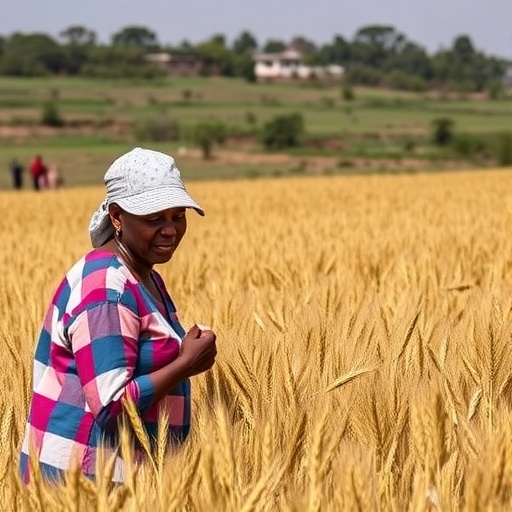
In the cool-temperate highlands of Northwest Ethiopia, where bread wheat has been cultivated for generations at elevations above 2,600 meters, farmers have long assumed that altitude was protection against the worst of a warming world. A new study dismantles that assumption. Researchers led by Tsegaye Demlie of the North Gondar agricultural system, working with collaborators including Gerrit Hoogenboom of the University of Georgia’s agro-meteorology community, have documented a paradox that is now rippling through climate-adaptation science: the world’s “climate refuges” — high, cold, seemingly sheltered mountain farms — are warming fast, and the farmers who sense it most acutely are precisely those least equipped to respond.
The study, published in Environmental and Sustainability Indicators, combined 38 years of station-level meteorological records (1981–2018) with a household survey of 200 smallholder wheat farmers in the Debark and Dabat districts of the North Gondar Zone. The meteorological analysis is unambiguous. Mean annual temperatures rose by 1.19 °C at Debark and 1.61 °C at Dabat over the study period — warming rates that rival, and in some months exceed, those recorded in much lower-lying East African zones. More troubling for agronomists is how the warming is distributed across the day. At Debark, maximum temperatures climbed by 1.45 °C while minimum temperatures rose only 0.68 °C, widening the diurnal temperature range and concentrating heat stress in the daylight hours when wheat canopies are photosynthesizing. Dabat showed the opposite signature — more uniform nighttime warming — meaning two adjacent highland districts are experiencing fundamentally different microclimatic regimes within a few tens of kilometers of each other.
The agronomic implications of this daytime-heat intensification are precisely the ones wheat physiologists fear most. Bread wheat (Triticum aestivum L.) supplies roughly 20 percent of human dietary energy globally, and its yield is acutely sensitive to temperature during anthesis and grain filling. Heat spikes during these phenological windows accelerate canopy senescence, shorten the grain-filling period, and depress seed weight, test weight, and milling quality — a pattern documented in global crop-modeling work following Asseng and colleagues, and now visible on the ground in North Gondar. Farmers in the survey identified this mechanism directly: 33 percent named high temperatures as the primary driver of declining crop performance, ahead of soil fertility decline (20.5 percent) and erratic rainfall onset (12.5 percent). In other words, smallholders’ risk perception tracked daytime heat spikes and overnight warming rather than the annual precipitation totals that dominate most regional climate indices — a cognitive signature the authors call the “high-altitude thermal-perception contradiction.”
The socioeconomic baseline of the surveyed households explains why perception has not translated into adaptation. The sample was deliberately gender-stratified: 150 male-headed and 50 female-headed households, selected through a four-stage purposive and stratified random sampling design across eight villages, with sample size determined by Cochran’s finite-population formula. What emerged was a portrait of structural fragility. Nearly three-quarters of household heads (73.5 percent) were functionally illiterate, only 5 percent had completed secondary education, and the mean age of household heads was 45.2 years, with 83.5 percent over 40. Average landholdings were just 0.92 hectares, supporting families of 4.5 people on average. These are the classic ingredients of an adaptation trap: enough ecological knowledge accumulated over decades of farming to perceive change, but too little literacy, liquidity, and labor to convert perception into investment.
Institutional data sharpened the picture. Only 26.5 percent of farmers had ever received climate-change training, 63 percent had no access to agricultural extension advisory services, and — the single most severe bottleneck — 82.5 percent lacked access to site-specific climate information such as downscaled forecasts or seasonal rainfall outlooks. Input adoption reflected these gaps: just 24.5 percent of households used improved bread wheat varieties and only 15 percent used inorganic fertilizer. Farmers trying to recalibrate planting dates against shifting rainfall calendars were doing so essentially blind, which the authors argue converts a cheap, flexible adaptation strategy into a gamble that frequently ends in poor germination or terminal drought stress.
To move beyond simple correlations, the team deployed a Multivariate Probit (MVP) model — an econometric framework that estimates five adaptation decisions simultaneously rather than treating each in isolation. The five strategies modeled jointly were adoption of improved wheat varieties, intercropping/crop diversification, sowing-date adjustment, soil-and-water conservation structures, and inorganic fertilizer use. The logic of the MVP specification matters: smallholder households do not choose practices one at a time, and unobserved factors — risk aversion, informal networks, hidden capital — influence multiple decisions at once. Estimating separate equations would discard those correlations and bias the coefficients. The model’s likelihood-ratio test strongly rejected independence of the error terms (χ²(10) = 38.42, p < 0.001), confirming that the strategies are jointly conditioned by shared, unmeasured household characteristics.
The estimated error correlations exposed the hidden architecture of smallholder decision-making. Positive correlations between improved varieties, sowing-date shifts (ρ = 0.415), conservation structures (ρ = 0.284), and fertilizer use (ρ = 0.362) revealed that better-resourced households assemble integrated technology bundles, stacking genetic, agronomic, and structural defenses against climate shocks. But the negative correlations told a starker story: intercropping was inversely correlated with both improved seeds (ρ = −0.184) and fertilizer (ρ = −0.210), a signature of substitutability under scarcity. Resource-poor households were not building bundles — they were substituting cheap, biological risk-hedging for inputs they could not afford, a pattern consistent with cash-constrained systems across Eastern Africa and South Asia.
Gender emerged as the deepest fault line in the data. Male-headed households were significantly more likely to adopt improved varieties (36.7 percent versus 20.0 percent, p < 0.05) and inorganic fertilizer, with marginal effects showing male heads at a 14.2 percentage-point advantage in seed adoption and 12.6 points in fertilizer use. Female-headed households, by contrast, deployed intercropping at nearly five times the male rate — 32.0 percent versus 6.7 percent (p < 0.05). The authors attribute this split not to preference but to patriarchal gatekeeping of credit, land tenure security, certified-seed channels, and extension contact, which mechanically steers women toward low-input, biodiversity-based strategies that prioritize household nutritional security over yield maximization. Physical soil-and-water conservation structures, which demand heavy labor, were adopted by only 16 percent of female heads — a reflection of the triple labor burden of childcare, domestic work, and field agriculture, absent any community labor-sharing arrangements.
Spatial heterogeneity compounded the gendered one. Households in better-connected kebeles such as Mikara adopted improved varieties at 46 percent, while remote Arbatensa lagged at 24 percent, with soil conservation dipping to just 6 percent. Proximity to markets, credit, and extension agents systematically reduced information asymmetries and technology transaction costs, meaning that adaptation capacity in these highlands is effectively rationed by geography. Farmers themselves ranked degraded soil fertility as the single greatest barrier to adaptation (29.5 percent), followed by inadequate climate information (22.0 percent) and lack of training and extension (17.0 percent) — a barrier hierarchy that places institutional failure nearly on par with biophysical degradation.
The precipitation side of the record added a final caution against complacency. Annual rainfall actually increased over the period — substantially so at Debark (+350.5 mm), attributed to orographic lifting at higher elevation — yet the authors argue this wetting trend is partly illusory from a crop-water standpoint. Rising temperatures amplify potential evapotranspiration and vapor-pressure deficits, meaning that extra rainfall can be evaporated away faster than it replenishes soil moisture during dry spells. More rain, in a hotter atmosphere, does not guarantee a better water balance for a wheat plant. It is precisely this kind of microclimatic complexity, the authors contend, that coarse regional climate models miss, and that only station-scale, multi-decadal records can capture.
The study’s policy prescription is correspondingly specific: abandon gender-neutral, one-size-fits-all extension models in favor of spatially targeted, gender-responsive systems that bundle stress-tolerant wheat genotypes with downscaled digital weather advisories and landscape-scale soil conservation investment. The paradox the researchers document — acute perception paired with paralyzed response — is not unique to North Gondar, but nowhere is it starker than in these high-altitude wheat fields, where the thermal refuge has quietly closed and the institutional scaffolding for adaptation has yet to be built.
Cite Scienmag News
Sloane Callahan. (September 3, 2026). Farmers in Northwest Ethiopia perceive climate change and adapt wheat farming. Scienmag. https://scienmag.com/farmers-in-northwest-ethiopia-perceive-climate-change-and-adapt-wheat-farming/
Sloane Callahan. "Farmers in Northwest Ethiopia perceive climate change and adapt wheat farming." Scienmag, 3 September 2026, https://scienmag.com/farmers-in-northwest-ethiopia-perceive-climate-change-and-adapt-wheat-farming/. Accessed 10 September 2026.
Sloane Callahan. "Farmers in Northwest Ethiopia perceive climate change and adapt wheat farming." Scienmag. September 3, 2026. https://scienmag.com/farmers-in-northwest-ethiopia-perceive-climate-change-and-adapt-wheat-farming/


