


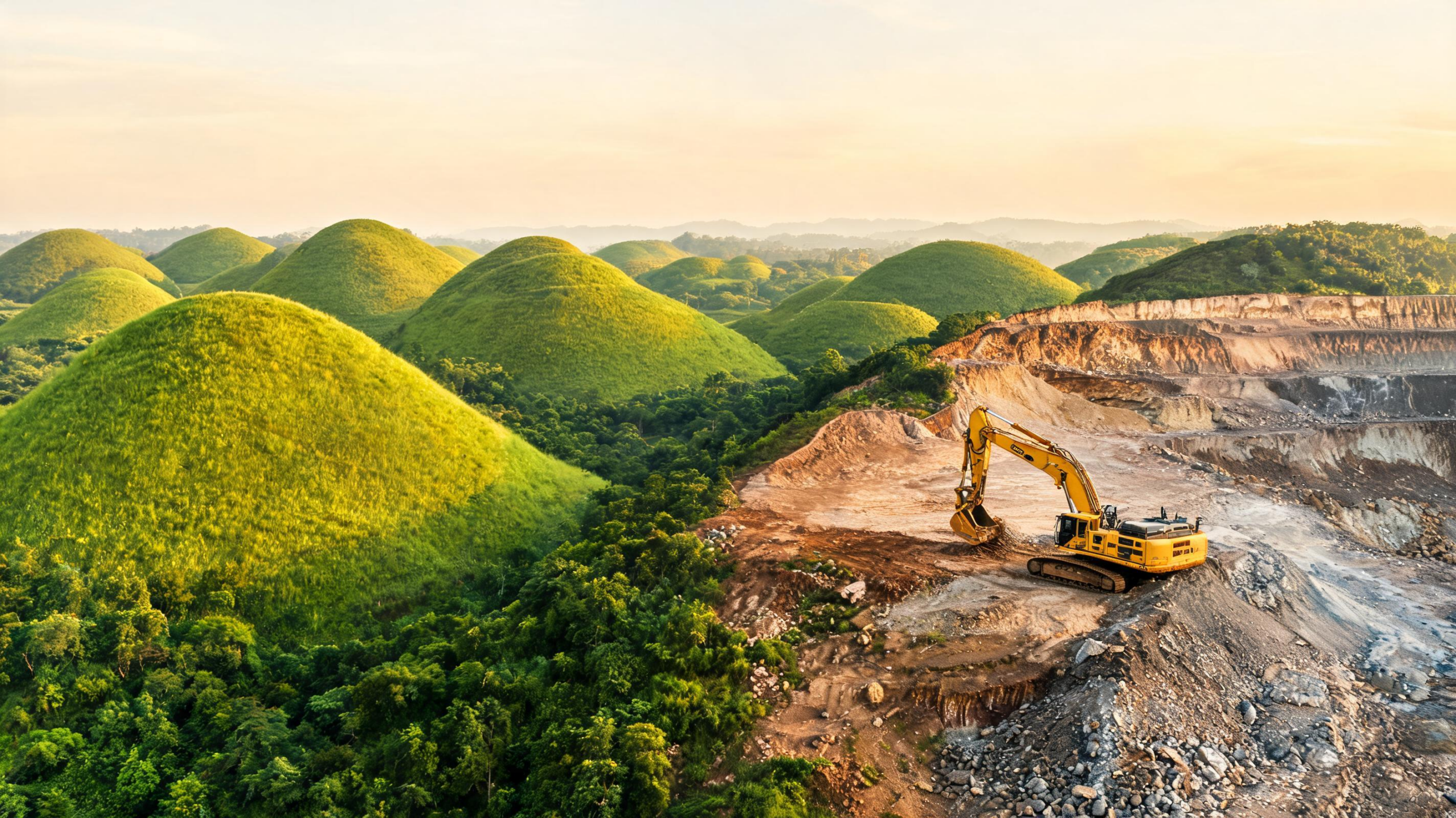
In the southern Philippine province of Davao Oriental, an online argument about nickel mining has turned into something approaching a digital town hall. When the provincial government posted on Facebook about a dialogue concerning open-pit mining operations near the Mount Hamiguitan Range Wildlife Sanctuary, a UNESCO World Heritage Site and ASEAN Heritage Park, the reaction was immediate and intense. A news outlet, SunStar Davao, republished the same images with English captions the same day. Between the two posts, users left more than 4,000 reactions and roughly 800 unique comments. Now, a research team led by Jhonnel Villegas of Davao Oriental State University and the Czech University of Life Sciences Prague has mined that digital discourse for scientific insight, showing how social media sentiment can be systematically analysed to inform community-based conservation in one of the world’s most biodiverse and heavily mined regions.
The study, published in the journal Discover Conservation, examined 481 unique comments drawn from the two Facebook posts, both dated October 7, 2025. The researchers deliberately waited about two months before scraping the data using a cloud-based automation service, ensuring that reactions and comments had stabilised before analysis. The provincial government page, with roughly 182,000 followers, attracted a more localised audience, while SunStar Davao’s 1.3 million followers gave the story a broader national reach. From the full set of 806 comments, the team excluded nearly 60 percent for reasons of relevance and substance, leaving a core of 481 substantive remarks. Many commenters appeared to have direct or indirect connections to Davao Oriental, evident from local expressions, self-references, and vivid descriptions of local ecosystems, livelihoods, and mining-related impacts, although the authors caution that these users cannot be treated as statistically representative of the general population.
The analytical approach was grounded in Social Representations Theory, a framework that explains how shared beliefs, values, and meanings are socially constructed and circulated through communication, shaping how communities understand contested issues. Rather than treating each comment as an isolated opinion, the researchers interpreted them as manifestations of collectively negotiated understandings of environmental risk, governance, livelihood, and community well-being. Comments written in Cebuano and Filipino were translated into English with the assistance of artificial intelligence tools and then carefully reviewed by team members fluent in the local languages, who worked to preserve tone, sarcasm, and culturally embedded meanings. Using Braun and Clarke’s six-step reflexive thematic analysis, two independent groups of researchers coded the comments separately, then reconciled discrepancies by consensus to strengthen reliability.
The results coalesced into six themes of public sentiment. The largest, community voice and protest, captured 139 comments and revealed a widespread sense that local voices were ignored or marginalised by those in authority, breeding scepticism toward official claims about biodiversity conservation, environmental rehabilitation, and responsible mining. Governance and accountability followed with 107 comments, expressing frustration over perceived government complicity, accusations of corruption and bribery, and anger that mining near the sanctuary has already cleared approximately 200 hectares of forest land. Environmental degradation drew 94 comments, with users describing stripped-bare mountains, dried rivers, declining biodiversity, and fragmented forest cover, and insisting that no amount of money or replanting can fully restore these sites. Calls for action and hope accounted for 55 comments, social and health impacts 20, and economic and livelihood impacts 15.
That final theme, though the smallest, captures perhaps the sharpest tension. Some commenters acknowledged that families rely on mining for their livelihoods and worried about job losses should operations cease, while others argued that communities survived long before the industry arrived and cautioned against dependence on a single sector. Calls mounted for alternative livelihood programmes, alongside dissatisfaction with the distribution of mining benefits, which many felt were disproportionately enjoyed by politicians, officials, and companies while communities bore the environmental costs. The study situates this local dispute within a global debate, noting that the Philippines ranks fifth in untapped reserves of valuable metal ores, with an estimated value of one trillion US dollars, and that mining productivity has grown exponentially worldwide over the past 150 years as the backbone of industrial and digital development.
What makes Davao Oriental exceptional, and the dispute so charged, is the ecological stakes. The Mount Hamiguitan Range Wildlife Sanctuary is home to the critically endangered Philippine Eagle, the national bird, and continues to yield new species to science, including the long-horned beetle Paraskeletodes hamiguitanensis and the recently described endemic plant Begonia corazoniae. The sanctuary’s ecological integrity is linked to downstream ecosystems that connect to Pujada Bay, a marine protected area recognised as one of the Most Beautiful Bays of the World and tentatively listed as a UNESCO World Heritage extension. The bay is an ancient nesting site for green, hawksbill, and olive ridley turtles, shelters the dugong, and lies within the Coral Triangle, the global epicentre of marine biodiversity. Parts of the mining tenements, which span roughly 5,000 hectares of coastal and mountainous concessions, overlap with the ancestral domain of the Mandaya indigenous people, whose cultural identity and ecological knowledge are deeply tied to the land.
From these findings, the team developed the RESPECT framework, a community-based action model that translates public sentiment into practical conservation strategy. Its components call for re-evaluating land-use plans and zoning policies to clearly separate conservation zones from mining concessions; expanding the boundaries of the sanctuary and the bay under a ridge-to-reef, whole-of-island perspective; sustaining environmental protection initiatives that empower indigenous and local communities as conservation champions; providing ecological regeneration of mined-out areas grounded in scientific assessments of soil, water, and biodiversity; and reducing reliance on mining income through alternative and additional livelihoods. The framework further urges voters to prioritise candidates with firm anti-mining and environmental agendas, promotes multi-stakeholder collaboration involving universities, churches, and civil society, and emphasises environmental education in schools to cultivate a stewardship ethic among the young. The framework was refined through consultation with academics, priests, environmental lawyers, church leaders, and advocates, ensuring it reflects community and multidisciplinary perspectives rather than academic interpretation alone.
The political context is shifting rapidly. The provincial government has issued statements inclined toward the cessation or closure of the nickel mining operations and has formally requested their rescission through provincial resolution. A House Bill has been filed to declare Davao Oriental a mining-free zone, although its passage has since been halted. Internationally, environmental groups have repeatedly called for a complete halt to mining near the heritage site, and reporting on nickel mining damage near the sanctuary has stirred national outrage. The researchers argue that these overlapping pressures make sentiment analysis especially valuable: while social media data cannot deliver sector-specific conclusions, they reveal how socially visible participants frame the trade-offs between economic development and environmental protection, where public conflict originates, and where community expectations for accountability and livelihood transition are most clearly articulated.
The study’s broader message is that digital discourse deserves a formal seat in environmental governance. Guided by Social Representations Theory, the authors contend that collective meanings about mining are constructed, shared, and reinforced through online social interaction, and that these expressions can and should guide public policy and social action aimed at natural resource management and biodiversity conservation. In a province where indigenous cultural communities maintain longstanding material, cultural, and spiritual relationships with land and sea, ignoring public sentiment risks both ecological damage and social conflict. The team recommends institutionalising the RESPECT framework to re-evaluate and reimagine the province’s mining sector, insisting that transparency and genuine community engagement are prerequisites for any ecologically centred mining practice. As mining faces mounting scrutiny worldwide, this study suggests that the comments section, often dismissed as noise, may in fact be a rich and largely untapped data source for the science of conservation.
The historical backdrop helps explain why emotions run so high in these online exchanges. The Philippines industrialised its mineral sector during the American occupation, and in 1995 the Mining Act, Republic Act 7942, was enacted to stimulate extraction and economic growth. Yet the industry has long been criticised for habitat degradation, biodiversity loss, and pollution, with environmental impact assessments frequently functioning more as compliance exercises than genuine safeguards. In Banaybanay, Davao Oriental, an overflowing mining catchment pond released orange laterite sediment rich in chromium and nickel, threatening freshwater and marine life in nearby waterways.
The choice of Facebook as a data source reflects its dominance in the Philippines, where it is among the most widely used platforms and where users often express sharply polarised political opinions. This makes the platform a natural arena for contested environmental issues, though the researchers acknowledge important limitations: only publicly shared comments could be collected, and demographic details such as age, locality, and political background could not be verified, meaning the sample cannot be generalised to the wider population.
The authors also frame the work as a form of citizen science, in which online expressions of environmental concern can serve as evidence for monitoring ecological decline and preventing conflict. This matters in Mindanao, where mining grievances have intersected with insurgency, poverty, and social exclusion, and where the killing of indigenous peoples has fuelled resistance to corporate extraction. Because mining impacts are not experienced uniformly, but are shaped by gendered roles and inequalities, the researchers argue that sentiment analysis can reveal whose concerns are loudest and whose remain unheard, helping policymakers design responses that are inclusive, equitable, and culturally sensitive rather than purely economic in orientation.
Subject of Research: Social media sentiment analysis to inform community-based conservation in mining-affected landscapes near a UNESCO World Heritage Site in Davao Oriental, the Philippines
Article Title: Analysing social media sentiments to inform community-based conservation in mining-affected landscapes near a World Heritage Site in Davao Oriental, the Philippines
Article References: Villegas, J., Verzosa, R., Bauyot, M. F., Hemillan, J., Pilar, J., Ngoho, M. C. J. N., Rivera, E., Medina, M. N., Antonio, E., & Sumile, E. (2026). Analysing social media sentiments to inform community-based conservation in mining-affected landscapes near a World Heritage Site in Davao Oriental, the Philippines. Discover Conservation, 3(1), Article 39. https://doi.org/10.1007/s44353-026-00107-w
Image Credits: AI Generated
DOI: 10.1007/s44353-026-00107-w
Keywords: social media sentiment, community-based conservation, open-pit mining, UNESCO World Heritage Site, Mount Hamiguitan, Davao Oriental, biodiversity, nickel mining, thematic analysis, Facebook, indigenous communities, ecological regeneration
Cite Scienmag News
Margaret Porter. (September 10, 2026). Facebook Fury Over Mining Near a UNESCO Site Is Rewriting Conservation in the Philippines. Scienmag. https://scienmag.com/facebook-fury-over-mining-near-a-unesco-site-is-rewriting-conservation-in-the-philippines/
Margaret Porter. "Facebook Fury Over Mining Near a UNESCO Site Is Rewriting Conservation in the Philippines." Scienmag, 10 September 2026, https://scienmag.com/facebook-fury-over-mining-near-a-unesco-site-is-rewriting-conservation-in-the-philippines/. Accessed 4 October 2026.
Margaret Porter. "Facebook Fury Over Mining Near a UNESCO Site Is Rewriting Conservation in the Philippines." Scienmag. September 10, 2026. https://scienmag.com/facebook-fury-over-mining-near-a-unesco-site-is-rewriting-conservation-in-the-philippines/


