


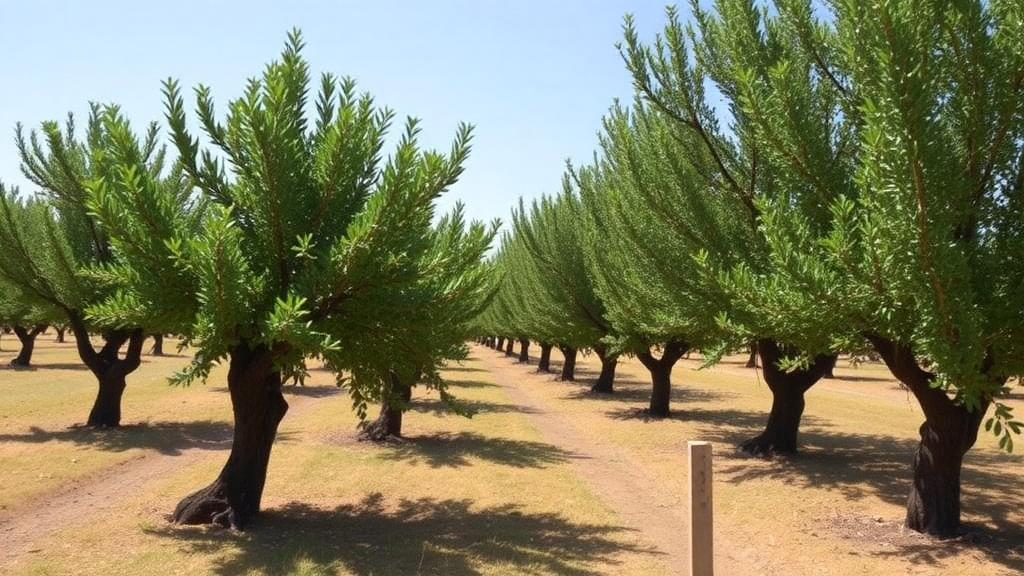
Scattered across the hills, home gardens, and abandoned farmland of central Italy’s Marche region grows a population of almond trees that commercial agriculture forgot decades ago. A new study published in iScience suggests that forgetting may have been the best thing that ever happened to them. Researchers from the University of Bari and the Marche regional agri-food innovation agency sampled 121 almond trees from rural areas across the region and subjected them to DNA fingerprinting using microsatellite markers. The results reveal a gene pool so distinct, so rich in rare genetic variants, that it stands apart from both the Italian commercial varieties and the international cultivars that dominate world almond production today.
The story behind these trees is as compelling as the genetics. Almond, Prunus dulcis, is among the oldest domesticated nut trees, native to Central Asia and spread westward to the Mediterranean, which became a secondary center of diversification for the species. In Italy, almond cultivation is concentrated in the south: Sicily and Apulia together account for 96 percent of national production. Yet small plantings and lone trees of unknown varieties persist in central regions including Marche, Abruzzo, and Sardinia. In Marche, historical records are sparse, but the picture that emerges is of a region where fruit trees were long grown in co-cultivation with herbaceous crops, exchanged locally, and largely neglected by industrial agriculture. Paradoxically, that neglect preserved diversity that intensive cultivation elsewhere has erased.
The twentieth century reshaped Marche agriculture repeatedly. Early in the century, specialized orchards appeared along the coast and in the valleys, and the region became known as an exporter of apples, quinces, pomegranates, peaches, plums, and apricots. During the Fascist period, state policy encouraged high-yielding varieties and the importation of new cultivars to test their suitability. Production collapsed during the Second World War and was abandoned in the postwar years as industrialization and rural exodus emptied the countryside. Agriculture reverted to older practices, with fruit trees interspersed among vines and perennials, and only a few species grown in home gardens for personal consumption. That retreat, the authors argue, slowed the loss of biodiversity and allowed many local varieties to survive into the twenty-first century.
To characterize this living legacy, the team geotagged and sampled leaves from 121 almond trees across the provinces of Ancona, Ascoli Piceno, Fermo, and Pesaro-Urbino, most of them from Ancona. They compared the local trees against 120 reference genotypes from Italian and international germplasm collections maintained by the Council for Agricultural Research and Economics and the regional research center CRSFA. Genomic DNA was extracted and amplified at thirteen simple sequence repeat loci, microsatellite markers preselected for their proven informativeness across the genus Prunus. Because microsatellites are codominant and unaffected by environmental conditions, they offer a far more accurate picture of genetic identity than traditional classification based on leaf shape, kernel size, or bloom color, which can shift with growing conditions.
The molecular results were striking. The thirteen markers produced 187 alleles in total, averaging 14 alleles per locus, with a mean polymorphism information content of 0.80, indicating that the markers were highly discriminating. The average observed heterozygosity was 0.68 against an expected heterozygosity of 0.82, and the Shannon diversity index reached 2.09, figures comparable to those reported for almond collections in Morocco, Central Asia, and other Italian regions. Crucially, no two Marche trees shared an identical genotype, and the pairwise relationship analysis found no duplicates or synonyms among the accessions. Every tree sampled was genetically unique, a level of individual distinctiveness that underscores how much untapped variation persists in these marginal orchards.
When the researchers built phylogenetic trees and ran clustering analyses, the Marche genotypes separated cleanly from the commercial references. A neighbor-joining analysis split the samples into two major clusters, with most Marche trees falling into a subgroup alongside Italian commercial varieties but distinct from them, while a separate subgroup contained US, Russian, Ukrainian, and Bulgarian cultivars together with two Apulian varieties. A Bayesian clustering analysis implemented in STRUCTURE identified three ancestral populations as the best fit: one composed mainly of Marche genotypes, one of Italian reference varieties, and one of international cultivars. The principal coordinate analysis confirmed the same pattern. The Marche trees, in other words, belong to a gene pool that is underrepresented in both national and international collections.
Perhaps the most remarkable finding came from the search for private alleles, variants found at frequencies below one percent in one population and absent from the other. The Marche almonds carried 36 private alleles across the marker set, at least one at every locus except one. Such richness in population-specific variants is exactly what breeders look for when seeking new sources of disease resistance, drought tolerance, or adaptation to difficult environments. The authors suggest that these trees, having survived harsh conditions and decades of neglect without human assistance, may harbor traits of resilience that could prove invaluable as climate change intensifies pressure on Mediterranean agriculture.
The genetic evidence also preserves echoes of history. Several Marche trees showed similarity to productive Apulian varieties such as Tuono, Pulita, and Mancina, and to French, Spanish, Greek, and American cultivars including Flots, Marcona, Retsou, and Texas. The researchers link this to the 1930s policy of testing international varieties in the region. A paternity analysis identified the parents of one sample, MA_64, as the Apulian variety Tuono and the US variety Tardy Nonpareil, the latter widely used to introduce late flowering, a trait that helps trees escape spring frosts. Three accessions clustered with early-flowering varieties and the wild species Prunus webbii, hinting at ancient gene flow between wild and cultivated almonds, the same introgression that gave modern cultivars their self-compatibility through varieties like Tuono and Genco.
The broader context gives the findings urgency. Modern almond breeding worldwide descends from a handful of founders, with Nonpareil, Tuono, Cristomorto, and Mission together accounting for nearly half of the genetic contribution of the world’s most grown varieties. That narrowing of the genetic base leaves the crop vulnerable to emerging threats, including the bacterium Xylella fastidiosa, which menaces almond along with olive, grapevine, and citrus, and against which control currently relies on vector management and the identification of resistant genotypes. International frameworks such as the Convention on Biological Diversity and the FAO plant treaty have made the conservation and sustainable use of crop genetic resources explicit priorities, and studies like this one supply the raw material for meeting them.
The authors are candid about limitations: thirteen markers, while informative, are fewer than would be needed to fully resolve the relationships, and the reference panel leaned heavily on Apulian accessions, so adding genotypes from Abruzzo and Sardinia would strengthen future comparisons. Still, the path forward is clear. The next steps involve deep morphological, biochemical, and agronomic characterization of the Marche accessions, including their nutrient and antioxidant profiles, work that could reveal favorable traits and make these nuts commercially valuable in their own right. Almonds are already an important food source, rich in fat, protein, and beneficial compounds such as oleic acid. If the forgotten trees of Marche carry adaptations bred by centuries of informal selection, their rescue from obscurity could help secure a more sustainable future for one of the world’s oldest nut crops.
Subject of Research: Genetic characterization of unexploited almond biodiversity in the Marche region of central Italy using microsatellite markers
Article Title: An unexploited almond biodiversity in central Italy: Genetic characterization and conservation strategies using molecular markers
Article References: Savoia, M. A., Sgaramella, N., Micheletti, A., Staffolani, P., Gaeta, L., Venerito, P., Miazzi, M. M., Fanelli, V., & Montemurro, C. (2026). An unexploited almond biodiversity in central Italy: Genetic characterization and conservation strategies using molecular markers. iScience, 29(10), Article 116502. https://doi.org/10.1016/j.isci.2026.116502
Image Credits: AI Generated
DOI: 10.1016/j.isci.2026.116502
Keywords: almond, Prunus dulcis, genetic diversity, microsatellite markers, Marche region, Italy, germplasm conservation, private alleles, Xylella fastidiosa, plant breeding, agrobiodiversity, Prunus webbii
Cite Scienmag News
Juliet Wilcox. (October 4, 2026). Forgotten Almond Trees in Central Italy Reveal a Hidden Genetic Treasure. Scienmag. https://scienmag.com/forgotten-almond-trees-in-central-italy-reveal-a-hidden-genetic-treasure/
Juliet Wilcox. "Forgotten Almond Trees in Central Italy Reveal a Hidden Genetic Treasure." Scienmag, 4 October 2026, https://scienmag.com/forgotten-almond-trees-in-central-italy-reveal-a-hidden-genetic-treasure/. Accessed 4 October 2026.
Juliet Wilcox. "Forgotten Almond Trees in Central Italy Reveal a Hidden Genetic Treasure." Scienmag. October 4, 2026. https://scienmag.com/forgotten-almond-trees-in-central-italy-reveal-a-hidden-genetic-treasure/


