


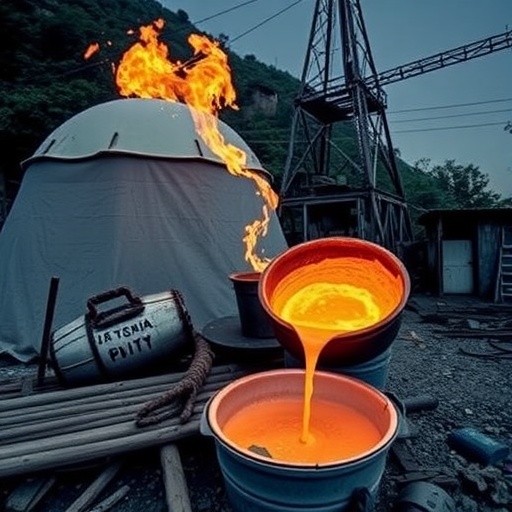
Mercury, the neurotoxic metal that binds gold into amalgam, is proving far harder to erase from the Tanzanian landscape than policymakers might have hoped. A new case study published in the Archives of Environmental Contamination and Toxicology reveals that total mercury residues from artisanal and small-scale gold mining operations persist not only at obvious disposal points but across broad swaths of soil and river sediment, penetrating more than a meter deep in places and drifting downstream toward Lake Victoria. The findings, led by Clavery Tungaraza and Eliapenda Elisante Mariki of Sokoine University of Agriculture in Tanzania together with Mark D. Cohen of the NOAA Air Resources Laboratory, suggest that the dream of simply cleaning up these sites may be far more difficult, and far more expensive, than national and international strategies currently acknowledge.
The research team focused on five artisanal mining sites scattered across Tanzania’s gold-bearing regions: Mgongo, Sekenke, Nyarugusu, Rwamgasa, and Mugusu. Each of these locations has hosted decades of informal gold extraction, in which miners crush ore and mix it with elemental mercury to capture fine gold particles, then squeeze or burn off the mercury to recover the precious metal. This technique, cheap and effective for individual miners, releases mercury directly into soils, tailings, waterways, and the atmosphere. While national inventories and the Minamata Convention on Mercury have targeted reductions in mercury use, the study’s central question was different and in some ways more sobering: even if mercury use stopped tomorrow, how much of it is already embedded in the environment, and how feasible would remediation actually be?
To answer that question, the researchers measured total mercury, abbreviated THg, in soil profiles at each of the five sites, sampling from the surface down to one meter. The results paint a consistent vertical picture across locations. Mercury concentrations are highest in the top 20 centimeters of soil, the zone where spilled amalgam, burned mercury vapor condensing on particles, and contaminated tailings accumulate most heavily. Below that surface layer, concentrations decline with depth but do not disappear. At the Nyarugusu mine site, the team recorded the highest surface-layer value of the entire study: 1.48 milligrams of mercury per kilogram of soil, with a standard deviation of plus or minus 0.02 mg/kg. Even at a depth of 100 centimeters, the same profile still registered 0.12 mg/kg, a moderate but meaningful decrease that demonstrates mercury’s mobility through the soil column. At Rwamgasa, samples pulled from 70 and 80 centimeters deep still contained 0.048 and 0.082 mg/kg respectively, concentrations that, while lower than the surface hotspots, remain well above what would be expected in uncontaminated background soils.
That deep penetration matters for a technical reason: most conventional remediation approaches are designed around excavating or treating the topmost contaminated layer. Soil capping, excavation and landfill disposal, thermal desorption, and stabilizing amendments are all most practical, and most cost-effective, when contamination is shallow and spatially confined. The Tanzanian data show neither condition holds. Mercury has been transported downward through soil profiles over years and decades, likely mediated by percolating rainwater carrying dissolved and colloid-bound mercury, by bioturbation from roots and soil-dwelling organisms that churn material downward, and by physical mixing during continued mining disturbance. Once mercury reaches these depths, excavation becomes impractical, and in situ treatment options face the challenge of delivering remedial agents through heterogeneous soil matrixes where mercury may be locked into mineral lattices or bound to organic matter in forms that resist extraction.
The horizontal dimension of the contamination is equally troubling. Along the Mabubi River, which drains directly through the Mugusu mine site, the researchers observed a clear gradient of mercury in surface-layer sediments distributed along the river’s course. Mercury does not simply sit where it was spilled. Physical erosion of contaminated tailings sends particle-bound mercury into the water column; seasonal flooding resuspends riverbed sediments and redistributes them downstream; and chemical processes, including the formation of soluble mercury complexes and the partitioning of mercury onto fine suspended particles, keep the metal in transit. Biological processes add another vector, as mercury accumulates in aquatic organisms and is excreted or deposited elsewhere. The net effect is a contamination footprint that expands far beyond any disposal site boundary, following the hydrology of the landscape itself.
The downstream destination of that hydrology is what elevates this study from a local environmental assessment to a regional warning. The Mabubi River feeds into Lake Victoria, the largest tropical lake in the world and the water source and fishery for millions of people in Tanzania, Uganda, and Kenya. Prior research, cited by the authors, has already documented elevated mercury in Lake Victoria fish species and associated human exposure in lakeside communities, and a companion study by members of the same team published in 2024 found elevated total mercury in water sources influenced by artisanal gold mining across Tanzania. In lake environments, the central chemical hazard intensifies: inorganic mercury deposited in oxygen-poor sediments can be converted by anaerobic bacteria into methylmercury, the organic form that biomagnifies powerfully up aquatic food chains. A single contaminated tributary therefore represents a slow-release loading source for an entire lake system, one that will continue to deliver mercury for decades regardless of what happens at the mine sites themselves.
The study’s numbers, while specific to Tanzania, sit within a global pattern. The United Nations Environment Programme’s global mercury assessments have identified artisanal and small-scale gold mining as the single largest source of anthropogenic mercury emissions to the environment worldwide, and historical parallels are instructive. Gold mining regions of California, Colombia, Indonesia, and Burkina Faso have all exhibited similar legacies of mercury embedded in soils and sediments long after mining ceased. What the new Tanzanian study adds is a systematic vertical and horizontal mapping of that legacy across multiple active sites, demonstrating that contamination extents are wide, layered, and hydrologically connected, which is precisely the combination that frustrates remediation planning. The authors frame their results explicitly as a challenge to the feasibility of eradication: significant mercury residues detected from surface to deep soil layers and across wide areas of river sediment, driven by simultaneous physical, environmental, biological, and chemical transport processes, create what they describe as a long-term contamination legacy that will continue to degrade environmental quality in affected regions.
For the miners and villagers who live at these sites, the contamination is not an abstraction. Communities at Mugusu and other locations farm contaminated soils, graze livestock on contaminated pastures, and draw water from contaminated rivers. Earlier work by Tungaraza and colleagues documented dietary mercury exposure among adults in the Mugusu mining village using a total diet approach, and separate studies have found mercury residues in free-grazing cattle and domestic fowl in the Geita district. Human health effects of mercury exposure are well established, ranging from tremor, memory loss, and kidney damage associated with inorganic and elemental forms to profound developmental neurotoxicity from methylmercury. The persistence documented in the new study means that even if occupational exposure pathways, such as direct handling of mercury during amalgamation, were eliminated tomorrow, environmental exposure pathways through food crops, livestock, fish, and dust would continue for a generation or more.
Tanzania’s policy architecture already recognizes the problem. The country has completed a Minamata Convention Initial Assessment, maintains an inventory of mercury releases, and published a National Action Plan for Artisanal and Small-Scale Gold Mining covering 2020 through 2025, all aimed at reducing and eventually eliminating mercury use in the sector. The new study does not argue against those efforts; rather, it recalibrates expectations about what they can achieve. Controlling future mercury releases and preventing new contamination are necessary and achievable goals, supported by alternative gold-extraction technologies such as gravity concentration and mercury-free capture methods. But remediation, in the sense of actively removing or neutralizing mercury already distributed through soil profiles to depths of one meter and along kilometers of river sediment, is a different order of problem. The authors’ analysis implies that for regions with similar contamination extents, resources may be better directed toward containment, monitoring, and protecting exposure pathways rather than pursuing full-scale cleanup that the science suggests is not realistically attainable.
The work, funded through the Partnerships for Enhanced Engagement in Research program of the U.S. National Academy of Sciences and USAID, also underscores the value of sustained, locally led environmental monitoring in the global south. Field sampling at artisanal mining sites depends on cooperation with the miners themselves, whom the authors thank for their assistance and guidance, and on laboratory capacity built through international partnerships, in this case with the Smithsonian Environmental Research Center. The data availability statement notes that the dataset can be shared upon request, opening the door for the kind of longitudinal follow-up that this contamination problem demands. Because mercury burdens in soil and sediment respond slowly to changes in mercury emissions, only repeated sampling over years will reveal whether the Minamata-era interventions are bending the curve of environmental mercury, or whether the legacy documented at Mgongo, Sekenke, Nyarugusu, Rwamgasa, and Mugusu is destined to spread still further through the rivers of the Lake Victoria basin.
Cite Scienmag News
Sloane Callahan. (September 10, 2026). Mercury Contamination Spreads Far Beyond Tanzanian Artisanal Gold Mine Sites. Scienmag. https://scienmag.com/mercury-contamination-spreads-far-beyond-tanzanian-artisanal-gold-mine-sites/
Sloane Callahan. "Mercury Contamination Spreads Far Beyond Tanzanian Artisanal Gold Mine Sites." Scienmag, 10 September 2026, https://scienmag.com/mercury-contamination-spreads-far-beyond-tanzanian-artisanal-gold-mine-sites/. Accessed 10 September 2026.
Sloane Callahan. "Mercury Contamination Spreads Far Beyond Tanzanian Artisanal Gold Mine Sites." Scienmag. September 10, 2026. https://scienmag.com/mercury-contamination-spreads-far-beyond-tanzanian-artisanal-gold-mine-sites/


