


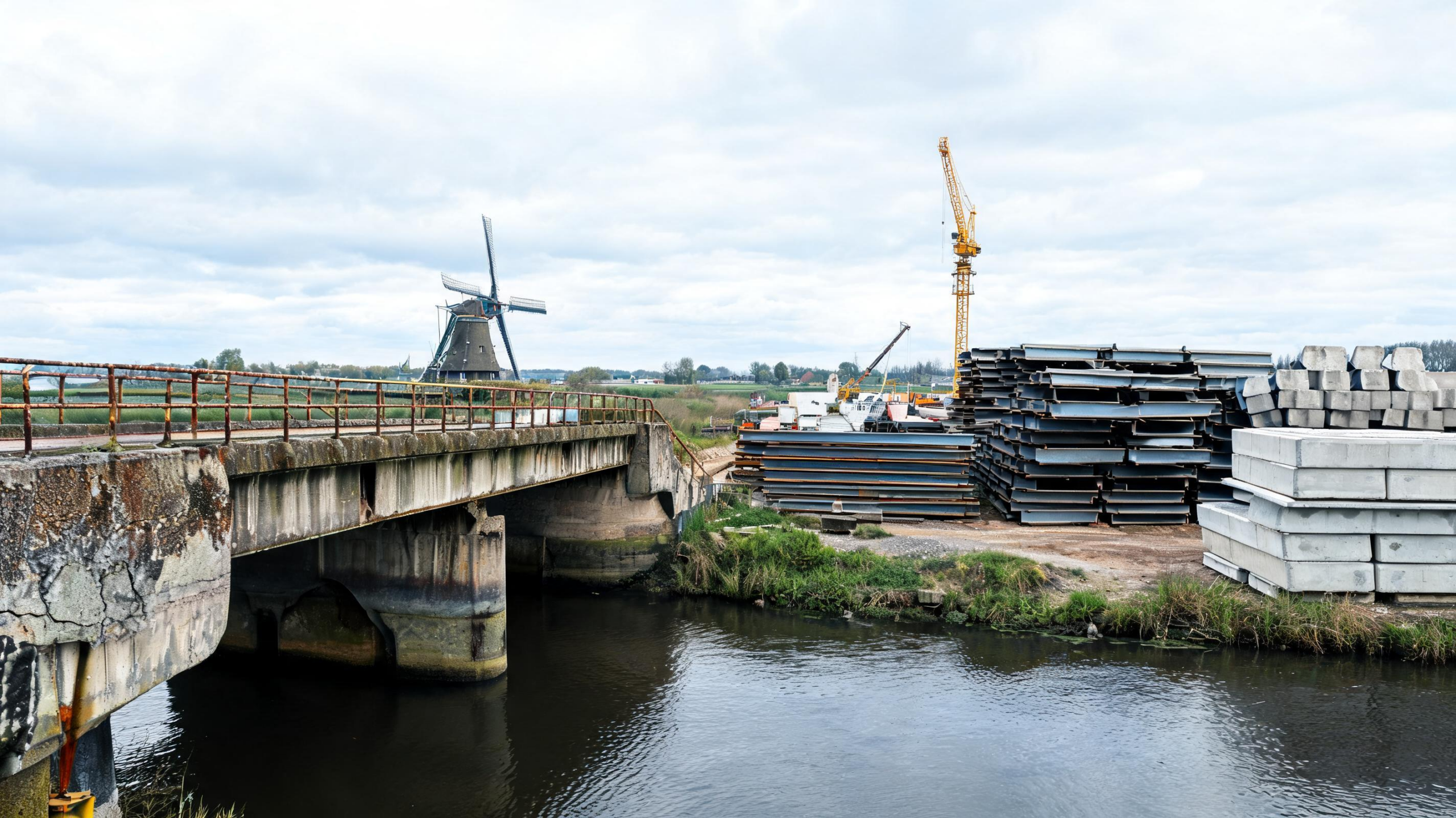
The Netherlands is sitting on an enormous, largely invisible mine. Bridges, tunnels, dikes, pipelines, wind turbine foundations, railways and sheet piles together hold millions of tonnes of steel, concrete and asphalt, and much of this infrastructure was built during the great construction wave of the 1960s and 1970s. That ageing stock is now approaching the end of its designed lifetime, forcing the country to plan a wave of replacements over the coming decades. A new study published in the Journal of Industrial Ecology by Md Faysal Tareq, Peter Berrill and Arnold Tukker of Leiden University, working with the Netherlands Organisation for Applied Scientific Research, has for the first time quantified at national scale how much raw material this replacement wave will demand and how much of it could realistically be met from the country’s own end-of-life infrastructure.
The team built a stock-based dynamic material flow analysis model, a technique that tracks how materials accumulate in use, how long they stay there, and when they flow out as waste. Historical stock development, material intensities and average lifetimes for Dutch macro infrastructure between 1950 and 2023 were drawn from the SUBLIME database, and the survival of infrastructure assets was modeled with a Weibull distribution, the statistical function most widely recommended for long-lived structures. Crucially, the researchers did not treat infrastructure as a single undifferentiated mass. They distinguished highways and railways, water works, oil and gas networks, electricity infrastructure and municipal utilities, because each category obeys its own lifespan dynamics, demand drivers and material intensities.
To capture uncertainty about the future, the team developed three scenarios running to 2070. A Reference scenario follows central projections from infrastructure asset owners and official outlooks, including Rijkswaterstaat traffic elasticity estimates, CBS population forecasts, the Dutch Delta Programme and KNMI climate scenarios. A High scenario pairs rapid energy transition and economic growth with aggressive end-of-life recovery mandates and advanced recycling infrastructure, while a Low scenario assumes weak policy support and slow technological diffusion. Demand was quantified through the stock-flow-service nexus, multiplying projected population, which may grow from about 17.9 million to between 19 and 24 million inhabitants by 2070, by per-capita infrastructure requirements and material intensities.
The headline finding is a dramatic divergence between materials. By 2070, annual demand for steel is projected to increase by 94 to 104 percent compared with 2024 levels, and concrete demand by 58 to 94 percent, while asphalt demand remains essentially flat, growing by only 1 to 2 percent. The driver of the surge is not road building but the energy transition. Offshore and onshore wind turbines, solar installations and the reshaping of oil and gas pipelines dominate future inflows, with energy infrastructure expected to account for roughly 55 to 76 percent of total steel demand and 48 to 75 percent of concrete demand by 2070. Total steel stocks are projected to roughly double from 22 million tonnes in 2000 to between 42 and 50 million tonnes, and concrete stocks to grow from 43 to between 62 and 86 million tonnes, while asphalt plateaus at about 380 to 400 million tonnes because the road network is mature and demand comes mainly from resurfacing rather than expansion.
On the supply side, the model projects a steadily growing stream of end-of-life materials. Steel outflows rise from 0.2 million tonnes per year in 2000 to 0.9 to 1.3 million tonnes per year by 2070, and concrete outflows grow from 0.5 to between 1.4 and 2.2 million tonnes per year. Applying material circularity strategies of reuse, remanufacturing, repurposing and recycling, the researchers estimate that between 0.51 and 1.1 million tonnes of steel, 0.6 and 1.75 million tonnes of concrete, and 19 and 22 million tonnes of asphalt could be recovered annually between 2024 and 2070. In theory this secondary supply could cover 74 to 86 percent of steel demand, 71 to 83 percent of concrete demand, and an extraordinary 92 to 101 percent of asphalt demand across the scenarios.
Yet the study’s most sobering message lies in the gap between theory and reality. When technological, regulatory and financial constraints are factored in, realized closed-loop circularity, meaning recovery of materials at their original functionality and value, is estimated at only around 31 to 40 percent for steel, a mere 3 to 23 percent for concrete, and 50 to 85 percent for asphalt over the projection period. Fully recovering end-of-life stocks would reduce annual virgin material demand by 16 to 49 percent between 2024 and 2070, but the Netherlands currently falls far short of that potential. The country proudly recycles over 98 percent of its construction and demolition waste, an EU-leading figure, but the authors show this is largely open-loop downcycling: crushed concrete ends up as road foundation and filler rather than returning to new structural concrete.
Concrete is the weakest link. Only about 3 percent of end-of-life concrete is genuinely recycled each year, with roughly 93 percent downcycled and 4 percent landfilled, reflecting strict quality standards, contamination problems and the lack of cost-effective technologies to recover high-value sand, coarse aggregates and cement paste. Steel faces a different bottleneck: most Dutch scrap is exported to Spain, Turkey, Finland and Germany because the country lacks domestic electric arc furnace capacity for structural steel, and its primary producer focuses on high-grade flat products requiring tightly controlled scrap. Recycled steel content in Dutch macro infrastructure manufacturing is consequently limited to 25 to 31 percent. Contamination adds another layer of difficulty, as an estimated 1 to 3 percent of Dutch steel scrap contains hexavalent chromium from legacy paints and is classified as hazardous waste, discouraging domestic processing. Regulation matters too: the NEN-EN 1090 standard, introduced in 2014, requires costly certification that older structural steel components cannot easily obtain, inadvertently restricting reuse, although the new NTA 8713 procedure of 2023 offers a path toward safe component-level reuse.
Asphalt, by contrast, is a circularity success story. The Dutch industry already produces new pavement with a 50 percent reclaimed asphalt pavement mix, and reclaimed supply closely tracks demand, allowing closed-loop recovery to meet up to 85 percent of demand under the High scenario. The main complications are logistical and chemical. Surplus reclaimed material must be stockpiled in a densely urbanized country where space is scarce, and pavements laid before the 1991 tar ban contain carcinogenic polycyclic aromatic hydrocarbons, so this contaminated granulate must be thermally cleaned at specialized facilities before its aggregates can re-enter the market.
The authors argue that the greatest leverage for improving national circularity lies in the booming energy sector, which will account for 37 to 50 percent of total steel and 23 to 40 percent of total concrete demand by 2070, meaning even modest improvements in design and recovery there yield disproportionate system-wide benefits. They call for commercializing high-grade concrete upcycling technologies, pivoting toward direct component-level reuse of structural steel, as pioneered by the national bridge parts bank, and embedding design for disassembly, modularity and digital material passports in new assets. Policy interventions such as end-of-life recovery mandates, secondary material procurement incentives and the Environmental Cost Indicator could push closed-loop circularity up to 13 to 35 percent higher than current trends. With the Netherlands committed to cutting emissions 55 percent by 2030 and achieving net zero by 2050, the study concludes that closing the infrastructure materials loop is not merely an environmental aspiration but a strategic necessity, one whose lessons apply equally to Germany, the United Kingdom and the United States as their own post-war infrastructure ages into scrap.
Subject of Research: Scenario-based dynamic material flow analysis of future material demand and circularity potential of Dutch non-building macro infrastructure stocks
Article Title: Scenario based dynamic material flow analysis of Dutch macro infrastructure stocks: assessing future material demand and circularity potentials
Article References: Tareq, M. F., Berrill, P., & Tukker, A. (2026). Scenario based dynamic material flow analysis of Dutch macro infrastructure stocks: assessing future material demand and circularity potentials. Journal of Industrial Ecology. https://doi.org/10.1007/s44498-026-00176-z
Image Credits: AI Generated
DOI: 10.1007/s44498-026-00176-z
Keywords: dynamic material flow analysis, macro infrastructure, circular economy, steel recycling, concrete downcycling, asphalt pavement, secondary raw materials, closed-loop circularity, Netherlands, end-of-life recovery, net-zero 2050, energy infrastructure
Cite Scienmag News
Sloane Callahan. (September 10, 2026). Netherlands Faces Surge in Steel and Concrete Demand as Ageing Infrastructure Reaches End of Life. Scienmag. https://scienmag.com/netherlands-faces-surge-in-steel-and-concrete-demand-as-ageing-infrastructure-reaches-end-of-life/
Sloane Callahan. "Netherlands Faces Surge in Steel and Concrete Demand as Ageing Infrastructure Reaches End of Life." Scienmag, 10 September 2026, https://scienmag.com/netherlands-faces-surge-in-steel-and-concrete-demand-as-ageing-infrastructure-reaches-end-of-life/. Accessed 4 October 2026.
Sloane Callahan. "Netherlands Faces Surge in Steel and Concrete Demand as Ageing Infrastructure Reaches End of Life." Scienmag. September 10, 2026. https://scienmag.com/netherlands-faces-surge-in-steel-and-concrete-demand-as-ageing-infrastructure-reaches-end-of-life/


