


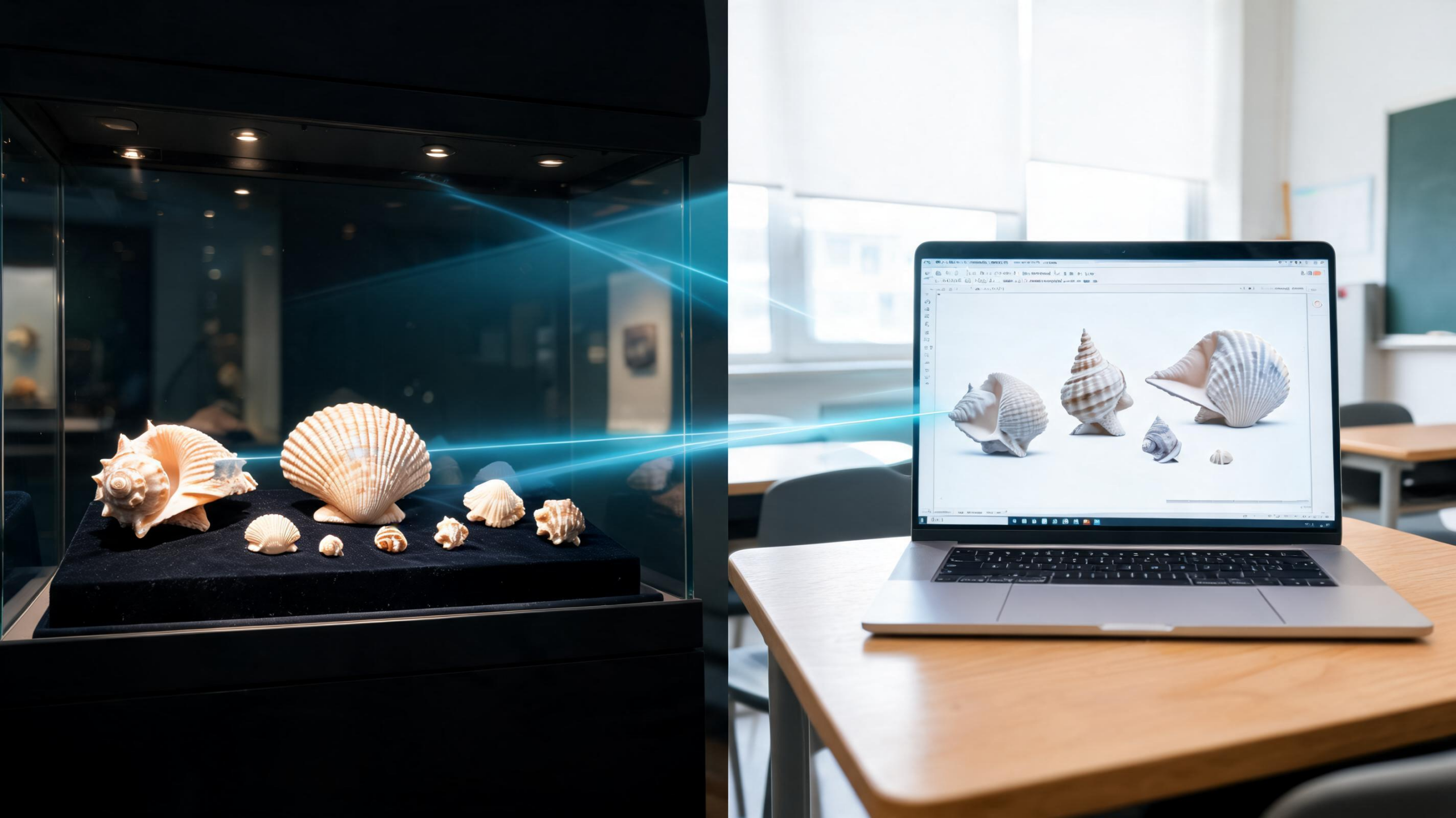
In a modest laboratory at the National University of La Plata in Argentina, rows of glass jars and paper-thin labels hold far more than the empty shells of snails and clams. They hold a new blueprint for how biodiversity might be taught. A research team led by Heliana Custodio and Gustavo Darrigran has spent years reorganising, cataloguing and digitising a university Malacological Collection, and their findings, published in Discover Ecology, suggest that physical and virtual biological collections could become among the most powerful and underused tools in environmental education. At a time when biodiversity loss is destabilising the ecosystems that underpin economies worldwide, the study makes the case that a shelf of shells, and their digital twins, may be exactly what classrooms need.
The premise rests on a simple pedagogical insight, famously captured by the Senegalese forester Baba Dioum in 1968: we will only conserve what we love, love what we understand, and understand what we are taught. Biological collections make that understanding tangible. Each specimen lot preserves multidimensional information, spanning historical, geographical, morphological and ecological dimensions, that abstract textbook diagrams simply cannot convey. When students handle a bivalve and trace the articulation of its valves, or spiral a gastropod shell in their fingers while considering its mode of life, they are engaging with empirical evidence, scientific methodology and the documentation practices of real research, all at once.
Yet the La Plata team is careful to stress that collections do not teach by themselves. Their educational value depends entirely on the intentional work of teachers who design activities around the specimens. That design principle is visible throughout the collection’s architecture. The researchers organised 254 specimens into five molluscan classes and assigned each lot to one of three purposes: teaching, marked DOC; outreach, marked EXT; and repository, marked REP, a reserve of replacement material for items damaged by handling. Colour-coded labels and a lot-naming system combining the first letters of the phylum and class allow staff and students to navigate the collection quickly, a practical but consequential detail for anyone who has watched a class of undergraduates wait while an instructor searches for the right jar.
The curation itself followed rigorous standards. Specimens were obtained during field surveys by the research group, mostly empty shells collected after natural death, using a minimal-impact sampling approach. Preservation relies on two methods: dry storage in jars and bags, and wet preservation in 70 percent ethanol. Taxonomic identifications were verified and updated against authoritative databases such as the Catalogue of Life and MolluscaBase, and the collection’s records were migrated into a spreadsheet structured according to the Darwin Core standard, the international data framework used by natural history collections worldwide. A data-entry protocol now governs how every field is completed, ensuring that information remains consistent as the collection grows.
The most eye-catching innovation, however, is what happened next: digitisation. Working with the Functional Digitisation Unit of the Museo de La Plata, the team generated three-dimensional models of specimens using two very different technologies. The first is deliberately low-tech in spirit. Using Polycam, a free smartphone application that builds 3D models through photogrammetry, the researchers created interactive models of two invasive bivalves, the golden mussel Limnoperna fortunei and the Asian clam Corbicula fluminea. The choice of a free mobile tool was intentional, so that any teacher with a phone or tablet could replicate the workflow and bring the same resources to their own students without institutional funding or specialised equipment.
The second technology operates at the other end of the precision spectrum. An Artec Micro II scanner, offering a resolution of five microns within a maximum scanning volume of 20 by 20 by 15 centimetres, was used to digitise seven non-native mollusc species. The result is the first three-dimensional Virtual Malacological Collection of invasive molluscs in Argentina, hosted online and freely explorable. In the rendered models, viewers can rotate a veined rapa whelk, Rapana venosa, and click on numbered points to see the anatomical names of individual shell parts, an experience that merges taxonomic instruction with the tactile exploration normally reserved for people standing in front of a museum drawer.
The virtual collection is already reshaping teacher training. In the Invertebrate Biology course at La Plata’s Faculty of Humanities and Education Sciences, students who are themselves future teachers are asked to design lesson plans about invasive mollusc species using the virtual collection as the central resource. The assignment is deliberately open-ended, and the results have ranged from illustrated fact sheets with QR codes linking to the 3D models, to guided discussion questions built on scientific articles and newspaper reports, to a Kahoot! quiz and a full board game. Classroom observations suggest that manipulating digital specimens without physical constraints helps students connect theoretical knowledge with socioscientific issues such as biological invasion, a problem the team notes is among the most pressing global threats to native species and ecosystem function.
The physical collection, meanwhile, travels beyond the university. Through a university outreach project, native marine molluscs from the Buenos Aires coast, including species such as the ribbed mussel Aulacomya atra, the blue mussel Mytilus edulis and the violet clam Eucallista purpurata, form the basis of workshops delivered in secondary schools and teacher training institutes across the province. Students work with dichotomous keys and malacological fact sheets accessed through QR codes, comparing shell articulation, umbo position and coiling patterns to infer how each animal fed and where it lived. Workshops close with debates on conservation strategies and the ethical responsibilities of citizens. At public fairs, visitors encounter a black ‘mystery box’ containing the same specimens; selecting one triggers questions about identification, habitat and human uses. The team reports that the activity routinely corrects misconceptions, for example the spherical, transparent egg capsules of Pachycymbiola brasiliana, which beachgoers frequently mistake for turtle eggs.
The researchers argue that these experiences address a documented gap. Earlier surveys cited in the study found that between 71 and 81 percent of students in Argentine teacher training programmes valued biological collections as educational resources, yet most did not know how to construct or use them, and between 33 and 38 percent reported being unable to use them in secondary schools for lack of material. Strikingly, between 69 and 81 percent of trainee teachers were unfamiliar with virtual collections, while 81 percent said they would use them if they could. Collections remain underutilised in classrooms, the authors note, because of structural limits such as scarce materials, restricted institutional access and insufficient teacher training, problems that digitisation can materially ease by removing temporal and spatial barriers to access.
The La Plata team’s conclusions are measured but forward-looking. A catalogued, organised and regularly updated physical and virtual collection streamlines the selection of teaching materials, reduces the wear and deterioration that handling inflicts on specimens, and gives teachers and students ready access to resources they could never build alone. But access alone, they caution, guarantees nothing; the pedagogical payoff depends on teachers who know these resources exist and plan deliberately around them. If the model spreads, the humble mollusc, ancient, abundant and endlessly varied, could become an unlikely ambassador for biodiversity literacy, its shells preserved in ethanol and resin, and now in pixel-perfect three dimensions, teaching a generation of students why the living world is worth understanding, and worth keeping.
The choice of molluscs as the foundation for this collection was no accident. Mollusca is one of the largest phyla in the animal kingdom, and its shells are durable, visually striking and easy to handle, making them unusually well suited to classroom work. The researchers also point to the phylum’s deep entanglement with human society, from food and ornament to economic and cultural uses, which gives teachers multiple entry points for connecting biology to students’ everyday experience.
The project sits within a broader institutional effort by the Biodiversity Education Study Group, known as GEEBio, whose Invertebrate Biology Collection Group has taken on the long-term administration of the collection. This matters because sustaining a teaching collection is not a one-off project but an ongoing commitment to curation, reconditioning and documentation, work that often goes unrecognised in academic settings.
The study also situates biological collections within ex situ conservation strategies, alongside seed banks and arboretums, framing them as primary repositories of biodiversity knowledge rather than mere teaching props. From this perspective, a well-maintained collection serves research, conservation management and public engagement simultaneously, with exhibitions and outreach activities fostering the public participation that conservation ultimately depends upon.
For teachers wondering how to begin, the researchers draw on prior work identifying three practical pathways: searching data portals to build customised lessons, collaborating with researchers to develop or adopt an existing resource such as the virtual collection, and contributing to citizen-science portals that expand collections with new data. Each route lowers the barrier that unfamiliarity has created.
Adopting standards like Darwin Core also connects a modest university collection to a global infrastructure of natural history data, meaning that local specimens can eventually inform research on species distributions, climate change and biological invasions far beyond Argentina. The open access publication of the study itself reflects this ethos of widening participation, allowing educators anywhere to examine the methods and adapt the model to their own institutional collections and regional fauna.
Subject of Research: Use of physical and virtual malacological collections as interactive educational resources for biodiversity learning
Article Title: Malacological collections as educational resources for interactive visual learning and biodiversity exploration
Article References: Custodio, H., Motta, J., Amoia, A., Arregui Longui, M., Vilches, A., & Darrigran, G. (2026). Malacological collections as educational resources for interactive visual learning and biodiversity exploration. Discover Ecology, 2(1), Article 19. https://doi.org/10.1007/s44396-026-00037-w
Image Credits: AI Generated
DOI: 10.1007/s44396-026-00037-w
Keywords: malacology, biological collections, biodiversity education, 3D digitisation, virtual collection, invasive species, environmental education, teacher training, Darwin Core, photogrammetry, science outreach, molluscs
Cite Scienmag News
Margaret Porter. (September 10, 2026). Shells Reimagined: How 3D Scanning Is Turning Museum Molluscs Into Classrooms. Scienmag. https://scienmag.com/shells-reimagined-how-3d-scanning-is-turning-museum-molluscs-into-classrooms/
Margaret Porter. "Shells Reimagined: How 3D Scanning Is Turning Museum Molluscs Into Classrooms." Scienmag, 10 September 2026, https://scienmag.com/shells-reimagined-how-3d-scanning-is-turning-museum-molluscs-into-classrooms/. Accessed 4 October 2026.
Margaret Porter. "Shells Reimagined: How 3D Scanning Is Turning Museum Molluscs Into Classrooms." Scienmag. September 10, 2026. https://scienmag.com/shells-reimagined-how-3d-scanning-is-turning-museum-molluscs-into-classrooms/


