


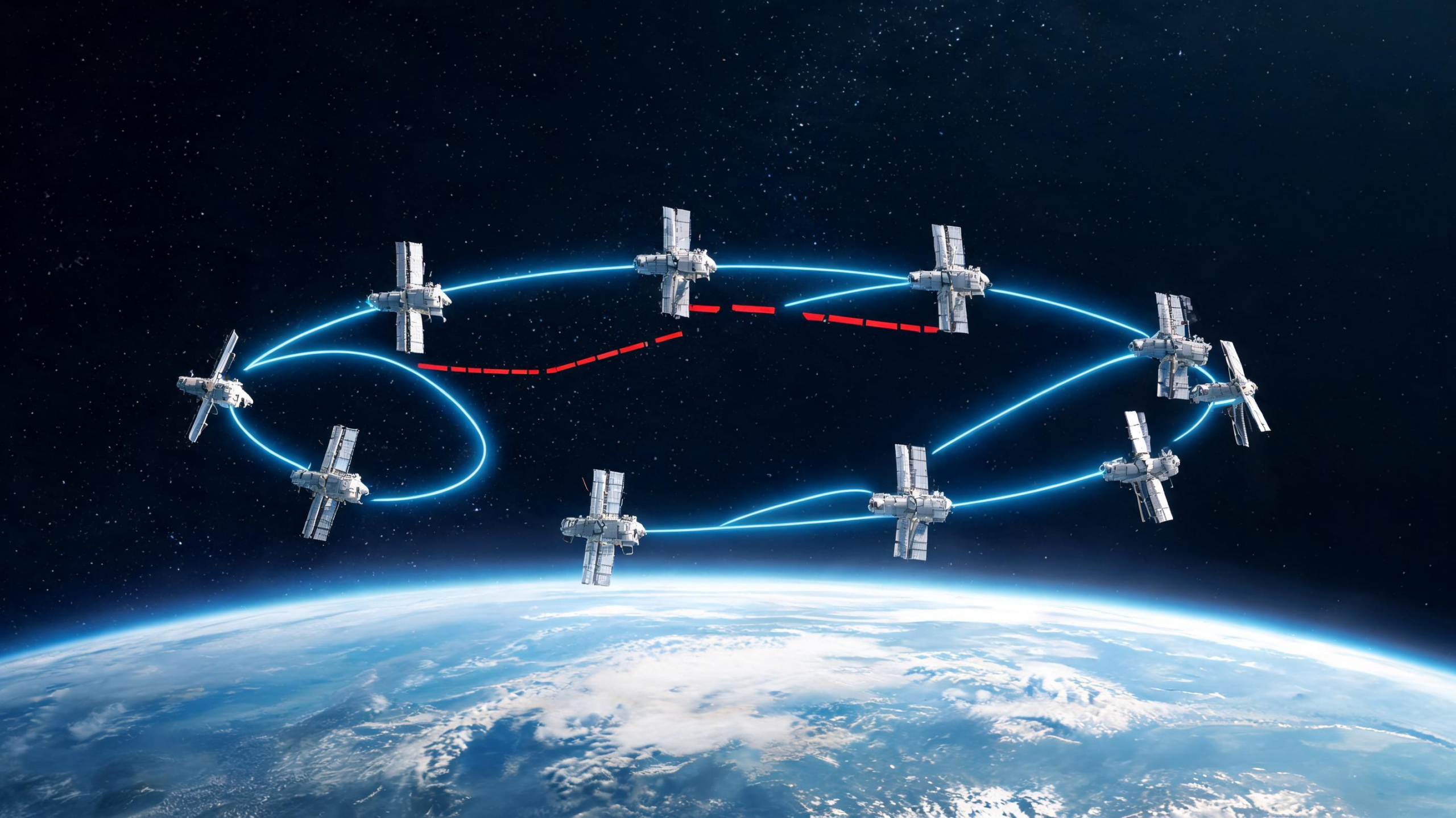
When thousands of satellites circle the Earth in low orbit, forming a planet-spanning web of laser and radio links, the network they create is unlike anything in terrestrial communications. It never sits still. Every satellite sweeps along its orbital path at roughly seven kilometers per second, ground stations rise and fall over the horizon, and the inter-satellite links that stitch the constellation together can flicker or fail without warning. A new study published in the International Journal of Aeronautical and Space Sciences tackles this instability head-on, proposing a hybrid routing architecture called BlockFLEX that promises to keep mega-constellation networks efficient, resilient and scalable even when a substantial fraction of their links go dark.
The research team, led by Xiangtong Wang and Wei Li of Sichuan University together with colleagues from the China Academy of Space Technology and other institutions, focuses on the two dynamics that most severely degrade routing in operational low-Earth-orbit systems. The first is the persistent churn of the satellite-ground topology: as spacecraft orbit and rotate with the planet, the map of who can talk to whom is rewritten continuously. The second is the intermittent failure of inter-satellite links, the point-to-point connections that carry traffic between neighboring satellites. Each of these effects is troublesome on its own; together, the authors argue, they simultaneously flood the network’s control plane with global update traffic and carve the connectivity graph into sparse, fragmented islands, degrading both the speed of route computation and the network’s ability to survive faults.
Conventional routing protocols were simply not built for this environment. Interior gateway protocols such as OSPF assume a relatively stable topology and rely on network-wide flooding of link-state updates whenever anything changes. In a mega-constellation, where link failures may occur somewhere in the network almost constantly, that flooding translates into an enormous and perpetual control overhead, consuming the very satellite bandwidth and processing capacity needed for user traffic. Geographic routing approaches, which forward packets based on physical position, avoid some of this overhead but can struggle with the polar regions, seam discontinuities and the sparse connectivity left behind by link failures. The BlockFLEX design borrows strategically from both traditions while insulating them from the worst of the churn.
The core idea is a robust virtual overlay built from anonymous blocks. Instead of treating every satellite as an individually addressable, constantly moving node, BlockFLEX groups satellites into clusters whose membership changes are hidden behind a stable abstraction. To the routing layer above, each block behaves as a coherent unit, masking the underlying motion of individual spacecraft and the comings and goings of their links. This is the same general principle that has long been used in mobile ad hoc networks, where clustering reduces the frequency with which routes must be recomputed, but the authors refine it for the specific geometry and failure patterns of LEO constellations, ensuring that the overlay remains stable even as its members change.
On top of this overlay, BlockFLEX deploys a two-tier hybrid routing strategy that splits responsibilities by scale. Between blocks, the architecture relies on convergence-free geographic forwarding: packets are passed from block to block based on spatial position, a method that requires no global route computation and therefore never stalls waiting for routing tables to converge after a change. Within each block, by contrast, a conventional convergence-isolated routing protocol manages fine-grained delivery. Because each block contains only a small fraction of the constellation’s satellites, the control traffic needed to maintain routes inside it stays confined to that block, localizing the propagation of updates and preventing a single link failure from triggering a constellation-wide signaling storm.
This division of labor is where the architecture derives most of its resilience. When an inter-satellite link fails, the blast radius of the disruption is contained. Packets in transit between blocks are rerouted by the geographic layer without any protocol negotiation, while the affected block recomputes its internal paths quietly and locally. The authors also incorporate complementary mechanisms aimed at scalability and efficiency, ensuring that the approach continues to perform as constellations grow from hundreds toward many thousands of satellites. The design draws on established tools such as graph partitioning for block construction and satellite positioning knowledge, including GPS-based ephemeris data, to keep the geographic layer accurate as orbits evolve.
The evaluation is notable for being grounded in models of currently operational LEO mega-constellations rather than purely synthetic topologies, and the team has released its source code and data publicly on GitHub to allow independent reproduction. In stress tests that randomly disabled up to thirty percent of all inter-satellite links, a failure rate far beyond what most operational scenarios would expect, BlockFLEX substantially outperformed state-of-the-art routing schemes in both resilience and efficiency. In practical terms, that means a higher fraction of packets still reach their destinations when links fail, and the network spends far less of its capacity on control-plane bookkeeping instead of user traffic.
The stakes of this engineering problem are rising quickly. Starlink already operates thousands of satellites with laser inter-satellite links, OneWeb and Amazon’s Kuiper are deploying their own fleets, and Chinese constellations such as Guowang and Qianfan are moving toward large-scale service. These systems aim to deliver broadband to aircraft, ships, rural communities and military users, and their commercial viability depends on squeezing maximum throughput out of expensive orbital infrastructure. Researchers have previously shown that adversarial or accidental failures can degrade LEO network performance dramatically, and studies of attack surfaces such as ICARUS have highlighted how exposed these networks can be. A routing layer that degrades gracefully under heavy link loss is therefore not merely an academic nicety but a competitive necessity.
BlockFLEX also fits into a broader architectural conversation about how the space network of the future should be organized. Some proposals advocate software-defined satellite networking, in which a centralized controller computes all routes; others favor entirely distributed or purely geographic schemes; standards bodies have begun formalizing routing architectures for satellite networks in documents such as recent RFCs on satellite routing. The hybrid, hierarchical philosophy behind BlockFLEX suggests a middle path: keep the global layer dumb and stable, and push the dynamic, failure-sensitive work to small, self-contained neighborhoods where it can be handled quickly and cheaply. That philosophy echoes design lessons from the terrestrial Internet itself, where hierarchy and locality have historically been the keys to scaling.
Open questions remain. The anonymous block abstraction must be maintained somehow, and the cost of regrouping satellites as orbits evolve, particularly across the constellation’s seams and polar regions, will matter at full scale. Interoperability with existing ground segment operations and with the proprietary scheduling algorithms used by commercial operators is another practical hurdle. Nonetheless, the demonstration that a hybrid block-based design can withstand the loss of nearly a third of its inter-satellite links while outperforming existing schemes marks a meaningful step toward routing infrastructure that is genuinely worthy of the mega-constellation era. As humanity wires the sky, the networks that survive will be the ones designed, like BlockFLEX, to expect failure as the norm rather than the exception.
Beyond the headline results, the study sits within a well-established lineage of research on grouping nodes in highly dynamic networks. Clustering was first explored in the late 1990s for reconfigurable wireless and mobile ad hoc networks, where grouping mobile nodes reduced how often routes needed repair. Applying that principle to orbiting spacecraft is attractive because the predictable geometry of satellite orbits makes membership changes computable in advance, unlike the random motion of terrestrial mobile devices.
The geographic forwarding tier likewise draws on decades of prior work. Early proposals for LEO constellations, including datagram routing algorithms from the INFOCOM literature of 2000 and geographic packet routing demonstrated in experimental satellite systems, showed that physical position is a remarkably stable routing signal in orbit, since satellite motion is deterministic and ephemeris data can be predicted far into the future. BlockFLEX inherits this determinism: the coarse decision about which block should receive a packet next can be made from positional knowledge alone, requiring no signaling exchange across a shaken topology.
Another contextual thread is the failure profile of the links themselves. Inter-satellite links in current constellations rely on free-space optical terminals with narrow beams, which must continuously acquire, track and point at one another as relative geometry changes. Acquisition and pointing errors, thermal effects and blockage all contribute to intermittent outages, making a thirty percent random-failure stress test a plausible extreme rather than pure fiction. The authors’ decision to evaluate on models of operational constellations, alongside publicly released code, positions the work for scrutiny as deployment scales and real-world link telemetry accumulates.
Subject of Research: Efficient and resilient routing for low-Earth-orbit mega-constellation satellite networks
Article Title: Towards an Efficient, Resilient and Scalable Routing for Mega-Constellation Networks
Article References: Wang, X., Li, W., Yang, M., Han, S., Jiang, M., & Wang, Y. (2026). Towards an Efficient, Resilient and Scalable Routing for Mega-Constellation Networks. International Journal of Aeronautical and Space Sciences. https://doi.org/10.1007/s42405-026-01289-2
Image Credits: AI Generated
DOI: 10.1007/s42405-026-01289-2
Keywords: mega-constellation networks, LEO satellites, inter-satellite link failures, hybrid routing, routing resilience, virtual overlay, geographic forwarding, network scalability, BlockFLEX, satellite communication, control-plane overhead, Sichuan University
Cite Scienmag News
Grant Pearson. (September 10, 2026). New Routing Architecture Keeps Mega Satellite Networks Running Through Link Failures. Scienmag. https://scienmag.com/new-routing-architecture-keeps-mega-satellite-networks-running-through-link-failures/
Grant Pearson. "New Routing Architecture Keeps Mega Satellite Networks Running Through Link Failures." Scienmag, 10 September 2026, https://scienmag.com/new-routing-architecture-keeps-mega-satellite-networks-running-through-link-failures/. Accessed 4 October 2026.
Grant Pearson. "New Routing Architecture Keeps Mega Satellite Networks Running Through Link Failures." Scienmag. September 10, 2026. https://scienmag.com/new-routing-architecture-keeps-mega-satellite-networks-running-through-link-failures/


