


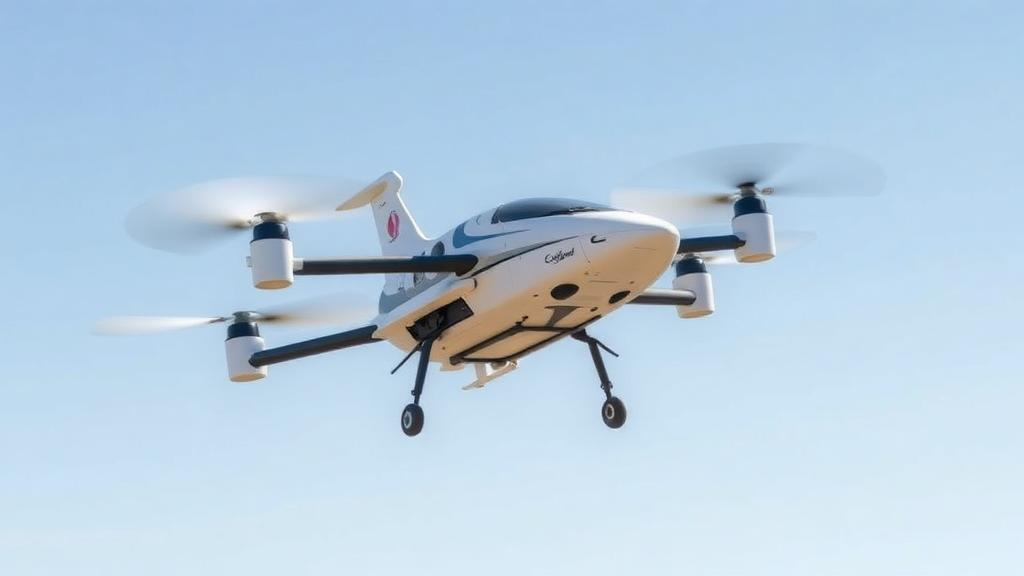
Tilt-rotor aircraft occupy a unique and demanding corner of aviation. By rotating their engine nacelles from a vertical position for takeoff and landing to a horizontal orientation for forward flight, they combine the vertical agility of a helicopter with the speed and range of a fixed-wing airplane. That versatility makes them attractive for military transport, search-and-rescue missions, and the rapidly growing field of advanced air mobility, where electric and hybrid aircraft promise to shuttle passengers between cities without runways. But the very design that gives tilt-rotors their flexibility also imposes a punishing aerodynamic compromise, one that a team of researchers in Beijing believes can be substantially eased by letting the blades themselves change shape in flight.
The core of the problem lies in the fact that a rotor propeller must operate in two radically different flow environments. In hover, the blades sweep through relatively still air, and their efficiency depends heavily on how the blade angle, or twist, is distributed along the span. In high-speed cruise, the advancing blade tips encounter fast axial flow, and the optimal twist distribution shifts dramatically. A conventional blade with a fixed twist, optimized for one regime, is inevitably a compromise in the other. Decades of rotorcraft theory, from classical blade element momentum analysis to modern computational fluid dynamics, have shown that no single fixed-twist geometry can deliver peak performance in both hovering and cruising simultaneously. The result is wasted energy, reduced payload, and shortened range.
Researchers led by Wenhui Yan and Qing Chen at the North China University of Technology, together with colleagues Kun Zhang, Xiao Tian, Zhenjun Zhao and Zonghan Yu, set out to quantify just how much performance is recoverable if the twist constraint is lifted. In a study published in the International Journal of Aeronautical and Space Sciences, they designed a high-performance rotor propeller whose blades can actively adjust their torsion angles through a dedicated actuation mechanism, then used validated computational fluid dynamics simulations to predict how the variable-twist design would behave across flight regimes. Their central finding is striking: by re-twisting the blades for hover, the average hovering efficiency rose from 68.05 percent to 73.22 percent, while cruise efficiency was preserved above 83 percent.
Those percentages may sound incremental, but in rotorcraft aerodynamics a five-percentage-point gain in hover efficiency is significant. Hover is the most energetically expensive flight condition for any vertical takeoff aircraft, because all of the lift must be generated by pushing air downward with no wing to share the load. Every point of propulsive efficiency recovered in hover translates directly into either a lighter battery or fuel load, a heavier payload, or more time on station. For urban air taxis that spend a large fraction of each mission climbing, descending, and hovering, the cumulative effect of such an improvement could reshape vehicle sizing and economics.
The methodology behind the result is as instructive as the headline numbers. Before running any performance predictions, the team validated their computational fluid dynamics setup and conducted grid-independence studies, a standard but essential step that ensures the simulated flow field does not change appreciably as the computational mesh is refined. Only after confirming that the numerical framework was trustworthy did they perform flow field simulations and aerodynamic performance predictions for the rotor propeller in its various twist configurations. This careful validation matters because rotor flows are notoriously difficult to simulate: they involve strong tip vortices, blade-vortex interactions, and in tilt-rotor applications, complex interference between the rotor wake and the wing or fuselage.
The aerodynamic design principles underpinning the work draw on a long lineage of propeller theory. Optimal propeller design, formalized in classical work such as Adkins and Liebeck’s formulation of optimum propellers, prescribes a specific distribution of blade pitch and chord along the radius for a given operating condition. The twist distribution is particularly sensitive to the inflow ratio, the ratio of axial to rotational velocity at each blade section. In hover, the inflow is dominated by the induced velocity of the rotor’s own downwash; in cruise, the forward speed dominates. Because these two inflow conditions demand different twist laws, a blade that can morph between them effectively carries two optimized designs in one structure, switching profiles as the mission demands.
The actuation mechanism that makes this possible is the engineering heart of the study. The authors describe a torsion actuation system that modifies the blade torsion angles of the propeller between flight modes. While the published abstract does not detail the internal mechanics, the broader field offers context: recent research has explored both active approaches, using servomechanisms or embedded actuators to deform blades on command, and passive approaches, in which composite blades exploit bend-twist coupling to deform aerodynamically under load. A 2024 study in Aerospace Science and Technology, for example, designed composite adaptive propeller blades with passive bend-twist deformation to handle periodic load variations, while other groups have harnessed structural instability for deployable blades and drawn on origami-inspired structures for morphing propeller systems. The Beijing team’s active torsion regulation sits within this growing family of morphing-rotor concepts.
What distinguishes the new study is its explicit demonstration that the hover gain does not come at the expense of cruise. A morphing design is only worthwhile if it preserves the performance of the baseline configuration in its strong regime while improving the weak one. By maintaining cruise efficiency above 83 percent, the variable-torsion propeller shows that the actuation concept can be integrated without degrading the high-speed characteristics that make tilt-rotors valuable in the first place. The authors frame this as a path toward significant improvements in payload capacity and multimodal aerodynamic efficiency, the twin metrics that determine whether a tilt-rotor design is commercially and operationally viable.
The implications extend beyond large military tilt-rotors. The same physics governs the prop-rotors of electric vertical takeoff and landing aircraft, the multicopter drones that dominate the consumer and logistics markets, and even ducted propellers and wind turbines, where twist distribution is equally central to performance. Related research highlighted by the journal spans ducted propeller hover optimization, stacked rotor configurations, and rotor-wing aerodynamic interaction studies, all grappling with aspects of the same efficiency challenge. If variable-torsion actuation can be made lightweight, reliable, and affordable at small scale, drone manufacturers could see meaningful endurance gains, since hover and low-speed flight dominate most commercial drone missions. At larger scale, the technology aligns with the certification ambitions of the emerging advanced air mobility industry, where every percentage point of efficiency affects range, noise, and operating cost.
Significant engineering hurdles remain before morphing blades leave the simulation and test bench for certified aircraft. Actuation hardware must survive the centrifugal loads of a spinning rotor, which at full scale can impose thousands of g on blade components, and it must do so with minimal weight and power penalty. Fatigue life, fail-safe behavior, and the certification pathway for a primary aerodynamic surface that changes shape in flight are all open questions. The study’s simulations, however rigorously validated, will need to be confirmed in wind tunnel and flight tests. Still, the work offers a clear and quantified answer to a question that has long hovered over tilt-rotor design: how much performance is locked away in the fixed-twist compromise? According to the numbers from the North China University of Technology team, at least five percentage points of hover efficiency, delivered without sacrificing the cruise performance that high-speed flight requires. As the aviation industry races toward a future of runway-independent flight, blades that twist on demand may prove to be one of the more elegant keys to unlocking it.
Subject of Research: Aerodynamic performance of variable-torsion rotor propellers for tilt-rotor aircraft
Article Title: Analyzing the Aerodynamic Performance of Variable Torsion Rotor Propellers
Article References: Yan, W., Chen, Q., Zhang, K., Tian, X., Zhao, Z., & Yu, Z. (2026). Analyzing the Aerodynamic Performance of Variable Torsion Rotor Propellers. International Journal of Aeronautical and Space Sciences. https://doi.org/10.1007/s42405-026-01235-2
Image Credits: AI Generated
DOI: 10.1007/s42405-026-01235-2
Keywords: tilt-rotor aircraft, rotor propeller, variable twist, aerodynamic efficiency, computational fluid dynamics, hovering efficiency, cruise efficiency, morphing blades, blade torsion actuation, advanced air mobility, rotorcraft, propeller design
Cite Scienmag News
Audrey Campbell. (October 4, 2026). Twisting Blades Could Give Tilt-Rotors a Hovering Efficiency Boost. Scienmag. https://scienmag.com/twisting-blades-could-give-tilt-rotors-a-hovering-efficiency-boost/
Audrey Campbell. "Twisting Blades Could Give Tilt-Rotors a Hovering Efficiency Boost." Scienmag, 4 October 2026, https://scienmag.com/twisting-blades-could-give-tilt-rotors-a-hovering-efficiency-boost/. Accessed 4 October 2026.
Audrey Campbell. "Twisting Blades Could Give Tilt-Rotors a Hovering Efficiency Boost." Scienmag. October 4, 2026. https://scienmag.com/twisting-blades-could-give-tilt-rotors-a-hovering-efficiency-boost/


