


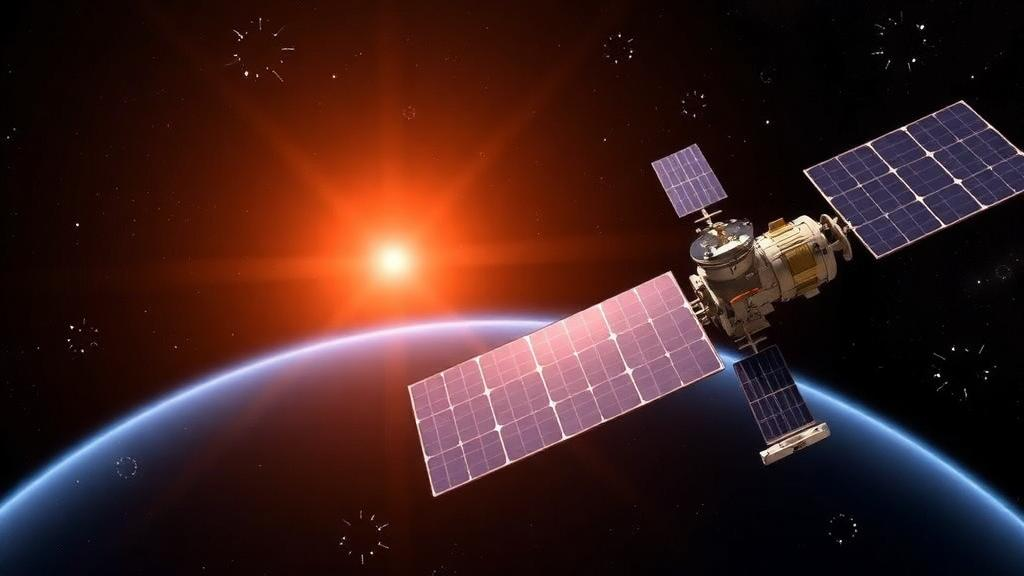
A quiet revolution may be brewing in the way spacecraft harvest their power. A review led by researchers at the University of Surrey and published in the journal Acta Astronautica argues that modern silicon solar cells, the same technology that dominates rooftop panels and utility-scale solar farms on Earth, could cut the cost of powering satellites by as much as 90 per cent when measured on beginning-of-life performance. The finding challenges nearly five decades of orthodoxy in the space industry, which abandoned silicon in the late 1970s in favour of more exotic compound semiconductors. Beyond the dramatic cost savings, the switch could also halve the mass of the solar arrays a spacecraft needs to carry, freeing precious kilograms for additional fuel, larger scientific instruments or simply a smaller and cheaper launch vehicle. At a time when the number of objects launched into orbit each year has exploded from around 120 in 2010 to more than 2,800 in 2024, the economics of spacecraft power have never mattered more.
The history here is one of technological succession. Silicon was the industry-standard solar cell material for spacecraft from 1958, when the earliest photovoltaic-powered satellites began operating, until 1977. In that year, gallium arsenide cells displaced it, offering better conversion efficiency and superior resistance to the radiation environment of space. The technology then evolved further into triple-junction cells built from gallium, indium and germanium, layered semiconductor structures that capture different portions of the solar spectrum in stacked absorbers. Those triple-junction devices have been the standard ever since, powering everything from communications constellations to deep-space probes. Their efficiency is genuinely impressive, but their price reflects the small, specialised, hand-finished production lines on which they are made, a manufacturing model fundamentally at odds with the scale the modern space economy now demands.
The cost gap documented by the Surrey team is stark. Triple-junction space cells cost between $250 and $450 per watt, whereas silicon cells cost tens of cents per watt. As of November 2025, the three main silicon designs used across the terrestrial photovoltaic industry, namely PERC, TOPCon and heterojunction architectures, averaged $0.275, $0.285 and $0.39 per watt respectively. The raw materials tell a similar story: silicon itself costs a few dollars per kilogram, while gallium and germanium, the critical elements in space-grade compound cells, cost thousands of dollars per kilogram. In other words, the price differential is not merely a matter of incremental manufacturing improvements but of an entire industrial ecosystem, one that produces silicon cells by the billions of watts every year in highly automated gigafactories.
Efficiency, of course, has been the traditional argument for the expensive option, and here the picture is more nuanced than the industry’s decades-old assumptions might suggest. Today, silicon heterostructure cells hold a record efficiency of 27.8 per cent, while perovskite/silicon tandem cells, which add a second light-absorbing layer on top of the silicon wafer, hold a record of 34.85 per cent. Those figures sit comfortably within the range that has historically justified spaceflight qualification. To make the comparison tangible for real missions, the Surrey researchers modelled two concrete formats: one face of a 3U CubeSat, a satellite roughly the size of a large loaf of bread, and a Micro Sat built by Surrey Satellite Technology Limited, which co-funds the lead author’s doctoral research and supplied the spacecraft data used in the study. When the space-qualified glass that protects the cells was included in the calculation, the saving was as large as 85 to 90 per cent.
Perhaps the most striking insight from the review concerns where the remaining money actually goes. Coverglass, not the cell itself, dominates the cost of a silicon array. Tommy Richards, lead author and postgraduate researcher at the University of Surrey’s Advanced Technology Institute, explained that the interesting finding was not simply that silicon is cheaper, but where the residual cost sits: once silicon cells are placed behind space-qualified glass, the glass is what the customer is paying for. He argued that this changes what engineers should be working on, noting that if the cell itself can be made tougher against radiation, thinner glass or substrates can be used, cutting cost and weight simultaneously. In his framing, the problem shifts from a materials contest into an engineering challenge that the community already knows how to attack, a reframing with significant implications for how research funding and design effort should be directed.
On the crucial metric of power per unit mass, silicon delivers a genuine performance leap. In the review, silicon heterojunction cells delivered roughly twice the specific power of the triple-junction option, at around 920 to 1,000 watts per kilogram against 455 to 505 watts per kilogram. In practical terms, a mission could carry half the solar cell mass for the same power output, a benefit that cascades through the entire spacecraft design, from the deployable array mechanisms to the attitude control budget. Silicon does produce less power for a given area, with the review putting the reduction at around 28 per cent at the start of a mission compared with triple-junction devices. But when the researchers scaled the silicon panels to match triple-junction output, and even included the cost of the extra panel structure required, silicon remained several times cheaper on beginning-of-life performance, suggesting that the area penalty is easily absorbed by the cost advantage.
Honesty about the technology’s weaknesses is what gives the review its credibility. Silicon is not the winner on every measure. For a given coverglass thickness, silicon is around 2.6 times less resistant to radiation than triple-junction cells, and triple-junction devices are also expected to retain more of their performance after five years in orbit. This end-of-life gap highlights the central technical challenge: improving the radiation resistance of silicon devices so that their beginning-of-life advantage survives the harsh environment of space. The review also identifies ultraviolet light as the least understood risk for bare devices. Modern silicon architectures degrade under ultraviolet exposure, and heterojunction cells, the best performers on efficiency, degrade more than PERC cells. Almost all testing conducted so far has used UVA, the lower-energy ultraviolet that reaches the Earth’s surface, rather than the more energetic vacuum ultraviolet found in space, leaving a significant gap in the qualification data.
The scale of future demand is what makes the argument urgent rather than merely academic. An average satellite needs close to a kilowatt of electrical power, and the constellation boom has multiplied that demand many times over. More ambitiously, proposed space-based solar power stations, which would collect sunlight in orbit and beam it to Earth as microwaves, could require structures kilometres across delivering gigawatts of output. The review argues that demand on that scale would consume the entire triple-junction market but would barely register against global silicon production capacity. Dr Jae Sung Yun, corresponding author from the Advanced Technology Institute, emphasised that collecting solar power in orbit and sending it back to Earth would require solar cells by the square kilometre, and that silicon is the one material humanity already knows how to make on that scale and can afford to make in such quantities.
The review does not simply declare silicon the victor; it sets out a concrete research agenda. The authors identify three priority areas for testing: modern cells under the high-energy ultraviolet found in space, across the temperature swings of a real orbit, and for radiation damage while the cells are actually generating power, a condition known to influence degradation behaviour. The review also revisits older ideas worth another look, including lithium doping, an approach first reported in 1966 that allowed cells to repair their own radiation damage over time but which was later set aside as the industry moved to compound semiconductors. Professor Ravi Silva, Director of the Advanced Technology Institute, argued that satellites should now be treated as infrastructure, underpinning weather forecasts, navigation, broadband, crop monitoring and disaster response, and that anything making satellites cheaper to build and lighter to launch widens access to that infrastructure for smaller nations, universities and start-ups rather than only the largest agencies and operators. If the vision of gigawatt-scale orbital power stations is ever to be realised, he suggested, the technology on rooftops and in solar farms could turn out to be the technology that powers the next generation of spacecraft.
Subject of Research: The use of terrestrial silicon photovoltaic technology to reduce satellite solar power costs
Article Title: Silicon solar cells could cut satellite power costs by up to 90 per cent
Article References: Silicon solar cells could cut satellite power costs by up to 90 per cent. (n.d.). Original publication
Image Credits: AI Generated
DOI: Not provided
Keywords: silicon solar cells, satellites, photovoltaics, triple-junction cells, space-based solar power, radiation resistance, coverglass, specific power, CubeSats, University of Surrey, Acta Astronautica, space technology
Cite Scienmag News
Grant Pearson. (October 4, 2026). Silicon solar cells could slash satellite power costs by up to 90 per cent, review finds. Scienmag. https://scienmag.com/silicon-solar-cells-could-slash-satellite-power-costs-by-up-to-90-per-cent-review-finds/
Grant Pearson. "Silicon solar cells could slash satellite power costs by up to 90 per cent, review finds." Scienmag, 4 October 2026, https://scienmag.com/silicon-solar-cells-could-slash-satellite-power-costs-by-up-to-90-per-cent-review-finds/. Accessed 4 October 2026.
Grant Pearson. "Silicon solar cells could slash satellite power costs by up to 90 per cent, review finds." Scienmag. October 4, 2026. https://scienmag.com/silicon-solar-cells-could-slash-satellite-power-costs-by-up-to-90-per-cent-review-finds/


