


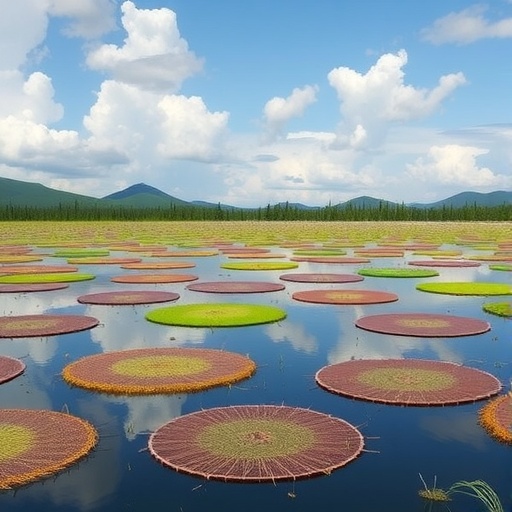
A lake can look still from the shoreline while undergoing a dramatic transformation beneath and across its surface. In a new study published in Communications Earth & Environment, researchers examine how the seasonal formation of floating plant mats reshapes the movement and chemistry of organic carbon in a lake undergoing “terrestrialization”—the gradual ecological transition from open water toward wetland and, eventually, land. The study, led by G. Cui, Y. Liu, L. Yan and colleagues, focuses on a process that is easy to see but difficult to quantify: the appearance of dense, buoyant vegetation that spreads across the water like a living carpet. According to the research, these floating mats are not merely visual features of a changing lake. They can act as temporary carbon-processing zones, altering how organic matter enters the water, moves through it, is transformed by microbes and ultimately leaves the aquatic system.
Organic carbon is one of the central currencies of freshwater ecosystems. It enters lakes through plant growth, soil erosion, groundwater, rainfall and the decomposition of vegetation. Once in the water, it can remain dissolved, attach to particles, settle into sediments, feed microorganisms or be converted into gases such as carbon dioxide and methane. The balance among these pathways determines whether a lake stores carbon, exports it downstream or releases part of it back into the atmosphere. That balance is rarely constant. Temperature, sunlight, hydrology and biological activity change throughout the year, causing the concentration and composition of carbon compounds to shift with the seasons. The study places floating-mat formation at the center of this seasonal story, suggesting that a lake’s carbon cycle can be reorganized when vegetation begins to occupy the water surface.
Floating mats typically develop when aquatic plants, algae or interconnected plant fragments accumulate at the surface and form a coherent layer. Their structure can change the physical environment immediately below them. A mat may reduce light penetration, slow water movement and trap suspended particles and detritus. It can also create sharp chemical gradients, with oxygen-rich conditions near illuminated surfaces and oxygen-poor conditions developing underneath as microorganisms consume oxygen while decomposing organic material. These gradients influence which microbial reactions dominate. In oxygenated zones, organic compounds may be oxidized through aerobic respiration. In darker, oxygen-depleted layers, other processes can become increasingly important, including anaerobic decomposition and methane production. By changing the boundary between air and water, a floating mat can therefore affect both the fate of carbon and the gases produced during its breakdown.
The researchers’ focus on a terrestrializing lake is especially significant because these systems occupy a transitional position between aquatic and terrestrial ecosystems. Terrestrialization is not simply the disappearance of a lake. It is a long ecological succession in which sediment, plant production and organic matter gradually reduce open-water habitat and encourage the expansion of marshes, floating vegetation and emergent plants. As this process advances, the lake’s shape, depth, water circulation and biological communities can all change. Organic carbon is both a driver and a product of that transformation. Plants add carbon-rich material to the ecosystem, while accumulated debris and sediment make the environment shallower and more suitable for further vegetation. The study investigates how seasonal mat formation participates in this feedback, linking short-term fluctuations to a much longer landscape-scale transition.
A key implication is that carbon measurements taken from open water may not fully represent what is happening in a mat-covered lake. Floating vegetation can create spatially distinct microhabitats over very short distances. Water beneath a dense mat may contain different concentrations and types of dissolved organic carbon than water at the lake’s edge or in unobstructed areas. Particulate carbon can become trapped among roots and stems, while soluble compounds released by plants may enter the surrounding water. Dead leaves and decomposing tissues add additional material, some of which is rapidly consumed by microbes and some of which is chemically resistant and more likely to persist. Seasonal expansion and collapse of the mats may repeatedly switch the system between carbon accumulation and carbon release, producing pulses that would be missed by occasional sampling.
The chemistry of organic carbon matters as much as its quantity. Dissolved organic carbon is not a single substance but a mixture of molecules with different sizes, structures and biological reactivities. Some compounds are easily consumed by bacteria, while others can persist for long periods or be transformed only slowly. Plant-derived carbon may contain aromatic and polymeric components associated with leaves, roots and vascular tissues, whereas microbial processing can generate smaller, more labile molecules. Sunlight can further alter dissolved carbon through photochemical reactions, breaking large molecules apart or making them more available to microorganisms. A surface mat changes the light field and the exchange of gases between water and atmosphere, potentially modifying all of these reactions. By connecting vegetation dynamics with carbon chemistry, the study highlights why “how much carbon” is present is only part of the ecological question.
The work also carries implications for greenhouse-gas research. Lakes and wetlands are often described as carbon sinks because they can bury large quantities of organic matter in sediments. At the same time, oxygen-poor decomposition can produce carbon dioxide and methane, allowing stored carbon to return to the atmosphere. Floating mats may intensify this tension. They can increase carbon inputs by producing biomass, slow the transport of oxygen into underlying water and provide abundant material for decomposition. Whether the net effect is greater storage or greater atmospheric emission depends on the balance among plant growth, decomposition, burial, gas production and physical export. The study does not reduce that balance to a simple label. Instead, it presents seasonal mat formation as a mechanism that can redirect carbon through several competing pathways, each with different consequences for climate and ecosystem function.
The findings are relevant beyond a single lake because aquatic vegetation is changing in many regions. Nutrient enrichment, warmer temperatures, altered rainfall and human modification of drainage systems can encourage excessive plant growth and accelerate the spread of floating vegetation. In some lakes, these mats are treated primarily as a nuisance because they obstruct navigation, reduce recreational access or create unpleasant odors. But the carbon perspective reveals a broader ecological consequence. A mat can function as a biological interface connecting water, atmosphere, sediment and plant communities. Its expansion may signal that the lake is moving toward a new ecological state, one in which open-water processes become less dominant and wetland-like processes take over. Understanding that shift could help scientists and managers distinguish temporary seasonal growth from a more persistent transformation.
The study’s wider message is that lake monitoring needs to follow ecological change across time rather than relying on isolated snapshots. Seasonal observations are essential because the same lake can behave like several different systems over the course of a year. Plant emergence, mat expansion, decomposition and winter decline can each alter the concentration, composition and fate of organic carbon. Measurements of water chemistry are most informative when paired with observations of vegetation cover, hydrological conditions, sediment accumulation and microbial activity. Such integrated monitoring can reveal whether carbon is being retained in biomass and sediment, exported in dissolved or particulate form, or converted into greenhouse gases. It can also improve models of how inland waters respond to climate change, since the expansion of floating vegetation may be both a consequence of environmental change and a mechanism that amplifies it.
By tracing the seasonal dynamics of organic carbon through a lake in the process of becoming more terrestrial, Cui and colleagues bring attention to an easily overlooked stage in ecosystem development. The floating mat is neither simply a plant community nor merely a layer on the water. It is a moving, decomposing and chemically active structure that can reorganize the lake’s carbon pathways. As climate and land use continue to reshape freshwater environments, such transitional systems may become increasingly common. Their future carbon balance will depend not only on how much vegetation grows, but also on when it appears, how long it persists, what happens beneath it and where its organic matter ultimately goes. The research offers a timely reminder that some of the most consequential changes in the global carbon cycle may begin with a quiet green surface spreading across a lake.
Cite Scienmag News
Violet Maxwell. (August 22, 2026). Floating Mats Drive Seasonal Carbon Dynamics as a Lake Becomes Terrestrial. Scienmag. https://scienmag.com/floating-mats-drive-seasonal-carbon-dynamics-as-a-lake-becomes-terrestrial/
Violet Maxwell. "Floating Mats Drive Seasonal Carbon Dynamics as a Lake Becomes Terrestrial." Scienmag, 22 August 2026, https://scienmag.com/floating-mats-drive-seasonal-carbon-dynamics-as-a-lake-becomes-terrestrial/. Accessed 4 September 2026.
Violet Maxwell. "Floating Mats Drive Seasonal Carbon Dynamics as a Lake Becomes Terrestrial." Scienmag. August 22, 2026. https://scienmag.com/floating-mats-drive-seasonal-carbon-dynamics-as-a-lake-becomes-terrestrial/


