


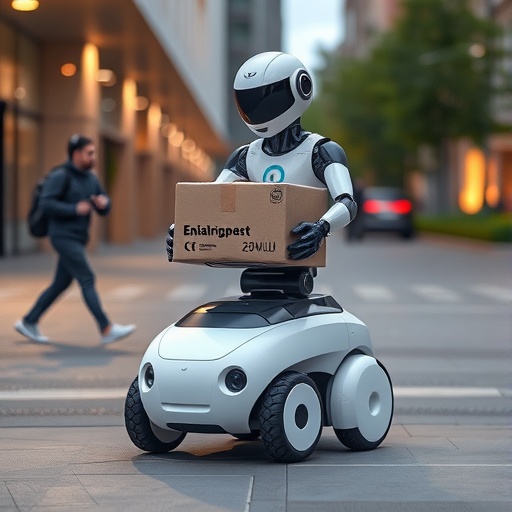
A groundbreaking study from Toyohashi University of Technology’s Cognitive Neurotechnology Unit, alongside its Visual Perception and Cognition Laboratory, has unveiled new insights into human interaction with autonomous mobile delivery robots. As cities worldwide transition toward integrating robotic assistance in everyday logistics, understanding the subtleties of human comfort and behavior during these encounters is critical. This pioneering research probes how individuals perceive and physically respond when handing over packages to robots in motion, highlighting conditions that foster comfortable and natural human-robot exchanges.
The investigation focused on scenarios mimicking future smart city environments where autonomous delivery robots operate alongside pedestrians. A central question was how the proximity of a robot during a package handoff influences human comfort and behavioral adjustments while walking. The research found a nuanced relationship: when robots approach closely, people generally report feeling more at ease, a stark contrast to the discomfort experienced when robots maintain greater distances during the interaction. This counterintuitive finding challenges the common assumption that maintaining ample personal space is preferable in human-robot encounters.
Crucially, the weight of the package emerged as a decisive factor shaping comfort levels. Participants carrying heavier loads exhibited a pronounced preference for robots that approached nearer, suggesting a perceived increase in robotic assistance or support. Conversely, distant robots seemed less helpful, potentially heightening physical strain or uncertainty. These reactions underscore that humans may subconsciously interpret robots’ approach behaviors as cooperative gestures rather than mere mechanical operations.
Interestingly, the experiments revealed that close robot proximity affected participants’ walking dynamics. Many slowed down or paused momentarily when the robot came near, displaying subtle hesitation. This behavior points to a cognitive assessment phase where individuals evaluate the robot’s movements and intentions, reinforcing the notion that humans treat these autonomous agents as interactive partners in the exchange rather than passive objects. These momentary behavioral adaptations signify the complexity of integrating robots seamlessly into pedestrian traffic.
The study employed three meticulously designed psychophysical experiments to dissect these phenomena. The first focused on varying the robot’s approach distance and monitoring subsequent changes in human gait and hesitation patterns. The second examined how different package weights influence comfort ratings and behavioral responses, revealing the interactive effect between physical burden and robot proximity. The third compared subjects knowledgeable about robotics with novices, discovering no substantial disparity in comfort levels, thereby suggesting that familiarity with technology does not significantly modulate initial comfort perceptions during such interactions.
Taken together, these findings imply that designing robot behaviors with a human-centric approach is paramount. It is not sufficient for robots to function effectively from an engineering standpoint; their motion patterns must resonate with innate human social and cognitive expectations. By calibrating proximity and movement dynamics, robots can transcend perceptions as impersonal tools, instead becoming empathetic collaborators that enhance daily activities and urban mobility.
The implications extend beyond logistics and automated delivery. In sectors such as hospitality, healthcare, and retail where robots increasingly interact with humans, understanding nuanced comfort thresholds can inform safer, more intuitive designs. Robots that adaptively modulate their approach speed and distance based on contextual cues could reduce anxiety and build trust, accelerating technology adoption and acceptance in society.
Assistant Professor Hideki Tamura, co-first author of the study, emphasized the transformative potential of embedding cognitive and behavioral insights into robotic motion design. He remarked that improving the naturalness of robot movements is essential for integrating autonomous systems into human environments organically. “Robots must move in ways that feel familiar and reassuring to people, fostering cooperation rather than alienation,” Tamura stated, underscoring the interdisciplinary challenge bridging engineering, psychology, and design.
Looking ahead, the Toyohashi research team plans to broaden this inquiry into more ecologically valid environments. Future studies aim to dissect how additional variables—including the robot’s size, appearance, ambient sounds, and trajectory speed—affect human perceptions and comfort levels. This comprehensive framework aspires to guide the creation of robotic systems that harmoniously coexist with humans in diverse contexts, from crowded urban spaces to intimate service settings.
Ultimately, this research lays fundamental groundwork for the social integration of robots as partners rather than threats or obstructions. By honing design principles that prioritize ergonomic and psychological factors, autonomous robots can become trusted aides that enrich human life and simplify routine tasks. The findings signal a future where robots are perceived less as isolated machines and more as collaborative agents woven into the fabric of daily existence.
Published in the International Journal of Social Robotics on October 20, 2025, this research presents a vital advance in the quest to humanize robotic intermediaries through careful motion and interaction design. It challenges developers to rethink not only robotic hardware but also the subtleties of movement and spacing that govern human comfort. Such human-in-the-loop design paradigms are poised to define the next generation of socially intelligent machines.
In conclusion, as autonomous robots proliferate in public and private domains, this study highlights the psychological and behavioral dimensions fundamental to their acceptance. Appropriate approach distances and fluid, anticipatory movements are not merely preferences but requisites for fostering seamless and pleasant collaborations. By aligning robotic motion with human expectations, we can catalyze a new era of harmonious coexistence between humans and machines.
Cite Scienmag News
Denise Maddox. (November 12, 2025). How Can People Easily Transfer Packages to Delivery Robots? Scienmag. https://scienmag.com/how-can-people-easily-transfer-packages-to-delivery-robots/
Denise Maddox. "How Can People Easily Transfer Packages to Delivery Robots?" Scienmag, 12 November 2025, https://scienmag.com/how-can-people-easily-transfer-packages-to-delivery-robots/. Accessed 3 September 2026.
Denise Maddox. "How Can People Easily Transfer Packages to Delivery Robots?" Scienmag. November 12, 2025. https://scienmag.com/how-can-people-easily-transfer-packages-to-delivery-robots/


