


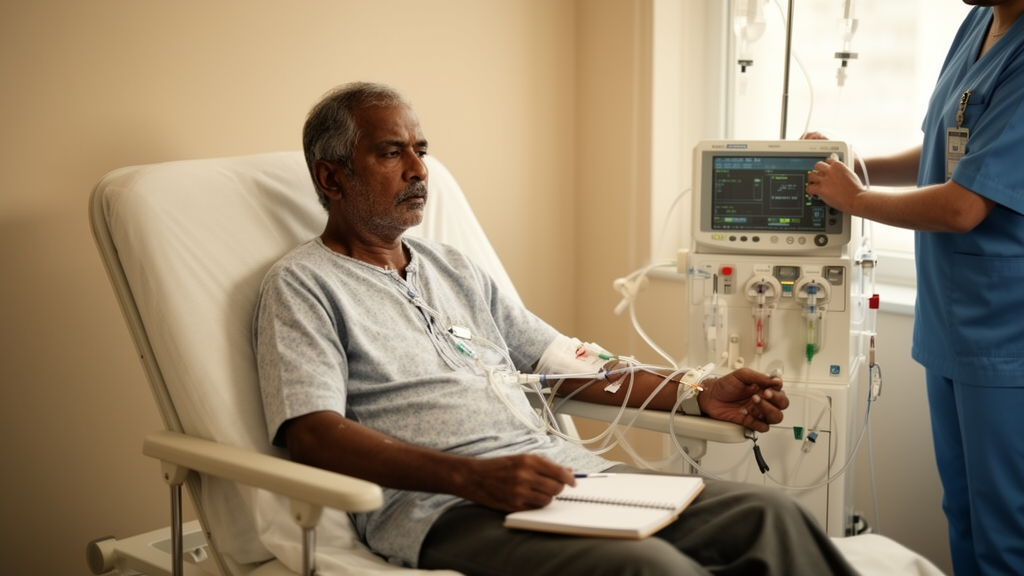
For the roughly 181 adults receiving maintenance hemodialysis at four hospital-based units in Bangladesh who took part in a new cross-sectional study, the stakes of getting nutrition right could hardly be higher. People on dialysis lose protein and other nutrients with every treatment session, and clinical guidelines from the Kidney Disease Outcomes Quality Initiative, known as KDOQI, prescribe precise daily targets: enough energy to prevent wasting, enough protein to preserve muscle, and strict limits on sodium and phosphorus to protect the heart and bones. Yet the new research, published in PLOS One by Farhana Akter and colleagues, reveals a troubling methodological blind spot at the heart of dialysis nutrition care, one that applies far beyond Bangladesh. When researchers measured what patients actually reported eating, and then statistically screened those reports for plausibility, the picture of guideline compliance shifted dramatically, and in opposite directions depending on whether the goal was eating enough or eating less.
The study team used three non-consecutive 24-hour dietary recalls, a standard technique in which trained interviewers ask participants to reconstruct everything they ate and drank over the previous day. Each participant completed three recalls on days that were not consecutive, which helps smooth out day-to-day variation in eating patterns. The researchers then compared reported intakes of energy, protein, sodium, and phosphorus against the KDOQI recommendations for hemodialysis patients, which specify an energy intake of 30 to 35 kilocalories per kilogram of body weight per day and a protein intake of at least 1.0 gram per kilogram per day. Appetite was assessed separately using the Appetite and Diet Assessment Tool, a validated questionnaire designed to capture the reduced hunger that is common in kidney disease.
The critical methodological innovation was the plausibility screening. Self-reported dietary intake is notoriously unreliable, because people systematically forget snacks, underestimate portion sizes, and sometimes consciously or unconsciously describe what they believe they should be eating. To detect this, the researchers calculated the ratio of each participant’s reported energy intake to their estimated basal metabolic rate, the energy the body burns at complete rest. Ratios that fall far below physiologically expected values signal under-reporting, while unusually high ratios signal over-reporting. Of the 178 participants with complete data, 65.2 percent reported energy intakes in the acceptable range, but 32.0 percent under-reported and 2.8 percent over-reported. In other words, roughly one in three patients gave accounts of their diets that were physiologically implausible.
The raw numbers before screening were already sobering. Only 20 of 176 participants, or 11.4 percent, met the energy target of 30 to 35 kilocalories per kilogram per day, and just 58 participants, or 33.0 percent, met the protein target of at least 1.0 gram per kilogram per day. On its face, this suggested a population facing severe dietary inadequacy, with most patients failing to eat enough to maintain their body mass and muscle stores. For a clinical team, such figures would argue for urgent nutritional supplementation, intensive dietary counseling, and possibly oral nutrition supplements for the majority of the dialysis population.
But when the researchers excluded the implausible reports, the estimates moved in opposite directions depending on the type of target, and this asymmetry is the study’s most important technical contribution. For intake targets, where the goal is to consume enough, adherence rose once under-reporters were removed from the analysis: energy compliance climbed from 11.4 percent to 15.5 percent, and protein compliance jumped from 33.0 percent to 47.4 percent. The logic is straightforward. Under-reporting makes it look as though patients are eating too little, so removing those biased records raises the apparent proportion of patients who actually meet minimum intake goals. Nearly half of plausible reporters were meeting the protein target, a considerably less alarming picture than one in three.
For restriction targets, the pattern reversed. Apparent adherence to the sodium limit fell from 73.6 percent to 65.5 percent after screening, and adherence to the phosphorus limit fell from 88.2 percent to 84.5 percent. Here the bias runs the other way: under-reporting makes it seem as though patients are consuming less sodium and phosphorus than they really are, inflating the apparent success of dietary restriction advice. Once implausible records are excluded, the true scale of excess sodium and phosphorus consumption becomes visible, and it is larger than the raw self-report data suggested. Unscreened self-report therefore simultaneously overstates dietary inadequacy and understates dietary excess, a double distortion that pushes clinical decisions in two wrong directions at once.
One finding stood out as nearly universal: the phosphorus-to-protein ratio exceeded 12 milligrams per gram in all but five participants. This ratio is a measure of dietary quality, because phosphorus in the diet tends to travel with protein, and foods that deliver protein with a heavy phosphorus load are particularly problematic for dialysis patients whose kidneys can no longer excrete the mineral. Elevated phosphorus drives secondary hyperparathyroidism, vascular calcification, and cardiovascular mortality in this population. A ratio above 12 milligrams per gram in virtually the entire cohort indicates that the available protein sources in these patients’ diets, likely dominated by legumes, grains, and processed items rather than phosphorus-lean animal proteins, carry an unfavorable mineral burden regardless of how much protein patients consume.
The appetite findings added a further layer of complexity. Poor appetite, assessed with the Appetite and Diet Assessment Tool, was common, affecting 42.0 percent of participants. Appetite loss is a recognized harbinger of protein-energy wasting in dialysis patients and is often treated as a direct driver of low intake. Yet in this study, poor appetite did not correspond to lower measured intake. Instead, appetite scores were associated with reporting plausibility, with a statistically significant relationship at p equal to 0.024. This suggests that patients who described poor appetite may have been describing their perception of their eating rather than their actual consumption, or that appetite influenced how they reported their diets rather than the diets themselves. For clinicians, this decoupling of subjective appetite from objective intake is a caution against using appetite questionnaires alone to identify patients at nutritional risk.
The clinical implications extend well beyond the four Bangladeshi dialysis units where the data were collected. Resource-limited settings have historically been underrepresented in nutrition research, and this study provides some of the first rigorous evidence on how KDOQI guideline compliance actually looks in South Asian hemodialysis populations, where dietary patterns, food costs, and access to renal dietitians differ substantially from the high-income contexts in which the guidelines were developed. The finding that nearly half of plausible reporters met protein targets, while almost none of the raw data suggested such compliance, demonstrates that screening for plausibility is not a statistical nicety but a decisive step that changes conclusions. Nutrition interventions designed on the basis of unscreened recall data could waste resources addressing a deficiency that is partly an artifact of measurement, while missing the genuine excess of sodium and phosphorus that screening reveals.
The broader lesson is one that nutrition science has been absorbing across many fields: self-reported dietary intake should not be used unfiltered to guide nutritional decisions. The authors’ conclusion applies with particular force to dialysis care, where the difference between eating too little protein and eating too much phosphorus can shape survival over years of treatment. Objective biomarkers, structured plausibility screening, and repeated recalls each add cost and complexity, but this study shows what happens when they are skipped: a population that appears starved of energy and protein may in fact be consuming more than the raw numbers suggest, while quietly exceeding the mineral limits that matter most for cardiovascular health. For the growing global population of dialysis patients, most of whom now live in low- and middle-income countries, closing that measurement gap may be as important as any new drug.
Subject of Research: Dietary intake patterns and KDOQI guideline compliance among hemodialysis patients in Bangladesh, with plausibility screening of self-reported intake
Article Title: Dietary intake patterns and KDOQI guideline compliance among hemodialysis patients in Bangladesh: Gaps, misreporting, and clinical implications
Article References: Akter, F., Rahman, T., Ahmed, S., Ripon, M. S. H., Sultana, M., Sultana, N., & Rashid, H.-U. (2026). Dietary intake patterns and KDOQI guideline compliance among hemodialysis patients in Bangladesh: Gaps, misreporting, and clinical implications. PLOS One, 21(10), e0360654. https://doi.org/10.1371/journal.pone.0360654
Image Credits: AI Generated
DOI: 10.1371/journal.pone.0360654
Keywords: hemodialysis, KDOQI guidelines, dietary intake, nutrition, Bangladesh, 24-hour recall, under-reporting, phosphorus-to-protein ratio, protein-energy wasting, appetite assessment, renal dietetics, PLOS One
Cite Scienmag News
Jerry Hayes. (October 15, 2026). Hidden Hunger in the Dialysis Chair: Self-Reported Diets Mislead Kidney Care in Bangladesh. Scienmag. https://scienmag.com/hidden-hunger-in-the-dialysis-chair-self-reported-diets-mislead-kidney-care-in-bangladesh/
Jerry Hayes. "Hidden Hunger in the Dialysis Chair: Self-Reported Diets Mislead Kidney Care in Bangladesh." Scienmag, 15 October 2026, https://scienmag.com/hidden-hunger-in-the-dialysis-chair-self-reported-diets-mislead-kidney-care-in-bangladesh/. Accessed 15 October 2026.
Jerry Hayes. "Hidden Hunger in the Dialysis Chair: Self-Reported Diets Mislead Kidney Care in Bangladesh." Scienmag. October 15, 2026. https://scienmag.com/hidden-hunger-in-the-dialysis-chair-self-reported-diets-mislead-kidney-care-in-bangladesh/


