


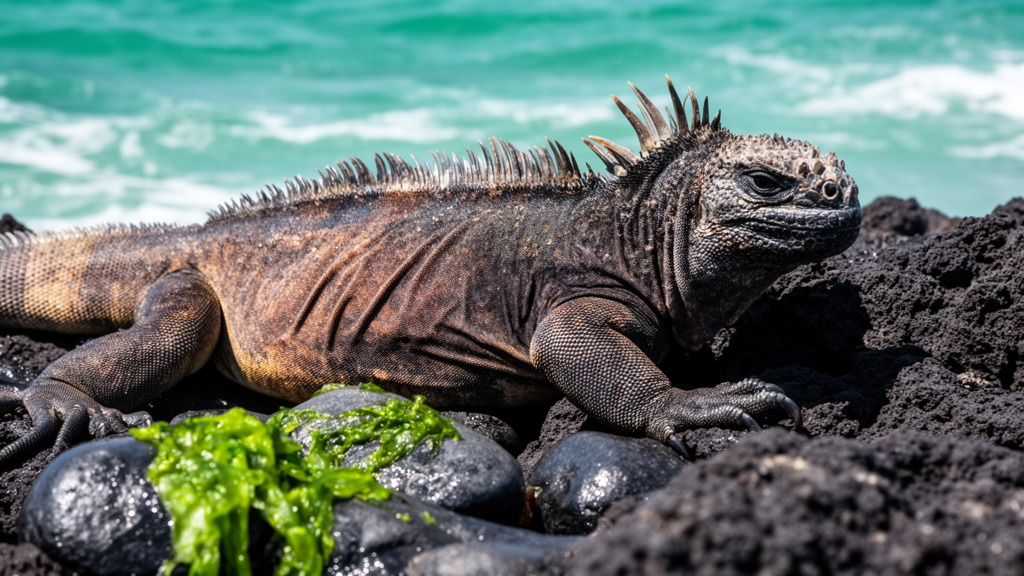
The world’s only ocean-foraging lizard is facing a convergence of threats that scientists say could push it beyond its limits. Galapagos marine iguanas, the remarkable reptiles that dive into cold Pacific waters to graze on algae and bask on volcanic rocks between feeding sessions, are being targeted by an expanding black-market trafficking network at precisely the moment a powerful Super El Niño is stripping away their primary food supply. In a letter published in Science, an international team of researchers led in part by marine eco-toxicologist Juan José Alava of Simon Fraser University warns that the combination of climate-driven starvation pressure and organized wildlife crime represents an unprecedented danger to a species already classified as Vulnerable by the International Union for Conservation of Nature.
The timing of the two crises is stark. The 2026/27 El Niño event began warming equatorial Pacific waters in May, the same month Ecuadorian officials discovered four Galapagos marine iguanas being kept in a private home near the mainland city of Guayaquil. Shortly afterward, authorities found a dozen more of the animals at a nearby airport, stuffed into handbags with their limbs bound to prevent movement. In late August, another 32 iguanas were recovered from a suitcase, tied up inside small plastic containers. Two weeks after that discovery, the ongoing El Niño event intensified to ‘super’ status, a designation reserved for the strongest episodes of this recurring ocean-atmosphere phenomenon.
El Niño conditions are not a marginal stress for this species; they strike at the core of its biology. Marine iguanas depend almost entirely on intertidal macroalgae, the dense mats of red and green seaweeds that flourish in the cool, nutrient-rich waters that normally bathe the Galapagos Archipelago. During an El Niño, the upwelling of cold, nutrient-laden water weakens or collapses, warm-water masses displace the productive conditions, and the algae that iguanas graze upon die back dramatically. The result, documented in previous strong El Niño events, is widespread starvation. Alava explains that the animals are already shrinking in body size and suffering mass mortality, either from lack of food or from exhausting themselves swimming longer distances in search of algae that no longer exists along their usual shorelines.
The physiological toll of these events is one of the more extraordinary features of the species’ biology. Marine iguanas are known to literally shrink their skeletons during food shortages, absorbing bone tissue to reduce their energy requirements, and their body condition can decline rapidly when algal cover collapses. A Super El Niño compounds this stress across the entire archipelago simultaneously, leaving no refuges within the species’ range. Against this backdrop of climate-driven famine, Alava says, the surge in trafficking adds a threat the animals have never faced at this scale. His team wrote the Science letter specifically to call international attention to what he describes as a strange uptick in smuggling to supply the exotic pet trade, occurring at the worst possible moment for wild populations.
The human cost of the smuggling operations is already evident. At least one confiscated iguana was found dead, and several more have died as a direct consequence of the trafficking attempts. Even the survivors face a long and complicated road home. The species is not a single homogeneous population: researchers recognize at least 11 subspecies, each highly evolved to survive the specific conditions of particular islands within the Galapagos chain. This means that rescued animals cannot simply be released at the nearest suitable beach. Once confiscated iguanas are rehabilitated, they must undergo DNA testing to determine which island population they originated from, so they can be returned to the correct location without disrupting the genetic distinctiveness that has accumulated over millennia of isolation on separate islands.
The legal architecture protecting the species is strong on paper. Galapagos marine iguanas are classified as Vulnerable globally, but 10 of the 11 recognized subspecies are categorized locally as Endangered or Critically Endangered, reflecting the precarious state of individual island populations. International commercial trade is strictly banned under the Convention on International Trade in Endangered Species of Wild Fauna and Flora, and the species enjoys full protection under Ecuadorian national law. Yet the smuggling operations that have come to light were not detected within the Galapagos Marine Reserve itself, a detail that Alava says reveals how traffickers are finding local ways around the ecological inspection checkpoints designed to stop exactly this kind of extraction from the protected archipelago.
Understanding how the animals leave the islands points to a chain of exploitation that extends well beyond the Galapagos. The iguanas are likely pulled from shorelines and shallow waters around the islands, and the researchers suggest that coastal fishing communities on Ecuador’s mainland may be drawn into the black market under duress. Those communities are facing intense economic hardship and extortion from organized crime, pressures that can leave residents feeling they have little choice but to participate when trafficking networks come calling. From there, the networks rely on local logistics operators and national or international facilitators to move the animals through inspection points and into Ecuador proper, where they are prepared for export to overseas markets spanning Africa, Asia, Europe, North America, and the Pacific.
Perhaps the most alarming element of the scheme, according to the researchers, is the way it exploits weaknesses in the international permitting system itself. Trafficking networks have obtained CITES export permits by falsely declaring wild-caught Galapagos marine iguanas as captive-bred animals in Uganda, Switzerland, Mali, and Japan, despite the fact that no authorized breeding facilities for the species exist in any of those countries. This fraudulent paperwork allows smuggled iguanas to cross international borders under the appearance of legality, laundering wild specimens taken from a fully protected population into the exotic pet trade. The captive-bred loophole is a known vulnerability in global wildlife trade regulation, and the Galapagos case demonstrates how readily it can be weaponized against a species that should never appear in commercial trade at all.
The researchers’ response, laid out in their Science letter, is a call for action at multiple levels of the trade chain. They are urging CITES to close the permitting loopholes that allow fraudulent captive-bred declarations, and they want member countries to strengthen oversight of the permitting system within their own borders so that false declarations are caught before animals are shipped. Within Ecuador, the team writes that the government must aggressively combat and litigate organized crime, while also providing financial support and sustainable alternative livelihoods to coastal citizens, addressing the socioeconomic pressures that make communities vulnerable to recruitment by trafficking networks. Without action on both the enforcement and the economic fronts, the researchers warn, the conditions that enabled this surge in smuggling will persist.
For a species that survived millions of years of isolation and the extremes of one of the planet’s most variable ocean systems, the current convergence of threats is unlike anything in its evolutionary history. Chemical spills and plastics pollution already burden marine iguana populations, as Alava notes, and the Super El Niño is now erasing the algae on which their survival depends. The addition of organized, international trafficking, complete with forged permits and criminal logistics, transforms a climate crisis into a compound emergency. The scientists hope that raising the alarm in one of the world’s most prominent scientific journals will galvanize the regulatory and enforcement responses needed before the world’s only sea-going lizard loses more ground, and more individuals, to a trade it never evolved to face.
Subject of Research: Illegal trafficking and Super El Niño climate impacts threatening Galapagos marine iguana survival
Article Title: Scientists alarmed as Super El Niño collides with ‘strange uptick’ in Galapagos iguana trafficking
Article References: Scientists alarmed as Super El Niño collides with ‘strange uptick’ in Galapagos iguana trafficking. (n.d.). Original publication
Image Credits: AI Generated
DOI: Not provided
Keywords: Galapagos marine iguana, wildlife trafficking, Super El Niño, CITES, Ecuador, exotic pet trade, marine conservation, macroalgae, organized crime, subspecies DNA testing, climate change, Simon Fraser University
Cite Scienmag News
Violet Maxwell. (October 15, 2026). Super El Niño and Rising Black-Market Trade Push Galapagos Marine Iguanas Toward Crisis. Scienmag. https://scienmag.com/super-el-nino-and-rising-black-market-trade-push-galapagos-marine-iguanas-toward-crisis/
Violet Maxwell. "Super El Niño and Rising Black-Market Trade Push Galapagos Marine Iguanas Toward Crisis." Scienmag, 15 October 2026, https://scienmag.com/super-el-nino-and-rising-black-market-trade-push-galapagos-marine-iguanas-toward-crisis/. Accessed 15 October 2026.
Violet Maxwell. "Super El Niño and Rising Black-Market Trade Push Galapagos Marine Iguanas Toward Crisis." Scienmag. October 15, 2026. https://scienmag.com/super-el-nino-and-rising-black-market-trade-push-galapagos-marine-iguanas-toward-crisis/


