


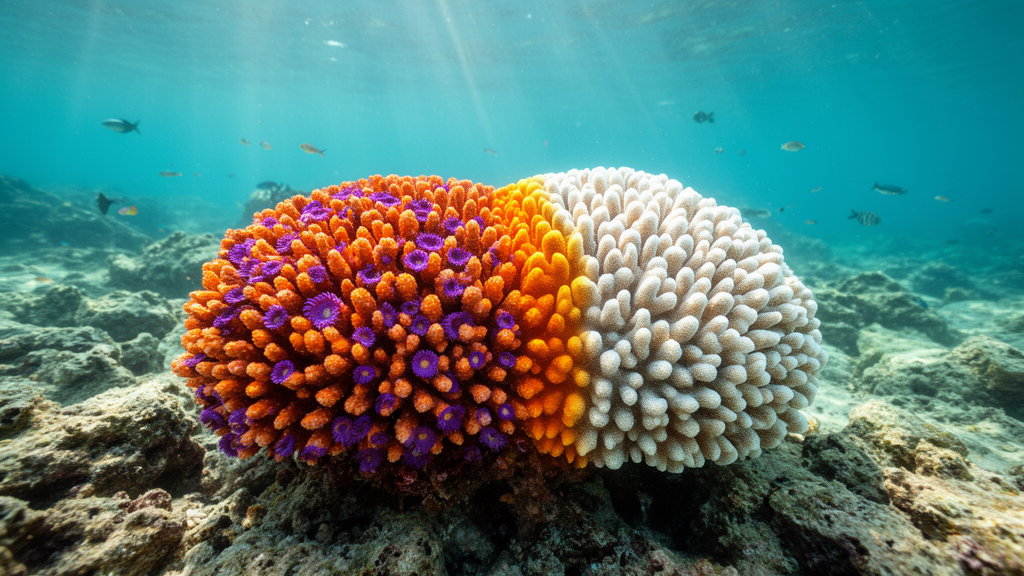
Coral reefs are collapsing under the pressure of warming oceans, and one of the most devastating mechanisms behind that decline is coral bleaching. When sea temperatures climb beyond tolerable thresholds, corals expel the microscopic dinoflagellate algae that live inside their tissues, algae that supply the bulk of the energy corals need to build their skeletons and sustain entire reef ecosystems. Without these photosynthetic partners, the corals turn ghostly white and, if symbionts do not return quickly enough, starve and die. Against this grim backdrop, a new study published in Science Advances offers a strikingly simple and unexpectedly fast intervention: brief physical contact between a healthy coral and a bleached one can restore the missing algae and trigger full recovery, sometimes in as little as three days.
The research, led by Daniel Collins and colleagues, demonstrates that when fragments of healthy and bleached coral are brought into direct contact, symbiotic dinoflagellates move from the healthy colony into the bleached one. The timescale of this transfer is remarkable. Just one week of contact was sufficient to initiate recovery in the experiments, and in some cases the process began after only three days. That speed matters enormously, because natural recovery from bleaching events in the wild typically takes far longer, often months, and in some cases the pace of recovery is simply too slow to prevent the death of the reef before symbiont populations can be reestablished. The algal recovery observed in this study is an order of magnitude faster than most recovery times documented in natural settings.
The mechanism behind this rapid rescue is as fascinating as the result itself. The researchers show that the symbiont transfer occurs through tissue fusion between the contacting corals. When two compatible coral colonies touch, their soft tissues can merge, creating a living bridge through which algae, nutrients, and cellular material can pass. This fusion, however, comes with a strict biological constraint: the procedure only succeeds when the corals involved share the same genetic background, meaning they belong to the same genet, a genetically identical colony derived from the same original individual. Corals from different genets, even of the same species, did not achieve recovery through this fusion-based pathway, presumably because their tissues recognize each other as foreign and refuse to merge.
Yet the study uncovered a second, more permissive route for symbiont movement. The researchers found that symbiont algae can also be transferred via the uptake of polyps, the small individual animals that make up a coral colony, when healthy and bleached corals come into contact. Intriguingly, this polyp-based transfer occurred in both same-genet and mixed-genet pairings, meaning it does not depend on genetic compatibility. However, the authors note that this pathway is slower and, critically, insufficient on its own to support full colony recovery. In their words, it reveals an additional, slower pathway for symbiont transfer that cannot independently rescue a bleached coral. The distinction between these two mechanisms, rapid fusion-based transfer restricted to genetically identical colonies and slower polyp uptake available more broadly, provides a nuanced picture of how symbionts can move between coral individuals.
The implications of this work extend well beyond the laboratory. Coral bleaching events have intensified in frequency and severity over recent decades, driven by marine heatwaves linked to climate change. Iconic reef systems, including the Great Barrier Reef, have suffered repeated mass bleaching episodes with insufficient time to recover between them. Traditional restoration approaches, such as growing coral fragments in nurseries and transplanting them onto damaged reefs, are labor-intensive and slow. The idea that a bleached coral could be rescued simply by placing it in contact with a healthy neighbor of the same genet suggests a potentially powerful and low-technology tool for reef managers, one that leverages the corals’ own biology rather than external inputs.
The genet restriction, however, presents a practical challenge. On a natural reef, genetically identical colonies are not always adjacent, and identifying which corals share a genet requires genetic analysis. Clonal corals that reproduce by fragmentation can form clusters of genetically identical individuals, and in such cases, a bleached fragment might be deliberately positioned near a healthy clone to facilitate tissue fusion. The study’s authors acknowledge that the next step is to determine whether these contact-based recovery strategies can be applied in the field at the scale of natural coral reefs, a question that will require testing under real-world conditions of currents, competition, predation, and fluctuating temperatures.
The speed of the recovery observed in the experiments deserves particular attention. An order of magnitude faster than most wild recovery times means the difference between a coral that survives a bleaching event and one that succumbs to it. After expelling their symbionts, bleached corals are in a race against time, relying on limited energy reserves while remaining vulnerable to disease and further thermal stress. If symbionts can be restored within days rather than months, the window of vulnerability shrinks dramatically, and the cumulative mortality that transforms a bleaching event into a reef-wide die-off could be reduced. This temporal advantage is precisely what makes the contact-based approach so compelling as a potential conservation tool.
The study also contributes to a deeper scientific understanding of coral symbiosis itself. The partnership between corals and their dinoflagellate algae, members of the family Symbiodiniaceae, is one of the most consequential mutualisms on the planet, underpinning the productivity of reefs that support roughly a quarter of marine species. How corals acquire, maintain, and lose these symbionts has been studied extensively, but direct symbiont transfer between coral individuals through tissue fusion had not previously been demonstrated as a route to bleaching recovery. The finding that corals can effectively share their photosynthetic partners with genetically identical kin adds a new dimension to how scientists think about colony interconnectedness and resilience within clonal coral populations.
From a broader perspective, the research arrives at a moment when reef restoration science is exploring an expanding toolkit, including assisted gene flow, selective breeding of heat-tolerant corals, probiotic treatments, and artificial shading. Contact-based symbiont transfer would sit alongside these approaches as a complementary strategy, potentially useful in nursery settings where corals of known genotypes are cultivated in close proximity. If field trials confirm that the laboratory results translate to reef conditions, managers might one day deliberately graft healthy tissue onto bleached colonies of the same genet, or arrange nursery-grown clones to act as symbiont donors during and after heat stress events.
Much work remains before such applications become reality. The experiments were conducted under controlled conditions, and the researchers themselves emphasize that scaling the approach to natural reefs is the critical next step. Questions about how tissue fusion behaves in turbulent water, whether transferred symbionts persist long-term, and how the method performs across different coral species and symbiont types all await answers. Still, the core discovery stands: a brief touch between compatible corals can accomplish in days what nature often takes months to achieve. In a field where every degree of warming and every week of delay carries existential weight, that simple biological fact may prove to be one of the most hopeful findings in coral science this decade.
Subject of Research: Symbiont transfer from healthy to bleached corals through tissue contact for rapid bleaching recovery
Article Title: Brief contact with healthy corals can transfer healthy symbiotic algae to bleached ones
Article References: Brief contact with healthy corals can transfer healthy symbiotic algae to bleached ones. (n.d.). Original publication
Image Credits: AI Generated
DOI: Not provided
Keywords: coral bleaching, symbiodiniaceae, dinoflagellate algae, tissue fusion, coral reef restoration, Science Advances, marine heatwaves, coral symbiosis, genet compatibility, polyp uptake, reef conservation, climate change
Cite Scienmag News
Violet Maxwell. (October 14, 2026). A Gentle Touch: Healthy Corals Can Rescue Bleached Neighbors in Days. Scienmag. https://scienmag.com/a-gentle-touch-healthy-corals-can-rescue-bleached-neighbors-in-days/
Violet Maxwell. "A Gentle Touch: Healthy Corals Can Rescue Bleached Neighbors in Days." Scienmag, 14 October 2026, https://scienmag.com/a-gentle-touch-healthy-corals-can-rescue-bleached-neighbors-in-days/. Accessed 14 October 2026.
Violet Maxwell. "A Gentle Touch: Healthy Corals Can Rescue Bleached Neighbors in Days." Scienmag. October 14, 2026. https://scienmag.com/a-gentle-touch-healthy-corals-can-rescue-bleached-neighbors-in-days/

