One of the most stubborn problems in pregnancy medicine may have just yielded a promising clue. Fetal growth restriction, a condition in which a baby fails to reach its full growth potential in the womb, remains a leading cause of illness and death in newborns, yet doctors have had little to offer beyond monitoring and early delivery. Now, a team of researchers reporting in PLOS Biology has identified a hormone produced by the placenta that appears to act as a direct chemical messenger telling the fetal liver to grow, and they have shown that restoring this hormone in animal models can partially reverse the condition.
The hormone in question is growth differentiation factor 15, commonly abbreviated as GDF15. It belongs to a large family of signaling proteins that coordinate development, metabolism, and stress responses throughout the body. GDF15 has attracted considerable attention in recent years for its roles in appetite regulation and nausea of pregnancy, but its function during fetal development has remained poorly understood. The new study, led by Xiao Peng Liu, Xiao Zhang, and colleagues, set out to determine whether this circulating protein might be more than a bystander in pregnancy, and whether the placenta itself might be an important source of the hormone that reaches the developing fetus.
The researchers began by measuring GDF15 levels in two different animal models of fetal growth restriction, one in mice and one in pigs. In both species, they found that GDF15 concentrations were significantly reduced in the placenta and in the fetal circulation. Crucially, the degree of reduction tracked closely with fetal weight: the lower the GDF15 level, the smaller the fetus. This correlation alone did not prove causation, but it provided a clear starting hypothesis. If GDF15 were merely a symptom of a struggling pregnancy, its levels would fall alongside everything else. If it were a driver of growth, removing it should be enough to restrict fetal development on its own.
To distinguish between these possibilities, the team engineered mice in which the Gdf15 gene was deleted specifically in the placenta while leaving the rest of the embryo genetically intact. The result was striking. Fetuses carrying placentas that could no longer produce GDF15 developed fetal growth restriction, even though their own tissues were fully capable of making the hormone. This experiment demonstrated that placental GDF15 is not redundant with GDF15 produced elsewhere in the fetus. The placenta, an organ long viewed primarily as a supplier of oxygen, nutrients, and waste exchange, appears to function as an endocrine gland whose hormonal output directly programs fetal growth.
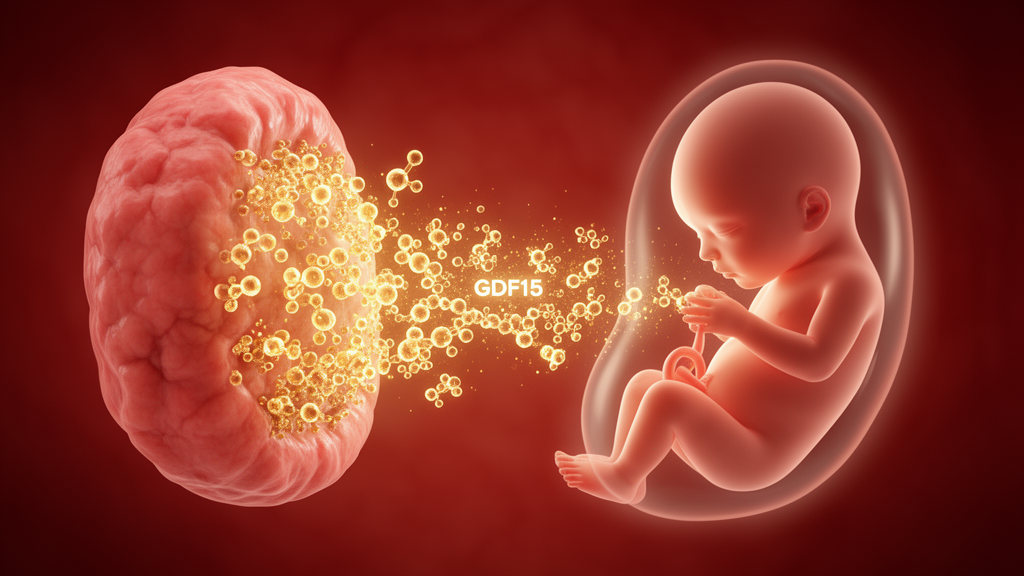
The next question was where the placental hormone goes and what it does once it arrives. By tracing the contribution of placental GDF15 to the fetal bloodstream, the researchers found that the placenta is a major contributor to the pool of GDF15 circulating in the fetus. The protein crosses into the fetal compartment and accumulates in the fetal liver, the metabolic powerhouse of the developing animal and the source of insulin-like growth factors that drive tissue expansion throughout the body. There, GDF15 engaged a well-known intracellular signaling pathway called STAT3, a transcription factor that becomes active when it is chemically modified by phosphorylation and then moves to the nucleus to switch genes on or off.
The target gene at the end of this pathway proved to be IGF2, or insulin-like growth factor 2, one of the most potent fetal growth promoters known to biology. IGF2 is famous among developmental biologists for its imprinting, meaning it is expressed from only one parental copy of the gene, and for its dramatic effects: mice engineered to lack IGF2 are born at roughly sixty percent of normal size. The new findings place placental GDF15 upstream of this master growth factor, activating hepatic STAT3 signaling, which in turn stimulates IGF2 production during pregnancy. When placental GDF15 was missing, the researchers measured reduced phosphorylation of STAT3 and reduced IGF2 levels in fetal livers, providing a coherent mechanistic chain from placenta to fetal liver to whole-body growth.
To confirm that STAT3 was genuinely required for this effect rather than merely correlated with it, the team turned to primary fetal hepatocytes, liver cells isolated directly from mouse fetuses and grown in culture. When these cells were exposed to GDF15, they responded by ramping up IGF2 production. But when the researchers inhibited STAT3 signaling in the same cells, the GDF15-induced increase in IGF2 was blocked. This loss-of-function experiment in a controlled cellular system strengthens the causal interpretation considerably. It shows that the hormone acts through STAT3, not around it, and that the STAT3 to IGF2 axis is the specific conduit through which placental GDF15 exerts its growth-promoting influence on the fetal liver.
Perhaps the most clinically exciting part of the study is what happened when the researchers tried to reverse the damage. Rather than delivering the GDF15 protein itself, which can be difficult to dose and target, they used a technology that has surged to prominence in recent years: lipid nanoparticles, the same delivery vehicles that made mRNA vaccines possible. The team encapsulated messenger RNA encoding Gdf15 into lipid nanoparticles engineered to target the placenta and administered them to pregnant animals whose placentas were deficient in the hormone. The treatment raised GDF15 levels in the placenta and fetal circulation, and the fetuses grew better, showing effective alleviation of fetal growth restriction. Importantly, the therapy also restored the downstream molecular signals, with treated FGR fetuses showing recovered hepatic phosphorylated STAT3 and IGF2 levels, confirming that the intervention worked through the same pathway the researchers had mapped.
The implications of this work extend in several directions at once. For basic developmental biology, the study establishes what the authors call a placenta-fetal liver metabolic axis, a hormonal communication line in which the placenta secretes GDF15 into the fetal circulation to activate hepatic STAT3 signaling and thereby stimulate IGF2-driven growth. This reframes the placenta as an active endocrine participant in fetal development rather than a passive interface. For obstetric medicine, the findings suggest that low placental GDF15 could serve as a biomarker for identifying pregnancies at risk of fetal growth restriction, potentially allowing earlier and more targeted surveillance. And for therapy, the demonstration that placenta-targeted mRNA delivered by lipid nanoparticles can rescue fetal growth in animal models opens a concrete path toward a treatment, something the field has lacked for decades.
Considerable work remains before any of this reaches the clinic. The study was conducted in mice and pigs, and the human placenta, while sharing many features with these models, differs in important ways that will need to be addressed in follow-up research. The safety of manipulating a growth signaling pathway during pregnancy, a period when even subtle perturbations can have lasting consequences, will demand rigorous evaluation, particularly given IGF2’s association with uncontrolled growth when dysregulated. Dosing, timing, and the long-term metabolic health of treated offspring are all open questions. Nevertheless, the identification of a specific, druggable placental hormone with a defined downstream pathway marks a genuine advance in understanding why some fetuses fail to grow, and it offers the first credible blueprint for intervening in the condition at its mechanistic root rather than simply watching and waiting.
Subject of Research: The role of placental GDF15 in regulating fetal growth through the hepatic STAT3-IGF2 pathway and its therapeutic potential for fetal growth restriction
Article Title: Deficiency of placental GDF15 causes fetal growth restriction by inhibiting fetal hepatic STAT3-IGF2 axis
Article References: Deficiency of placental GDF15 causes fetal growth restriction by inhibiting fetal hepatic STAT3-IGF2 axis. (n.d.). https://doi.org/10.1371/journal.pbio.3004061
Image Credits: AI Generated
DOI: 10.1371/journal.pbio.3004061
Keywords: GDF15, fetal growth restriction, placenta, STAT3, IGF2, fetal liver, lipid nanoparticles, mRNA therapy, PLOS Biology, pregnancy, endocrine signaling, developmental biology
Cite Scienmag News
Harold Sullivan. (October 14, 2026). Placental Hormone GDF15 Emerges as Key Driver of Fetal Growth and Potential Therapy. Scienmag. https://scienmag.com/placental-hormone-gdf15-emerges-as-key-driver-of-fetal-growth-and-potential-therapy/
Harold Sullivan. "Placental Hormone GDF15 Emerges as Key Driver of Fetal Growth and Potential Therapy." Scienmag, 14 October 2026, https://scienmag.com/placental-hormone-gdf15-emerges-as-key-driver-of-fetal-growth-and-potential-therapy/. Accessed 14 October 2026.
Harold Sullivan. "Placental Hormone GDF15 Emerges as Key Driver of Fetal Growth and Potential Therapy." Scienmag. October 14, 2026. https://scienmag.com/placental-hormone-gdf15-emerges-as-key-driver-of-fetal-growth-and-potential-therapy/