


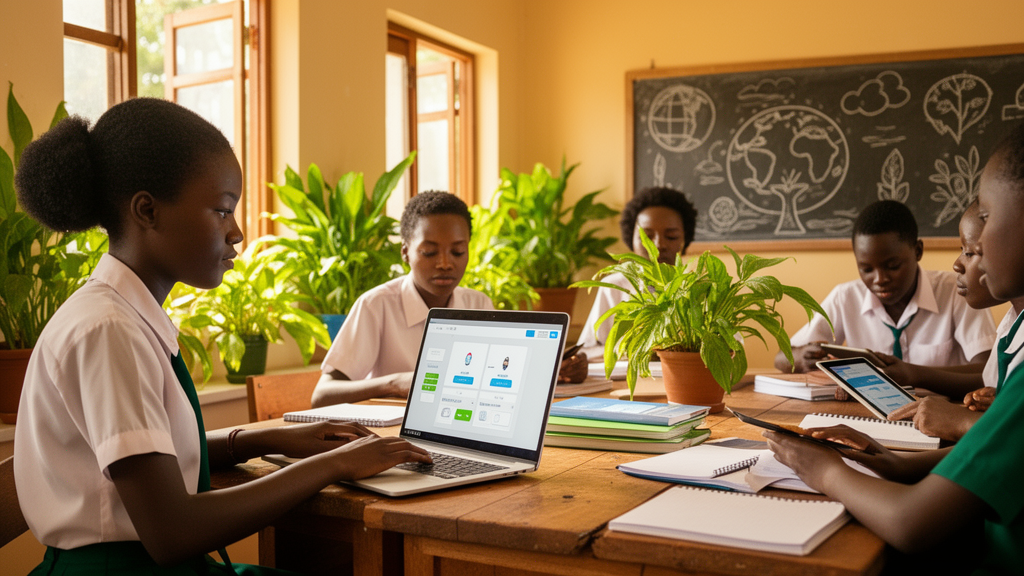
In a classroom in southwestern Uganda, a group of working primary school teachers is learning about climate change, biodiversity loss and pollution not from a printed handout crammed into a weekend session, but from a free website they can open on their phones at any hour. The website, called the EnviroEd Learning Hub, was built entirely on Google Sites, a tool that requires no programming skills and costs nothing to host. A new study published in Discover Education reports that this deliberately low-cost platform significantly improved how 52 in-service teacher trainees engaged with environmental education, offering a striking counterpoint to the assumption that meaningful digital learning requires expensive infrastructure or sophisticated software.
The research team, led by Nicodemus Epaphras of the Aga Khan University Institute for Educational Development in Dar es Salaam, together with Esther Kibga and Jane Rarieya, chose a methodology known as Design-Based Research, or DBR. Rather than evaluating a finished product, DBR builds an intervention in cycles: design, implement, analyse, refine, and repeat. The researchers moved through four phases between March and April 2025, beginning with a needs assessment of the trainees’ digital readiness, then building a prototype, testing it for two weeks, and finally refining it based on surveys, interviews, focus group discussions and Google Analytics data collected at every stage.
The context matters enormously. Uganda’s Diploma in Education Primary programme serves practising teachers who attend face-to-face classes only on weekends and during school holidays, a model that keeps them employed but slashes contact time with instructors. Environmental education is part of the curriculum, yet it has long been delivered through lectures and printed materials, leaving little room for the inquiry, collaboration and experiential learning that UNESCO’s Education for Sustainable Development roadmap demands. The study’s needs assessment confirmed the scale of the challenge: half of the students had never used an online learning platform before, and some initially confused Google Classroom with the Google search engine itself.
The technical constraints were equally revealing. Every single respondent said they would access the platform primarily through a smartphone, a finding later confirmed by Google Analytics. Internet access was moderate for 64 percent of students and limited for 8 percent, while data costs loomed as a persistent worry. Anticipating these barriers, the design team made deliberate choices: media files were compressed, most content was offered in downloadable PDF and Word formats, and a QR code was printed and posted on class noticeboards so students could reach the site without typing long web addresses.
The prototype itself was a study in pragmatic design. Its homepage opened with a tutorial video showing how to navigate the site, followed by clear navigation buttons. Content pages covered each topic of the environmental education module, enriched with embedded videos and images curated to explain concepts that are notoriously hard to convey in text alone, such as pollution dynamics and human-environment interactions. Interactive Kahoot quizzes allowed self-assessment, a chatbot on every page offered individualised support, and a WhatsApp group link connected learners to peers and facilitators.
The numbers from the two-week prototype test told a promising story. Google Analytics recorded 33 active users with an average engagement time of just under five minutes, and the page on pollution held attention longest. In the second survey round, ease of locating information scored a mean of 4.48 out of 5, platform speed and stability 4.38, and perceived effectiveness for learning environmental education 4.56. The lowest-rated item, at a mean of just 2.06, was consistency of internet access, an external infrastructural problem no amount of interface design could fix.
Feedback from that round drove a substantial redesign. The team added more instructional videos, integrated quizzes through Kahoot and Google Forms, published weekly schedules on an announcement banner, simplified menu labels, and added Next and Previous buttons for linear navigation. The discussion forum was rebuilt, media files were compressed further, and local case studies were woven into the content, including wetland enforcement actions by Uganda’s environment authority, deforestation cases, and pollution of the River Rwizi. One teacher educator was trained in content editing and site management, embedding sustainability into the platform itself.
The final evaluation showed the refinement had worked. Average engagement time per active user nearly doubled to 8 minutes and 49 seconds, with peak usage occurring on weekends when students were off duty. Multimedia resources were the most valued feature, preferred by 76 percent of respondents, and 88 percent agreed that videos and images enhanced their understanding of environmental concepts. Navigation was rated easy or very easy by 86 percent, and overall satisfaction reached a mean of 4.38 out of 5. Students described the platform as a mobile library, praising the fact that they did not need to be online at a specific time, unlike video-conference teaching, and many reported growing confidence in applying environmental concepts in their own classrooms.
Theoretically, the study is notable for pairing two frameworks rarely combined in a single intervention. The Technology Acceptance Model, which explains adoption through perceived usefulness and perceived ease of use, guided the interface decisions: simplified navigation, tutorials and scaffolding for users with uneven digital confidence. Social Constructivist Theory, rooted in Vygotsky’s idea that knowledge is built through dialogue and mediated tools, informed the pedagogical layer: discussion forums, comment-enabled lessons, sequenced modules and facilitator feedback designed to move learners through their zone of proximal development. The authors argue the two proved mutually reinforcing, since usable design created the conditions under which collaborative features could actually be taken up.
The researchers are candid about limits. The study measured perceptions, engagement and analytics, not learning gains, since no pre- and post-intervention assessments were administered, and they call for quasi-experimental follow-ups to test effects on knowledge, environmental literacy and teaching practice. Collaborative learning also remained only partially realised, constrained by slow connections that hampered real-time interaction. Yet the central message stands out for its practicality: in resource-constrained teacher education systems across Sub-Saharan Africa, a free, contextually tuned website, designed iteratively with the very teachers it serves, can extend scarce contact hours, sustain engagement and build professional confidence. The barriers that remain, data costs, unreliable power and patchy connectivity, are structural rather than technical, and they demand policy investment rather than better software alone.
Subject of Research: A design-based research study developing and evaluating a Google Sites-based learning platform for environmental education in Ugandan primary teacher training.
Article Title: Designing a contextual google site-based learning platform for environmental education in Ugandan teacher training: a design-based research study
Article References: Epaphras, N., Kibga, E., & Rarieya, J. (2026). Designing a contextual google site-based learning platform for environmental education in Ugandan teacher training: a design-based research study. Discover Education, 5(1), Article 1161. https://doi.org/10.1007/s44217-026-02291-2
Image Credits: AI Generated
DOI: 10.1007/s44217-026-02291-2
Keywords: environmental education, Google Sites, teacher training, Uganda, design-based research, educational technology, e-learning, Technology Acceptance Model, social constructivism, multimedia learning, digital divide, sub-Saharan Africa
Cite Scienmag News
Courtney Benton. (October 15, 2026). Free Google Sites Platform Boosts Environmental Learning for Ugandan Trainee Teachers. Scienmag. https://scienmag.com/free-google-sites-platform-boosts-environmental-learning-for-ugandan-trainee-teachers/
Courtney Benton. "Free Google Sites Platform Boosts Environmental Learning for Ugandan Trainee Teachers." Scienmag, 15 October 2026, https://scienmag.com/free-google-sites-platform-boosts-environmental-learning-for-ugandan-trainee-teachers/. Accessed 15 October 2026.
Courtney Benton. "Free Google Sites Platform Boosts Environmental Learning for Ugandan Trainee Teachers." Scienmag. October 15, 2026. https://scienmag.com/free-google-sites-platform-boosts-environmental-learning-for-ugandan-trainee-teachers/


