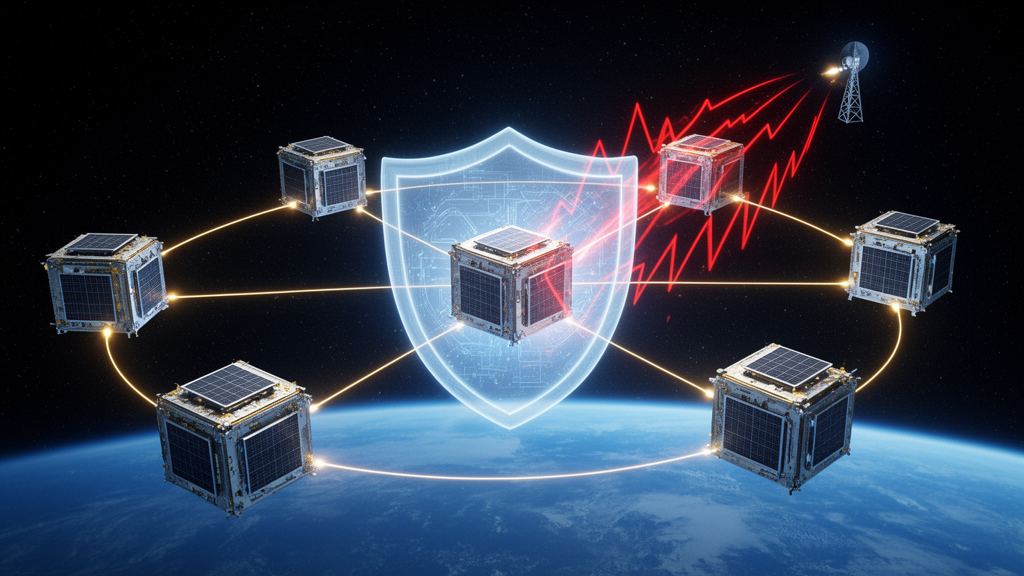
The satellites and high-altitude platforms that promise to weave 5G coverage across oceans, deserts, polar regions and disaster zones share an uncomfortable secret: they are extraordinarily difficult to secure. Unlike a cellular tower bolted to the ground, a node in a non-terrestrial network sweeps across the sky at kilometres per second, hands connections between beams and gateways in mid-flight, and endures signal delays that make the rapid back-and-forth of conventional authentication a genuine engineering burden. A new study published in Scientific Reports by N. Sankeerthana and M. Dakshayini of B.M.S. College of Engineering in Bengaluru argues that these conditions demand a fundamentally different security philosophy, and the researchers have built a proof-of-concept system to demonstrate it. Their framework, described as an adaptive behavioural zero-trust security framework, continuously re-evaluates whether each node in the network deserves to keep talking, and it does so with latencies and overheads low enough to be theoretically compatible with the punishing constraints of orbital communications.
The starting point for the work is the recognition that perimeter defences, the traditional castle-and-moat model of network security, map poorly onto non-terrestrial networks. In a conventional terrestrial 5G deployment, a device authenticates once at the edge of the network and is then largely trusted as it moves between base stations. In a satellite constellation, however, the topology is in constant flux. Links form and dissolve as spacecraft pass over ground stations, handovers occur far more frequently, and the round-trip delays introduced by distances of hundreds or thousands of kilometres stretch authentication exchanges to the point where they can disrupt live sessions. Static authentication, the authors argue, leaves windows of vulnerability during which a compromised or spoofed node can operate freely. Their answer is to borrow the zero-trust principle, in which no node is trusted by default and every access request must be continuously justified, and adapt it to the physics of space-based networking.
At the heart of the proposed framework sits a machine learning engine that judges trustworthiness from behaviour rather than credentials alone. The researchers feed network signal information into an isolation forest algorithm, an unsupervised anomaly detection method that works by randomly partitioning data and measuring how easily each observation can be isolated from the rest. Anomalies, by their nature, are isolated in fewer random splits than normal observations, which makes the technique computationally light and well suited to streaming telemetry. The team evaluated the engine on 50,000 simulated non-terrestrial network telemetry samples, deliberately keeping a 4-to-1 class imbalance so that anomalous behaviour remained a minority signal, mirroring real-world conditions where attacks are rare events. Under those conditions the detector achieved 88.00 percent accuracy, an average precision of 0.9856 and a receiver operating characteristic area under the curve of 0.9969, figures that indicate the model separates normal from suspicious behaviour with high fidelity despite the skewed data.
Perhaps the most striking result concerns spoofing, one of the most dangerous attack classes for satellite systems because an adversary who convincingly impersonates a legitimate node can intercept or redirect traffic across an entire constellation. Within the simulated environment, the framework detected live spoofing attempts with 100 percent success and achieved an attack recall of 1.0000 with zero false negatives, meaning no attack in the evaluation set slipped past undetected. The researchers attribute this performance to the specific features that their importance analysis identified as the dominant drivers of the zero-trust score. Rather than relying on abstract traffic statistics, the model leans on physics-based kinematic metrics: velocity deviation, GPS distance and Doppler shift. These are quantities that an attacker cannot easily fake, because they are dictated by orbital mechanics. A node claiming to be a particular satellite must move as that satellite moves, and any mismatch between claimed and observed kinematics becomes a powerful telltale of impersonation.
Continuous authentication, however, creates its own problem. If every handover and every access request triggers a fresh cryptographic challenge, the signalling load and the latency of re-authentication can balloon, defeating the purpose of a fast, responsive network. Traditional handover authentication in such systems can peak at around 1600 milliseconds, an eternity for sessions that must survive rapid satellite transitions. The second pillar of the new framework is a proactive cryptographic caching mechanism that anticipates re-authentication needs and pre-stages the necessary cryptographic material before it is requested. Under warm-cache, rule-based conditions, this mechanism reduced re-authentication latency to 7.2 milliseconds while preserving 99.5 percent session continuity, a reduction of more than two orders of magnitude compared with the traditional handover peaks. In practical terms, a connection could survive a satellite handover without the user or application ever noticing an authentication pause.
When the researchers subsequently integrated the machine learning engine with the caching system, the combined framework exhibited a signalling overhead of just 0.75 percent, well below the 8 percent target the authors set as an upper bound for practical deployability. That figure matters because security mechanisms in resource-constrained networks often fail not on detection accuracy but on cost: every extra message exchanged for authentication consumes bandwidth, power and processing time that the network’s primary mission requires. A security layer that adds less than one percent signalling overhead, while continuously scoring every node, represents the kind of efficiency profile that could plausibly be carried by satellite payloads and ground segments without degrading service. The framework’s policy decision point engine completes the loop, translating anomaly scores into access control decisions instantly, so that a node whose behavioural score degrades can be demoted, quarantined or disconnected without waiting for a human operator.
The architectural logic deserves closer attention because it illustrates how zero trust can be operationalised in an environment where the network perimeter is, quite literally, in orbit. In the proposed design, telemetry from network signals flows continuously into the anomaly detection engine, which produces a score for each node. That score is not a binary verdict but a graded measure of trustworthiness, and the policy decision point maps it onto access control actions in real time. A node exhibiting slight kinematic drift might be flagged for heightened monitoring, while one showing a gross Doppler inconsistency with its claimed orbit could be cut off mid-session. This graduated response is what makes the system adaptive: the level of scrutiny and the restrictiveness of access scale with the assessed risk, rather than applying a single static rule to all nodes at all times. It is a security posture that assumes compromise is possible at any moment and designs the network to contain it quickly.
The authors are careful to frame their results as a proof of concept rather than a fielded system. All 50,000 telemetry samples were generated in a simulated environment, and the headline latency and continuity figures for the caching mechanism were evaluated under warm-cache, rule-based conditions before the machine learning engine was integrated. Real constellations will present messier data, adversarial pressure that actively tries to game the anomaly detector, and hardware constraints that simulation can only approximate. The researchers position the work as demonstrating that adaptive, low-overhead security integrations are theoretically viable under orbital constraints, paving the way for future physical validation and for extension into next-generation 6G networks, where the integration of terrestrial and non-terrestrial segments is expected to deepen further and the attack surface will grow accordingly.
Even so, the study arrives at a moment when the security of space-based communications has become a matter of urgent public and strategic concern. Commercial constellations now carry broadband traffic to millions of subscribers, militaries depend on satellite links for command and control, and emergency responders increasingly rely on non-terrestrial coverage when terrestrial infrastructure fails. Spoofing and impersonation attacks against such systems could have consequences far beyond a dropped video call, and the industry has been searching for authentication models that do not collapse under the latency and mobility constraints of orbit. The Bengaluru team’s finding that orbital mechanics themselves, expressed through velocity deviation, GPS distance and Doppler shift, can serve as the strongest signals of trustworthiness is an elegant inversion: the very physics that makes satellite networking hard also furnishes an attacker with an unfakeable fingerprint. If subsequent physical trials bear out the simulation results, continuous behavioural authentication could become a standard layer in the security stack of the satellite networks that increasingly hold the connected world together.
Subject of Research: An adaptive behavioural zero-trust security framework with proactive cryptographic caching for continuous authentication in 5G non-terrestrial networks
Article Title: An adaptive behavioural zero-trust security framework with proactive cryptographic caching for continuous authentication in 5G non-terrestrial networks
Article References: Sankeerthana, N., & Dakshayini, M. (2026). An adaptive behavioural zero-trust security framework with proactive cryptographic caching for continuous authentication in 5G non-terrestrial networks. Scientific Reports. https://doi.org/10.1038/s41598-026-73550-3
Image Credits: AI Generated
DOI: 10.1038/s41598-026-73550-3
Keywords: adaptive, behavioural, zero-trust, security, framework, proactive, cryptographic, caching, continuous, authentication, non-terrestrial, networks
Cite Scienmag News
Hailey Crawford. (October 15, 2026). Zero-Trust AI Framework Could Keep Satellite Networks Safe From Spoofing Attacks. Scienmag. https://scienmag.com/zero-trust-ai-framework-could-keep-satellite-networks-safe-from-spoofing-attacks/
Hailey Crawford. "Zero-Trust AI Framework Could Keep Satellite Networks Safe From Spoofing Attacks." Scienmag, 15 October 2026, https://scienmag.com/zero-trust-ai-framework-could-keep-satellite-networks-safe-from-spoofing-attacks/. Accessed 15 October 2026.
Hailey Crawford. "Zero-Trust AI Framework Could Keep Satellite Networks Safe From Spoofing Attacks." Scienmag. October 15, 2026. https://scienmag.com/zero-trust-ai-framework-could-keep-satellite-networks-safe-from-spoofing-attacks/