


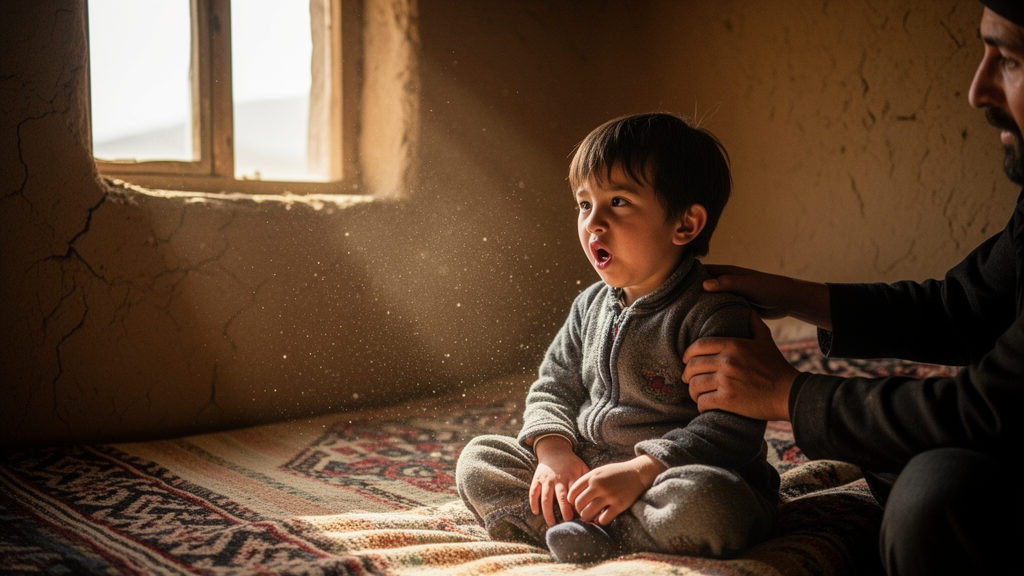
In the far western city of Kashgar, where the Taklamakan’s dust can swallow the sky in a matter of hours, a year-long study has documented how asthma quietly reshapes the childhoods of Uyghur families. The research, published in the International Journal for Equity in Health, followed fifteen Uyghur children aged six to twelve with physician-diagnosed asthma, together with their mothers, through clinics, homes and schools. Its central finding is stark: the physical activity these children lose is not the product of poor parenting or individual choices, but of structural, cultural and environmental forces that converge inside a single household.
The study, led by SuBiNuEr ShaYiTi of Kashgar Prefecture Second People’s Hospital together with Shanshan Wang and colleagues at Shanghai Jiao Tong University, took the form of a longitudinal critical ethnography. Rather than surveying families at a single point in time, the researchers embedded themselves in the everyday rhythms of clinical visits, family life and schooling across a full year. They combined participant observation, in-depth interviews and medical record review, then analyzed the material using a taxonomic method within an explicitly intersectional framework, tracing how social positions and structural conditions combined within the same child-caregiver dyad.
That methodological choice matters. Most existing accounts of pediatric asthma management focus on individual knowledge, attitudes and self-efficacy, the psychological levers clinicians typically try to adjust. But those frameworks, the authors argue, cannot explain how structural, cultural and environmental conditions become mutually constitutive rather than merely additive for one child. A family facing an understaffed clinic, a school without physical education, gendered expectations and seasonal sandstorms is not dealing with four separate problems; the researchers found these forces interlock, each amplifying the others in ways that single-level interventions cannot untangle.
The first of these forces is institutional. Kashgar’s rural healthcare and education system, the study found, is overstretched in ways that fragment clinical guidance and displace physical education. Children with asthma received inconsistent advice across encounters, leaving caregivers uncertain about whether exercise would strengthen their child’s lungs or trigger a dangerous attack. In schools, the marginalization of physical education removed one of the few structured settings where a child with a chronic respiratory condition could be safely active under supervision. The result was a systematic narrowing of opportunities for movement, driven not by any individual actor’s intent but by the sheer scarcity of resources distributed across the system.
Cultural forces operated on a different register but pointed in the same direction. Gender norms and asthma-related stigma intensified restrictions on activity, particularly for girls, through expectations of gentleness and protective caution. The study’s title captures the other side of that coin: a mother’s description of her son as a boy who must shoulder great responsibilities, a framing that positioned physical vigor as duty for boys while casting caution as virtue for girls. Asthma carried a social weight of its own, and families responded by wrapping affected children in layers of protection that, however loving, further constricted the spaces in which they could run, play and exert themselves.
Then there is the environment itself. Kashgar’s seasonal sandstorms are not a metaphorical hazard but a recurring respiratory event, and the study documents how they transformed children’s already limited spaces for movement into genuine risks. The material conditions of homes and livelihoods compounded the problem: housing quality, dust exposure and the demands of family work all shaped when, where and whether a child with asthma could safely be active. For a condition in which exercise is medically beneficial when properly managed, an environment that punishes exertion creates a cruel paradox, in which the very activity that could improve lung function is the activity most likely to provoke an attack.
The intersectional analysis reveals why this compounding is so difficult to reverse. A girl with asthma in a resource-poor school district faces a disadvantage that is not simply the sum of her gender, her diagnosis and her geography. The researchers found that these co-occurring conditions produced compounded disadvantage within individual families, meaning that addressing any one factor in isolation leaves the others intact. A culturally sensitive clinic visit, for example, cannot restore physical education that a school cannot staff, and a well-equipped school cannot clear the air of a sandstorm. The study’s conclusion is explicit: restricted physical activity among these children is produced through multi-level inequities embedded in social, institutional and environmental contexts, not individual behavior or family failure.
Yet the ethnography is not a story of pure deprivation. Across the fifteen dyads, families sustained culturally embedded resources that could anchor better interventions. Dance, pastoral play and communal activities remain living practices in these communities, forms of movement that are meaningful, joyful and socially reinforced rather than prescribed. The authors point to these as foundations for culturally responsive interventions, arguing that health equity work should recognize the cultural strengths communities already possess rather than importing generic exercise programs that carry no local resonance.
The policy implications the researchers draw are correspondingly structural. They call for culturally responsive clinical guidance that gives families consistent, actionable advice about exercise and asthma, an equitable distribution of educational and environmental resources so that rural schools and clinics are not left behind, and a broader recognition that the burden these families carry is systemic. Framed this way, the measure of success is not whether an individual mother learns to manage her child’s inhaler more confidently, but whether the institutions and environments surrounding that family change enough to make safe activity possible in the first place.
The study’s reach extends beyond Kashgar. The authors suggest their findings may offer transferable conceptual insights for minority and Indigenous communities elsewhere who navigate chronic illness amid structural disadvantage, even as they caution that the specific mechanisms documented here are rooted in Kashgar’s particular ethnic and ecological context. For researchers and clinicians working at the intersection of chronic disease and health equity, the message is a demanding one: to understand why a child with asthma stops moving, one must look past the child entirely, to the clinic that cannot advise, the school that cannot teach, the culture that cannot permit, and the sky that sometimes fills with sand. The research was approved by the Research Ethics Committee of Public Health and Nursing at Shanghai Jiao Tong University School of Medicine, with written informed consent from all parents or guardians and assent from the children, and the authors declare no competing interests.
Subject of Research: Structural, cultural and environmental inequities limiting physical activity among Uyghur children with asthma in Kashgar, China
Article Title: “He’s a boy who must shoulder great responsibilities”: structural, cultural and environmental inequities shaping physical activity among Uyghur children with asthma in China
Article References: “He’s a boy who must shoulder great responsibilities”: structural, cultural and environmental inequities shaping physical activity among Uyghur children with asthma in China. (n.d.). https://doi.org/10.1186/s12939-026-03058-9
Image Credits: AI Generated
DOI: 10.1186/s12939-026-03058-9
Keywords: asthma, Uyghur children, health equity, physical activity, critical ethnography, China, gender norms, environmental exposure, sandstorms, minority health, pediatric chronic illness, Kashgar
Cite Scienmag News
Harold Sullivan. (October 14, 2026). Asthma, Dust and Duty: How Inequity Keeps Uyghur Children From Moving. Scienmag. https://scienmag.com/asthma-dust-and-duty-how-inequity-keeps-uyghur-children-from-moving/
Harold Sullivan. "Asthma, Dust and Duty: How Inequity Keeps Uyghur Children From Moving." Scienmag, 14 October 2026, https://scienmag.com/asthma-dust-and-duty-how-inequity-keeps-uyghur-children-from-moving/. Accessed 14 October 2026.
Harold Sullivan. "Asthma, Dust and Duty: How Inequity Keeps Uyghur Children From Moving." Scienmag. October 14, 2026. https://scienmag.com/asthma-dust-and-duty-how-inequity-keeps-uyghur-children-from-moving/


