


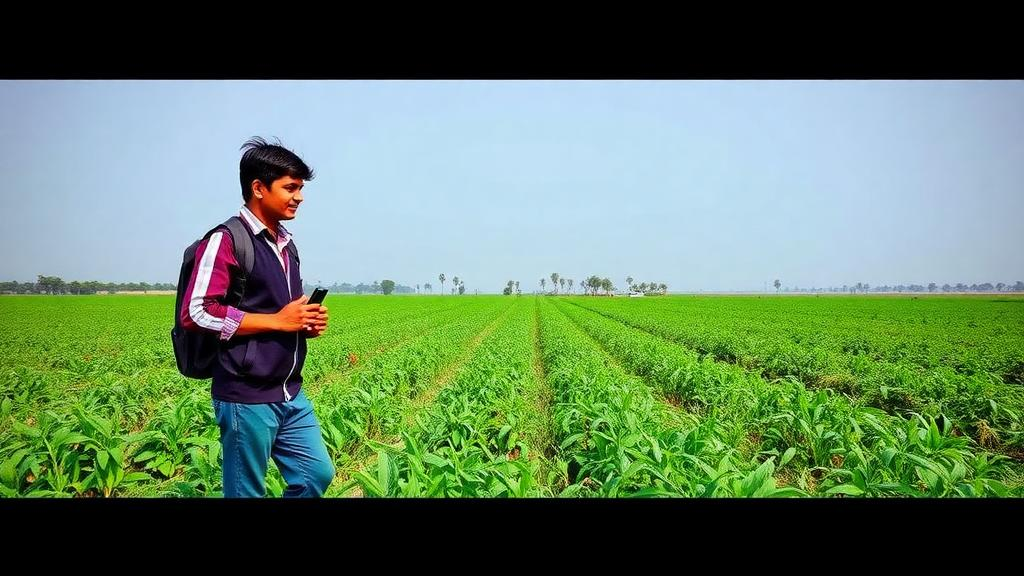
India’s agricultural sector is worth an estimated $554 billion, the second largest in the world, and it is modernizing fast with digital tools, climate-smart practices, and a wave of agri-tech startups. Yet the people expected to run this transformation—young, trained agricultural graduates—are increasingly walking away from the fields. A new study published in Discover Education offers one of the most detailed psychological portraits yet of why. Surveying 285 agriculture students at two Indian universities, researchers led by Chandrmauli Chaurasiya of Vellore Institute of Technology found that the single most desired career was not farming, not agribusiness, and not research, but the humble government job. Of the 285 respondents, 173 picked government employment as their first choice, while only 21 chose agripreneurship, the least popular option of the five pathways studied.
The research team applied the Theory of Planned Behavior, a widely used psychological framework that explains intentions through three forces: attitude, the personal evaluation of a behavior; subjective norms, the perceived approval of family, peers, and society; and perceived behavioral control, the sense of having the resources and ability to act. They added a fourth construct, self-efficacy, borrowed from Bandura’s Social Cognitive Theory. What makes the study unusual is that instead of treating agricultural career intention as a single yes-or-no outcome, the researchers split it into five distinct destinations—government jobs, researcher or professor positions, farming, agripreneurship, and civil services—and modeled the odds of each against government employment using multinomial logistic regression in STATA 17.
The sample was drawn purposively from Deen Dayal Upadhyaya Gorakhpur University in Uttar Pradesh and VIT University in Tamil Nadu, institutions chosen because they sit in semi-urban regions where traditional and modern agriculture coexist and because they represent northern and southern India’s different agro-climatic and cultural zones. Respondents answered a structured questionnaire distributed through Google Forms. The team pre-tested the instrument, confirmed internal consistency with Cronbach’s alpha values all above the 0.70 threshold—attitude scored 0.960 and self-efficacy 0.962—and validated the constructs through expert review and factor analysis. A post-hoc power analysis in G*Power 3.1 returned a value of 0.999, far above the conventional 0.80 benchmark, indicating the study had excellent statistical sensitivity despite its modest sample.
The descriptive statistics alone tell a striking story. More than 80 percent of the students came from farming families, and 198 of the 285 were from rural areas, meaning most respondents had grown up with agriculture literally at their doorstep. Biology was the dominant academic background at the higher secondary level, with 169 students, and most had studied in English medium. Yet even among this cohort—arguably the most agriculture-embedded group of young people in the country—the gravitational pull of secure public employment dominated every demographic slice. Government jobs were the top choice for both men and women, across both universities, and regardless of whether students came from farming households.
The regression results revealed which psychological levers actually move career intentions. Attitude toward agriculture emerged as a strong, significant predictor of choosing a research or academic career over a government job, with a coefficient of 1.25 (p = 0.005). Subjective norms were similarly powerful (1.04, p = 0.009), suggesting that encouragement and perceived prestige from teachers, family, and peers are critical for steering students toward laboratories and lecture halls. This aligns closely with what the Theory of Planned Behavior predicts: positive personal evaluations and social validation strengthen intention, particularly for long-horizon paths like research that demand sustained commitment.
But the study also uncovered a genuine paradox. Self-efficacy—the confidence students have in their own abilities—was a significant negative predictor of research careers (-0.93, p = 0.032) and a marginal negative predictor for both civil services and agripreneurship. In other words, the most self-assured students were the ones least likely to pick these paths relative to government employment. The authors interpret this counterintuitively: highly confident students may prefer careers with clear recruitment mechanisms, faster returns, and greater certainty, viewing research and entrepreneurship as prolonged, uncertain gambles. Self-efficacy, it turns out, does not uniformly push people toward ambitious options; it interacts with how students weigh risk against reward.
Language proficiency produced one of the study’s most practical findings. Students with stronger language skills were significantly more likely to choose agripreneurship over government jobs (1.29, p = 0.039) and showed a marginal positive tendency toward farming (0.93, p = 0.057). Communication ability, the researchers argue, functions as a form of human capital in modern agriculture, easing networking, marketing, input negotiation, and engagement with digital and global agri-networks. Meanwhile, the constants for farming (-4.48, p = 0.001) and agripreneurship (-4.59, p = 0.006) were strongly negative, indicating that structural deterrents—income instability, physical labor intensity, financial risk, limited access to capital, and lower social prestige—overwhelm individual attributes. Even students inclined toward these paths are being held back by forces no single personality trait can overcome.
Demographics mattered too, though in patterned ways. Female students leaned toward research and civil services, while male students showed a marginal preference for farming, echoing persistent gender norms and traditional roles around land ownership and family expectations. Institutional affiliation shaped preferences as well: students at DDU Gorakhpur University, a public university with many rural students, showed stronger interest in government jobs, farming, and civil services, whereas VIT students, embedded in a more urban, tech-oriented environment, were comparatively less drawn to these options. The authors caution, however, that university affiliation lost statistical significance once psychological factors were accounted for, suggesting the institutional effect operates largely through the attitudes and norms students bring with them.
Perhaps the most theoretically interesting contradiction is that attitudes and subjective norms, which so strongly reinforced government job preferences, did not extend to agripreneurship despite years of policy advocacy for agri-startups under initiatives like RKVY-RAFTAAR and the National Education Policy 2020. Social approval, the study suggests, is context-dependent: government employment is perceived as secure and socially endorsed, while entrepreneurship is still coded as risky and uncertain. The gap between policy push and student perception persists because mentorship, market access, and risk-sharing mechanisms remain insufficient to shift the underlying norms.
The authors close with concrete recommendations: targeted career awareness programs exposing students to the full spectrum of agricultural opportunities, curriculum reforms that showcase real-world success stories and hands-on training in tech-driven ventures, and structured land-leasing schemes that give landless but educated young people temporary, renewable access to cultivable land, supported by input subsidies and digital tools. The broader message is that India’s agricultural future will not be secured by exhortation alone. If the sector wants its best and brightest, it must change what a career in agriculture is perceived to be—not a fallback of last resort, but a path with genuine security, prestige, and reward.
Subject of Research: Psychological and socio-demographic drivers of agricultural career intentions among Indian university students using the Theory of Planned Behavior
Article Title: Cultivating agricultural career intentions through behavioral drivers among students
Article References: Chaurasiya, C., Priya, A. P., Mansingh, J. P., Ihou, A. F. Y., & Mathew, M. (2026). Cultivating agricultural career intentions through behavioral drivers among students. Discover Education, 5(1), Article 1168. https://doi.org/10.1007/s44217-026-02286-z
Image Credits: AI Generated
DOI: 10.1007/s44217-026-02286-z
Keywords: agricultural careers, Theory of Planned Behavior, career intentions, agripreneurship, government jobs, self-efficacy, subjective norms, India, agricultural education, multinomial logistic regression, youth in agriculture, career counseling
Cite Scienmag News
Alan Morgan. (October 14, 2026). Why Indian Agriculture Students Still Crave the Security of a Government Job. Scienmag. https://scienmag.com/why-indian-agriculture-students-still-crave-the-security-of-a-government-job/
Alan Morgan. "Why Indian Agriculture Students Still Crave the Security of a Government Job." Scienmag, 14 October 2026, https://scienmag.com/why-indian-agriculture-students-still-crave-the-security-of-a-government-job/. Accessed 14 October 2026.
Alan Morgan. "Why Indian Agriculture Students Still Crave the Security of a Government Job." Scienmag. October 14, 2026. https://scienmag.com/why-indian-agriculture-students-still-crave-the-security-of-a-government-job/


