


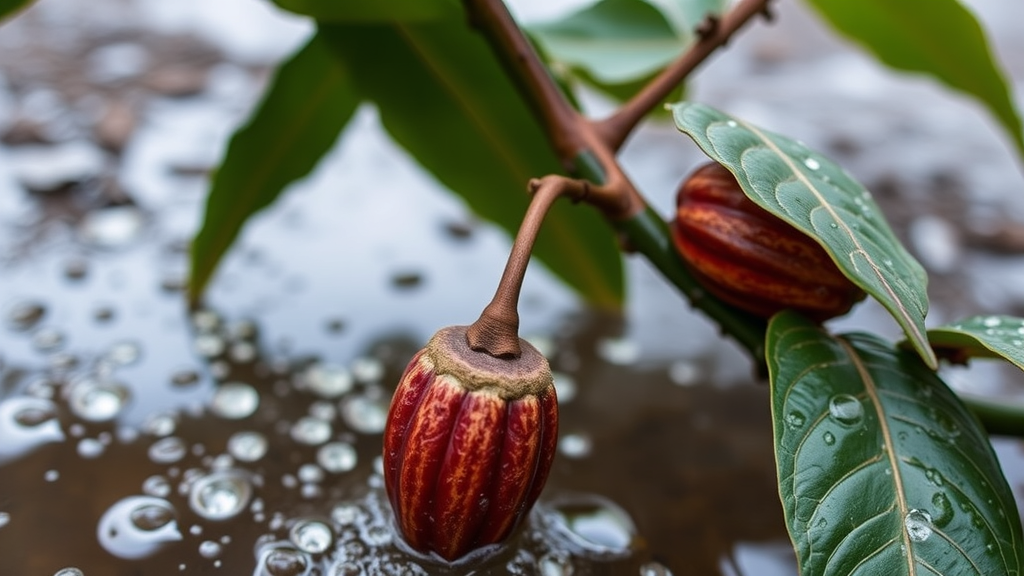
For generations, the conversation about climate change and chocolate has centered on one word: drought. Rising temperatures and shrinking rainfall across West Africa’s cocoa belt have dominated headlines, and with good reason, as farmers watch their trees wilt under increasingly hostile conditions. But new research from Harvard University and the University of Ghana reveals that the opposite extreme—too much rain—has been quietly devastating cocoa harvests, and that this threat may be far more predictable than scientists once assumed. The findings suggest that with better forecasts, farmers could protect both their livelihoods and one of the world’s most beloved foods before the damage is done.
Cocoa is an unforgiving crop. The trees live for decades, and a successful harvest depends on an intricate, months-long sequence of flowering, pollination, and pod development. Each stage has precise water requirements, and a misstep at any point can ripple through the entire growing season. Too little rain at the wrong moment stresses the trees; too much rain, arriving while the trees are flowering or as young pods begin to form, can flood root systems and—critically—create ideal conditions for fungal diseases that thrive in wet conditions. Anna Lea Albright, who led the research as a postdoctoral fellow at the Harvard University Center for the Environment, explains that while drought’s dangers are well established, the other extreme has been dangerously underappreciated. Heavy rain during flowering, or rain that encourages the spread of fungal infection during flowering and early pod development, turns out to matter just as much.
The quantitative case is striking. In Ghana, the world’s second-largest cocoa producer, the researchers found that excess rain during the wet season, combined with dry-season drought, explains roughly two-thirds of the year-to-year swings in the national cocoa harvest. That is a remarkable degree of explanatory power for a crop whose fortunes are typically attributed to a bewildering mix of agronomic, economic, and political factors. The study, published in the Proceedings of the National Academy of Sciences, relied on two decades of newly available district-level data from the Ghana Cocoa Board, the government agency that oversees the industry. Because production grew steadily over that period as more land came into cultivation, the team stripped out each district’s long-term trend to isolate the year-to-year fluctuations they wanted to understand.
With those swings in hand, the researchers subjected them to a battery of statistical tests against daily weather records. Average rainfall, heavy downpours, dry spells, soil moisture, and temperature extremes were all in the lineup of possible culprits. The verdict was clear: the best predictors of a bad cocoa year in Ghana were heavy rain during the main wet season and too little rain during the dry season. In other words, it is not simply how much water falls on a cocoa farm in a year, but when it falls and how violently it arrives. Short, intense bursts of rain—exactly the kind of events that average rainfall statistics smooth over—turn out to inflict disproportionate damage.
The timing of these destructive rains is no accident of geography. In Ghana, the most damaging downpours arrive during the April-to-June wet season, precisely when cocoa trees are flowering and young pods are beginning to form—the crop’s most vulnerable window. Later, during the November-to-February dry period, insufficient rain can hurt the crop as pods continue to develop. Because cocoa is especially vulnerable at certain stages of its growth cycle, adaptation cannot be a blunt instrument; it must be precise. Disease control efforts, for instance, can be timed around periods of heavy rain, but only if farmers receive forecasts with enough lead time to act—a capacity the research team is now working to develop.
To test whether Ghana was an anomaly, the researchers widened their lens to two other major producers on different continents: Ecuador and Indonesia. The pattern held. Years with heavier wet-season rains tended to be worse for cocoa in both countries, suggesting that the vulnerability is not a local quirk of West African agriculture but a fundamental feature of how the crop responds to water extremes across the tropics. This consistency across continents strengthens the case that rainfall extremes deserve a central place in climate-risk assessments for global cocoa, alongside the heat and drought concerns that have dominated the literature to date.
The predictability angle is where the research becomes genuinely actionable. The team emphasizes that the rains that hurt cocoa are tied to larger climate patterns, such as El Niño and shifts in Atlantic sea-surface temperatures. Because these drivers operate on seasonal timescales, some bad years may be predictable months before the damage is done—early enough to give farmers a meaningful warning. The stakes are illustrated by current conditions: a strong El Niño is developing, an event that typically favors heavy rainfall in coastal Ecuador and drier weather across West Africa and Indonesia. A functioning early-warning system could, in principle, tell farmers in each region which of these risks is elevated for the coming season.
The consequences of getting this wrong are already visible on grocery shelves. The volatility documented in the study echoes through global markets, where raw cocoa prices tripled in 2024, a spike attributed in part to climate-driven supply shocks. Chocolate manufacturers have responded with higher prices, smaller bars, and reformulated products, meaning the costs of unpredictable rainfall are being borne not only by farmers but by consumers worldwide. Senior author Peter Huybers, chair of Harvard’s Department of Earth and Planetary Sciences, hopes the findings will help reduce future crop damage, possibly by encouraging more canopy cover to shield cocoa flowers from large raindrops, or by retaining more leaf litter to prevent the splashes that transmit infection from soil to cocoa pods. These are inexpensive, locally implementable measures—but they work best when farmers know wet conditions are coming.
The study comes with important caveats that the researchers are careful to acknowledge. Rain is not the only problem Ghanaian cocoa farmers face. Aging trees, gold mining encroaching on farmland, smuggling, fertilizer costs, pests, and disease can all depress production, and none of these factors can be addressed by a weather forecast. There is also a technical limitation: rainfall data do not always capture the biggest downpours well, and those are precisely the events that matter most for crop damage. And looking further ahead, the picture grows murkier still. Climate change has the potential to substantially alter the timing and pattern of rainfall in cocoa-growing regions, yet current climate models struggle to effectively represent even the present-day climatology of rainfall over West Africa, let alone project how it will change in coming decades.
Even so, the study performs a valuable service by clarifying the nature of the climate threat to chocolate. Cocoa’s future is not simply a story about a hotter world. It is a story about when the rain falls, how hard it falls, and whether the people who grow the crop can anticipate those extremes with enough warning to adapt. For decades, climate science has taught farmers to fear the sun and the drought. This research shows that the rain itself—arriving too hard, too fast, at the wrong moment—may be the more immediate and more tractable danger. Turning seasonal climate patterns into practical warnings for millions of smallholder farmers is now the challenge, and one that could determine whether the world’s chocolate supply grows more secure or more precarious in the years ahead.
Subject of Research: How rainfall extremes drive cocoa yield losses across the tropics and could be predicted in advance
Article Title: Chocolate’s new climate threat: Too much rain
Article References: Chocolate’s new climate threat: Too much rain. (n.d.). Original publication
Image Credits: AI Generated
DOI: Not provided
Keywords: cocoa, chocolate, climate change, heavy rainfall, drought, West Africa, Ghana, El Niño, crop yields, fungal disease, seasonal forecasting, Harvard University
Cite Scienmag News
Alan Morgan. (September 14, 2026). Heavy Rains, Not Just Drought, Are Sinking Cocoa Harvests and Chocolate Supplies. Scienmag. https://scienmag.com/heavy-rains-not-just-drought-are-sinking-cocoa-harvests-and-chocolate-supplies/
Alan Morgan. "Heavy Rains, Not Just Drought, Are Sinking Cocoa Harvests and Chocolate Supplies." Scienmag, 14 September 2026, https://scienmag.com/heavy-rains-not-just-drought-are-sinking-cocoa-harvests-and-chocolate-supplies/. Accessed 5 October 2026.
Alan Morgan. "Heavy Rains, Not Just Drought, Are Sinking Cocoa Harvests and Chocolate Supplies." Scienmag. September 14, 2026. https://scienmag.com/heavy-rains-not-just-drought-are-sinking-cocoa-harvests-and-chocolate-supplies/


