


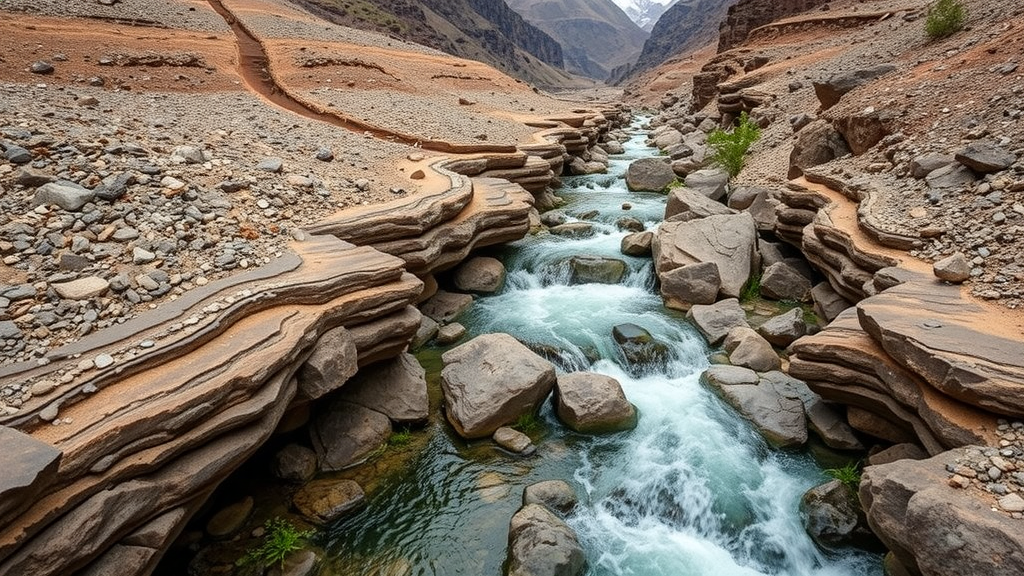
High in the Sierra Nevada of southeastern Spain, a network of irrigation channels built more than a thousand years ago is doing something unexpected: it is helping to keep river ecosystems alive. A new study published in Water Resources Management reveals that the deliberate inefficiency of these ancient ditches, known locally as acequias de careo, combined with natural groundwater upwelling, buffers the ecological damage caused by the heavy diversion of water from mountain headwater streams. The findings carry a provocative message for modern water policy, where the relentless pursuit of engineering efficiency may be quietly eroding biodiversity in some of the planet’s most vulnerable freshwater habitats.
Freshwater ecosystems rank among the most biodiverse and most threatened environments on Earth, and headwater streams sit at the top of the conservation agenda because of their outsized influence on the biodiversity, functioning, and connectivity of entire river networks. In Mediterranean mountains, where irrigated agriculture and climate change have extensively reshaped flow regimes, these small streams face mounting pressure. Sierra Nevada, a designated Biosphere Reserve and a recognized Mediterranean biodiversity super hotspot, offers a striking case study. There, careo ditches have been documented since the eighth to tenth centuries, diverting snowmelt from headwater reaches and distributing it across upper slopes to artificially recharge aquifers in weathered fractured rock, extending water availability for lowland farms and towns through the dry season.
A research team led by scientists from the University of Almeria, the Andalusian Centre for Global Change, and the Geological and Mining Institute of Spain examined five first- and second-order headwater streams on the southern face of the park, in the Alpujarra region, at altitudes between 1800 and 2000 meters. In each stream, a small, rudimentary weir built of loose rocks and gravel diverts water into a careo ditch. The researchers compared upstream reference reaches with downstream flow-impacted reaches, sampling benthic macroinvertebrates in spring during snowmelt and in autumn after the prolonged dry period, while continuously monitoring discharge and water temperature from November 2022 onward.
The magnitude of diversion was severe. Proportional flow reduction downstream of the weirs most frequently ranged from 76 to 98 percent of upstream discharge, with mean reductions exceeding 0.85 for much of the year in the Cáñar, Mecina, and Bérchules streams. In absolute terms, downstream flows often fell below 10 liters per second. Yet despite these extreme withdrawals, the impacted reaches never dried. They remained perennial throughout the year, maintaining the longitudinal hydrological connectivity that ecologists consider critical for stream life. The team attributes this persistence to two concurrent processes: seepage returning from the leaky weirs and unlined or poorly sealed ditches, and groundwater effluents from the region’s weathered hard-rock aquifers.
The groundwater signal was unmistakable in the temperature records. Downstream reaches showed significantly higher winter temperatures despite their lower discharge, along with lower summer maxima and reduced spring daily fluctuations, a thermal fingerprint of groundwater-fed baseflow. Water chemistry, by contrast, remained remarkably stable across reach types, with only slightly lower oxygen and higher salinity downstream, differences that were not statistically significant. Total dissolved nitrogen was actually higher upstream, suggesting stronger surface runoff influence at reference sites. This chemical stability matters, because it means that any ecological differences between reaches could be traced primarily to physical habitat alteration, such as reduced flow diversity and increased sedimentation, rather than to water quality degradation.
The biological consequences were nuanced. Macroinvertebrate density was substantially reduced downstream, particularly in spring, when it was roughly 50 percent lower than at upstream sites, a pattern consistent across all functional feeding groups and supported by medium effect sizes. The prolonged duration of the reduction, which persisted for at least a full year, contracted the wetted channel width by 63 to 85 percent, slashing total benthic abundance per reach length to about one-tenth of reference values. The authors warn that this decline in benthic production, together with reduced insect drift and emergence, likely creates severe food shortages for trout and riparian insectivorous predators that depend on aquatic insects crossing the land-water interface.
Surprisingly, local alpha diversity and interlocal beta diversity, measured as taxa richness, Shannon diversity, and community turnover, did not differ significantly between upstream and downstream reaches, and community composition showed no detectable separation in ordination analyses. The researchers propose that the maintenance of hydrological connectivity prevented the impacted reaches from degrading into isolated pools, a fate that typically traps invertebrates, intensifies predation, and triggers prey population collapse. Groundwater subsidies may also have mitigated local diversity losses, since moderate upwelling is known to enhance macroinvertebrate abundance and richness in alpine streams by moderating the harsh abiotic stress imposed by meltwater.
However, the buffering was incomplete, and the damage emerged at larger scales. Regional gamma diversity, estimated from rarefaction curves, was significantly lower in the sets of downstream reaches in both seasons, indicating that even small, non-significant losses of local richness can accumulate into substantial regional declines. Sensitive components of the community also eroded: the taxonomic richness of collector-gatherers dropped significantly in spring, and several biotic indices based on the pollution- and disturbance-sensitive insect orders Ephemeroptera, Plecoptera, and Trichoptera, the EPT taxa, declined significantly at impacted sites. Notably, the IBMWP index, the regulatory standard for Iberian river biomonitoring, classified both reach types as being of good quality and failed to distinguish them, suggesting that current monitoring frameworks may be blind to the early functional erosion caused by flow diversion unless they incorporate EPT-driven metrics.
The study’s most consequential implication concerns the global push toward irrigation efficiency. Modern water policy has favored concrete-lined canals and sealed infrastructure that minimize seepage, yet the Sierra Nevada findings suggest that these very inefficiencies, the leaky weirs and porous ditches of the traditional system, are essential to sustaining downstream flow and biodiversity, particularly in reaches that lack groundwater inflow. The authors invoke the well-documented irrigation efficiency paradox, in which saving water at the infrastructure scale can paradoxically intensify overall water consumption and ecological harm, and they argue that reversing the efficiency-first trend is urgent to halt river degradation in biodiversity-rich mountain regions.
Ultimately, the researchers argue that preserving as many stream reaches as possible under natural or ecologically compatible flow regimes is mandatory in biodiversity hotspots, because moderate local losses compound into regional extirpation. As climate change intensifies aridity across the Mediterranean and agricultural water demands climb, the centuries-old careo systems, increasingly framed as nature-based solutions for aquifer recharge, offer a rare example of human water infrastructure coexisting with, and even underwriting, freshwater conservation. The lesson from Sierra Nevada is that sometimes the most valuable feature of an irrigation system is not how efficiently it moves water, but how much it lets slip away.
Subject of Research: Ecological effects of traditional irrigation water diversion on benthic macroinvertebrate biodiversity in Sierra Nevada headwater streams
Article Title: Leakage from Traditional Irrigation Systems and Groundwater Upwelling Buffer the Impact of Heavy Streamflow Diversion on Benthic Biodiversity
Article References: Casas, J. J., Fenoy, E., Rubio-Ríos, J., Villegas, J., Salinas-Bonillo, M. J., Zakaluk, T., Martos-Rosillo, S., & Cabello, J. (2026). Leakage from Traditional Irrigation Systems and Groundwater Upwelling Buffer the Impact of Heavy Streamflow Diversion on Benthic Biodiversity. Water Resources Management, 40(11), Article 517. https://doi.org/10.1007/s11269-026-04861-3
Image Credits: AI Generated
DOI: 10.1007/s11269-026-04861-3
Keywords: benthic macroinvertebrates, headwater streams, irrigation ditches, groundwater upwelling, hydrological connectivity, water abstraction, Sierra Nevada, EPT taxa, biotic indices, environmental flows, Mediterranean mountains, biodiversity conservation
Cite Scienmag News
Margaret Porter. (September 14, 2026). Ancient Leaky Irrigation Channels Quietly Shield Mountain Stream Life From Severe Water Diversion. Scienmag. https://scienmag.com/ancient-leaky-irrigation-channels-quietly-shield-mountain-stream-life-from-severe-water-diversion/
Margaret Porter. "Ancient Leaky Irrigation Channels Quietly Shield Mountain Stream Life From Severe Water Diversion." Scienmag, 14 September 2026, https://scienmag.com/ancient-leaky-irrigation-channels-quietly-shield-mountain-stream-life-from-severe-water-diversion/. Accessed 4 October 2026.
Margaret Porter. "Ancient Leaky Irrigation Channels Quietly Shield Mountain Stream Life From Severe Water Diversion." Scienmag. September 14, 2026. https://scienmag.com/ancient-leaky-irrigation-channels-quietly-shield-mountain-stream-life-from-severe-water-diversion/


