


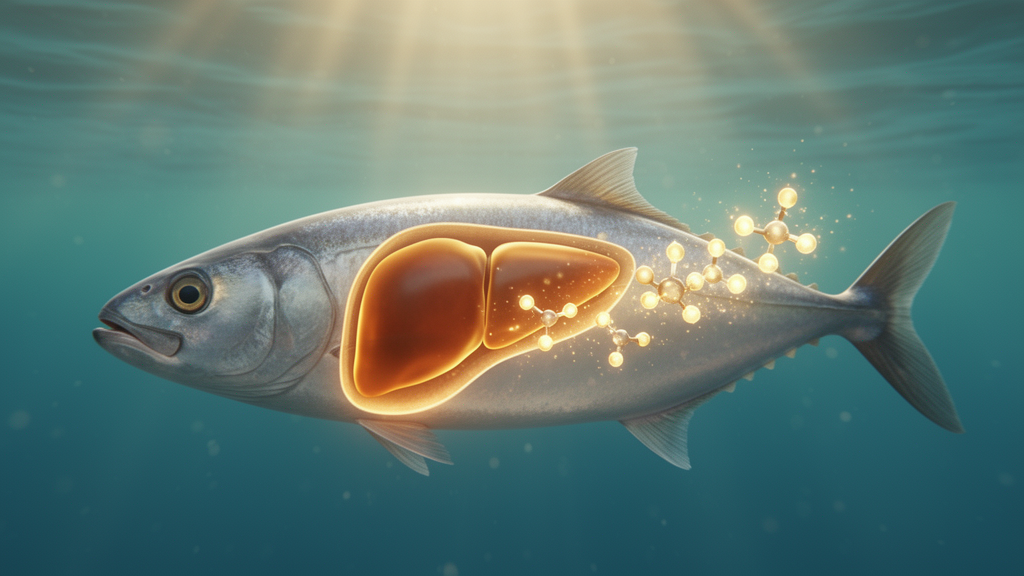
When seawater creeps toward 34 degrees Celsius, farmed golden pompano do not simply get uncomfortable — their livers begin a quiet, system-wide reorganization that scientists have now mapped in unusual detail. A new study published in Stress Biology followed juvenile Trachinotus ovatus, one of China’s most important marine aquaculture species, through seven days of sustained high-temperature exposure and documented a cascade of changes spanning tissue architecture, oxidative chemistry, iron handling, immune signaling, cell death pathways, and bile acid metabolism. The fish survived. Their livers, however, told a story of an organism pushed to the edge of its comfort zone and improvising furiously to stay functional.
The experimental setup was deliberately grounded in real-world conditions. Juvenile pompano, averaging about nine grams, were acclimated at 29 degrees Celsius before being randomly assigned to control tanks or heat-stress tanks, where the water was warmed by one degree per hour until it reached 34 degrees and held there for a week. That figure is not arbitrary: summer waters in southern China’s aquaculture regions now approach 34 degrees regularly, well above the species’ optimal growth range of roughly 22 to 28 degrees. Every fish in both groups survived the full seven days, but the heat-exposed animals drifted apart from their schooling cohesion and swam less spontaneously — early behavioral hints that something deeper was wrong.
Under the microscope, the damage was unmistakable. Control livers showed the tidy architecture expected of healthy teleost tissue: hepatocytes arranged in orderly cords around a central vein, sinusoids clear and well-formed. In the heat-stressed group, that order collapsed. Hepatocytes loosened and lost their distinct boundaries, cytoplasm filled with vacuoles, nuclei shrank, shifted position, or dissolved entirely, sinusoids ballooned outward, and inflammatory cells infiltrated the tissue. The authors interpret this as a significant sublethal challenge — hot enough to disrupt hepatic homeostasis, not yet hot enough to kill. That distinction matters, because it captures precisely the conditions commercial farms face each summer: fish that live, but at a physiological cost.
At the biochemical level, the heat triggered a full mobilization of antioxidant defenses. The Nrf2 pathway — the master switch for cellular redox protection — lit up, with elevated expression of Nrf2 itself along with its downstream targets heme oxygenase-1 and NQO1, and even its own regulator Keap1. Total antioxidant capacity and anti-superoxide activity rose in parallel. Perhaps counterintuitively, the classic markers of oxidative damage — lipid peroxidation products and malondialdehyde — actually fell, along with hydrogen peroxide. The team reads this not as an absence of stress but as an effective compensatory response: the antioxidant machinery ramped up fast enough to scavenge reactive oxygen species before they could shred membrane lipids. Yet the simultaneous drop in glutathione, glutathione peroxidase activity, and anti-hydroxyl radical capacity reveals that the system was running a deficit even while winning battles — redox homeostasis remained partially disrupted.
One of the study’s most technically interesting threads involves ferroptosis, the iron-dependent form of cell death driven by lipid peroxide accumulation. Heat exposure raised hepatic iron levels and increased expression of NCOA4, the gene that drives ferritin degradation and releases stored iron into the cell — a move that, on its own, would raise ferroptotic vulnerability. But the fish counterprogrammed. Ferritin heavy chain 1 and ferroportin 1, which sequester and export iron respectively, were upregulated alongside NFS1, which builds iron-sulfur clusters. The GPx4-mediated lipid peroxide detoxification axis strengthened too, with GPx4, the cystine transporter SLC7A11, and p53 all rising together. Although PTGS2, a canonical ferroptosis marker, was elevated, the actual lipid peroxidation products declined. The verdict: ferroptosis-related regulation was visibly rearranged, but the execution of ferroptosis itself was not evident — adaptation, not self-destruction.
The immune picture was less reassuring. Pro-inflammatory signaling surged, with interleukin-1β and tumor necrosis factor-α both upregulated. But the anti-inflammatory arm did not respond in a coordinated way: TGF-β rose while interleukin-10 fell, a divergent pattern the authors describe as dysregulated anti-inflammatory control. More worrying for farmers, IL-8 — which recruits immune cells to inflammatory sites — was downregulated, and so were the immunoglobulin genes IgM and IgT, the workhorses of systemic and mucosal antibody immunity in fish. In plain terms, the liver was inflamed but poorly defended: alarm bells ringing while the security guards were sent home. This aligns with field observations that heat-stressed pompano become more susceptible to bacterial and parasitic infections, and it offers a mechanistic explanation for why summer disease outbreaks track water temperature.
Apoptosis-related genes showed a similarly split profile. CHOP, the transcriptional sentinel of endoplasmic reticulum stress, was upregulated along with the executioner caspases 9 and 3, while cytochrome C expression fell. The pattern suggests heat pushed cells toward the apoptotic cascade transcriptionally, even as the mitochondrial release pathway behaved unexpectedly. The authors are careful here — these are coordinated transcriptional responses affecting apoptotic homeostasis, not proof of widespread cell death, and the divergence between genes hints that different apoptotic routes respond to thermal stress on different timetables.
The most novel contribution lies in bile acids. Using liquid chromatography–tandem mass spectrometry, the team quantified 14 of 39 targeted bile acid species and found that heat stress selectively shrank the pool of unconjugated, free bile acids, with cholic acid, chenodeoxycholic acid, and 7-ketolithocholic acid dropping significantly — three metabolites the authors flag as potential biomarkers of thermal stress. Meanwhile the genes governing bile acid handling responded in kind: FXR, the nuclear receptor that orchestrates bile acid homeostasis, rose alongside SULT1 and UGT8, enzymes that detoxify and eliminate hydrophobic bile acids. Because excess hydrophobic free bile acids can damage membranes and fuel oxidative injury, the researchers interpret the shrinkage as adaptive — a way of limiting bile acid cytotoxicity under heat. Intriguingly, FXR activation is known in other systems to suppress lipid peroxidation and ferroptosis, and here its upregulation coincided with rising GPx4 and falling lipid peroxide markers, suggesting bile acid remodeling and antioxidant defense may be two faces of the same stress program.
The study has limits the authors acknowledge candidly: sample sizes were adequate but modest, feeding and growth were not quantitatively tracked, and standard liver injury markers such as ALT and direct hepatic ROS measurements were not taken. Even so, the work lands at a practical moment. As marine heatwaves intensify in the South China Sea, heat stress is becoming a structural constraint on pompano farming rather than an occasional bad summer. By showing exactly which molecular levers a heat-stressed liver pulls — Nrf2-driven antioxidant mobilization, iron recalibration without ferroptosis, immune suppression, and a deliberate contraction of the free bile acid pool — the study points toward targeted interventions, most immediately bile acid-based functional feed additives that could support the FXR axis before temperatures climb. For a species now central to China’s mariculture output, that is the difference between watching livers quietly reorganize under heat and actually helping them do it.
Subject of Research: Hepatic physiological and bile acid metabolic responses of Trachinotus ovatus to high-temperature stress
Article Title: High-temperature stress response in the liver of Trachinotus ovatus: a cascade of oxidative stress, immunity, and bile acid metabolic reprogramming
Article References: Zhu, R., Xiao, M., Huang, X., Zhang, D., Zhou, F., Yang, Y., Guo, H., & Duan, Y. (2026). High-temperature stress response in the liver of Trachinotus ovatus: a cascade of oxidative stress, immunity, and bile acid metabolic reprogramming. Stress Biology, 6(1), Article 71. https://doi.org/10.1007/s44154-026-00344-y
Image Credits: AI Generated
DOI: 10.1007/s44154-026-00344-y
Keywords: Trachinotus ovatus, heat stress, aquaculture, liver, oxidative stress, bile acids, ferroptosis, Nrf2, immune suppression, FXR, marine heatwaves, metabolomics
Cite Scienmag News
Drew Townsend. (October 19, 2026). Heat-Stressed Fish Livers Rework Bile Acids to Survive Warming Seas. Scienmag. https://scienmag.com/heat-stressed-fish-livers-rework-bile-acids-to-survive-warming-seas/
Drew Townsend. "Heat-Stressed Fish Livers Rework Bile Acids to Survive Warming Seas." Scienmag, 19 October 2026, https://scienmag.com/heat-stressed-fish-livers-rework-bile-acids-to-survive-warming-seas/. Accessed 19 October 2026.
Drew Townsend. "Heat-Stressed Fish Livers Rework Bile Acids to Survive Warming Seas." Scienmag. October 19, 2026. https://scienmag.com/heat-stressed-fish-livers-rework-bile-acids-to-survive-warming-seas/


