


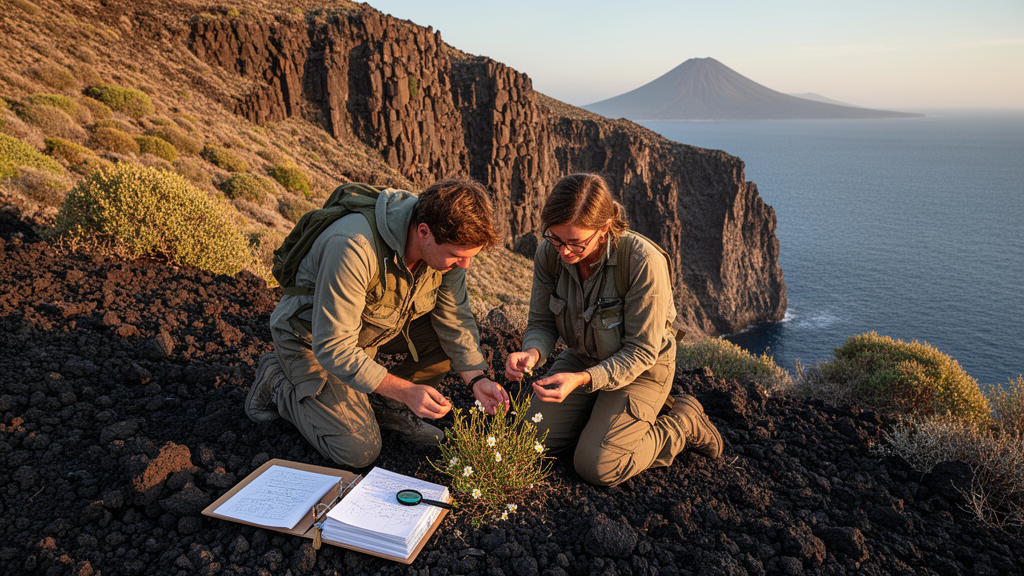
The volcanic islands of Lipari and Panarea, rising from the Tyrrhenian Sea off the northern coast of Sicily, have long fascinated botanists, yet their plant life has never been fully catalogued in modern times. Now a large team of Italian botanists has published the results of an intensive four-day field survey that documents 386 species and subspecies of vascular plants across the two islands, including a species never before recorded in the wild in Italy and four others new to the regional flora of Sicily. The work, carried out in April 2022 by the Working Group for Floristics, Systematics and Evolution of the Italian Botanical Society, represents the most comprehensive snapshot of the flora of these Aeolian islands to date and underscores both the botanical richness and the ecological vulnerabilities of small Mediterranean islands.
The expedition brought together eighteen active participants, along with six guests, drawn from universities and research institutions across Italy. Between 19 and 22 April 2022, the team traversed five carefully planned routes: three covering the southern, western and northern sectors of Lipari, one crossing the southern part of Panarea, and a final circuit through the main village of Lipari and its surroundings. The routes were designed to maximize environmental heterogeneity among sampling sites, to target areas with scarce floristic records, and to include localities of recognized naturalistic value. Habitats encountered ranged from dry stone walls and roadside verges to maquis scrub, garrigue, sea cliffs, beaches, abandoned agricultural terraces and ornamental plantings around settlements.
In total, the participants prepared 1,664 herbarium specimens, each pressed, dried and labelled for long-term preservation in public and private herbaria. Every collector drafted an individual list of the species they had gathered, and the coordinator of the working group later merged these lists and convened a workshop at the Herbarium Mediterraneum Panormitanum of the University of Palermo in February 2023 to revise critical collections and resolve unidentified specimens. The resulting inventory comprises 386 specific and subspecific taxa belonging to 241 genera and 74 families. Taxonomic nomenclature follows the updated checklists of the vascular flora native and alien to Italy, together with subsequent updates compiled in the Portal to the Flora of Italy.
Perhaps the most striking result concerns the alien species. Of the 386 taxa recorded, 48, or 12.4 percent, are not native to the region: 20 are casual, 26 naturalized and two invasive. The invasive pair, Ailanthus altissima, the tree of heaven, and Oxalis pes-caprae, the Bermuda buttercup, are notorious invaders elsewhere in the Mediterranean. Among the aliens, one discovery stands out: Oenothera odorata, an evening primrose native to South America, is here recorded as a naturalized species new to the entire Italian vascular flora. The Lipari population had previously been misidentified as Oenothera stricta subsp. stricta in records dating back to 2008. Careful morphological study of the newly collected specimens, following the standard taxonomic treatment of the genus and confirmed by direct comparison with original material of both species, established the correct identity. The authors note that other Italian records currently attributed to Oenothera stricta subsp. stricta also require verification, suggesting that this South American plant may be more widespread in Italy than previously thought.
Four additional aliens were recorded for the first time in Sicily. Dimorphotheca ecklonis, an ornamental daisy from South Africa, Nassella tenuissima, a fine-leaved Argentinian grass popular in gardens, Solanum torvum, a spiny shrub known as turkey berry, and Viola wittrockiana, the familiar garden pansy, all turned up during the survey. The finding of Nassella tenuissima carries particular concern: the grass was recently planted as an ornamental near a winery on Lipari and is already spreading into surrounding areas, probably through wind dispersal of its seeds. The researchers strongly recommend its removal before it becomes naturalized on the island, a cautionary example of how horticultural choices can seed future invasions on ecologically fragile islands.
The survey also documented the escape of other ornamental plantings. Phyllostachys aurea, golden bamboo, is being maintained as a living fence around a villa on Panarea and has begun reproducing vegetatively beyond its intended bounds, sending up new shoots in the surrounding area. Such observations illustrate a recurring theme of the study: the ornamental trade and gardening practices around settlements act as a continuous pipeline of potential invaders onto these small islands, where native communities have evolved in isolation and often lack defences against vigorous newcomers.
Against this wave of aliens, the native endemic flora of the two islands proved remarkably limited in the sampled area. Only three Italian endemics were found: Centaurea aeolica, a knapweed exclusive to the Aeolian archipelago, Helichrysum litoreum, a curry-scented everlasting also present in other Tyrrhenian Italian regions, and Dianthus rupicola subsp. aeolicus, a cliff-dwelling pink that also occurs on the promontory of Capo Milazzo in northeastern Sicily. Both the helichrysum and the pink are listed as Least Concern in the Red List of the Italian endemic flora. Centaurea aeolica is the only one of the three restricted entirely to the Aeolian Islands, a reminder of how narrowly some endemics are distributed and how easily a single localized disturbance could erase them. The researchers emphasize that small Mediterranean islands are biodiversity hotspots harbouring rare habitats and endemic species, making the spread of invasive species a particularly serious environmental threat there.
Not every significant find involved an alien. The survey relocated Wahlenbergia lobeliodes subsp. nutabunda on Panarea at Costa del Capraro, roughly 120 years after it was last recorded there by the pioneering botanist Michele Lojacono-Pojero in 1903, and about 40 years after a later record from Cala dei Zimmari. This ephemeral plant, which also occurs in Sardinia and Calabria, has a very short vegetative cycle, making it easy to overlook and rarely reported. Equally notable was Serapias nurrica subsp. nurrica, an orchid absent from earlier published sources for the islands, found on Panarea within old abandoned agricultural terraces and on wasteland in the southern and western parts of Lipari. Gamochaeta pensylvanica, a North American neophyte first collected in Italy in 1980 and in Sicily in 2015, was also recorded, apparently introduced as a contaminant by plant nurseries and steadily expanding its range.
The choice of Lipari and Panarea reflects a deliberate strategy. The Italian Botanical Society’s working group has spent two decades organizing floristic excursions to poorly explored corners of the country, selecting territories based on gaps in floristic knowledge. Although botanists have visited the Aeolian Islands since the first half of the nineteenth century, beginning with Giovanni Gussone’s landmark floras of Sicily in the 1820s through the 1840s, followed by Lojacono-Pojero in 1877 and 1902 and Giuseppe Zodda in 1902, complete and updated floristic lists for Lipari and Panarea have never been published. Gioachino Ferro of the University of Catania devoted much of his career to the archipelago’s flora, but his death halted publication of his synthesis. Before this survey, the Wikiplantbase #Sicilia database held only 262 records for Lipari and just 107 for Panarea.
Both islands are quiescent volcanoes shaped by fire and by centuries of human activity. Lipari, the largest of the Aeolian Islands at 37.2 square kilometres and reaching 594 metres on Mount Sant’Angelo, is built of varied volcanic formations producing ever-shifting regosols and lithosols, and more than 660 taxa have been documented for it, 14 percent of them alien to Italy. Panarea, far smaller at 3.3 square kilometres and 420 metres at its peak, is composed of andesitic to dacitic and rhyolitic rocks, with weak hydrothermal activity on Lipari’s western side and active submarine fumaroles about 2.5 kilometres off its coast. Human presence dates back to the fifth millennium before present, and Greek and Roman colonization brought the first profound landscape changes; until the early twentieth century most of the islands’ surface was cultivated. Today agriculture covers only about 15 percent of Lipari and 5 percent of Panarea, and abandoned fields are being recolonized by natural vegetation, including Erica arborea and Arbutus unedo maquis, Cistus and Genista tyrrhena garrigues, and grasslands. The new inventory provides the baseline that conservationists and island managers need to track these changes, to catch invasive species before they take hold, and to protect the endemic plants that exist nowhere else.
Subject of Research: Floristic inventory of the volcanic islands Lipari and Panarea in the Aeolian archipelago, Sicily
Article Title: Contribution to the floristic knowledge of Lipari and Panarea Islands (Sicilia, Italy)
Article References: Barone, G., Bajona, E., Bartolucci, F., Cancellieri, L., Caruso, G., Conti, F., Domina, G., Fascetti, S., Franzoni, J., Laface, V. L. A., Pinzani, L., Rosati, L., Scoppola, A., Stinca, A., Tilia, A., & Crisafulli, A. (2023). Contribution to the floristic knowledge of Lipari and Panarea Islands (Sicilia, Italy). Italian Botanist, 16, 59-71. https://doi.org/10.3897/italianbotanist.16.113415
Image Credits: AI Generated
DOI: 10.3897/italianbotanist.16.113415
Keywords: floristics, Aeolian Islands, Lipari, Panarea, alien species, endemic plants, herbarium specimens, biodiversity, invasive species, Sicily, Mediterranean flora, Oenothera odorata
Cite Scienmag News
Margaret Porter. (October 19, 2026). Botanists Document 386 Plant Species on Two Volcanic Italian Islands, Uncovering a Species New to Italy. Scienmag. https://scienmag.com/botanists-document-386-plant-species-on-two-volcanic-italian-islands-uncovering-a-species-new-to-italy/
Margaret Porter. "Botanists Document 386 Plant Species on Two Volcanic Italian Islands, Uncovering a Species New to Italy." Scienmag, 19 October 2026, https://scienmag.com/botanists-document-386-plant-species-on-two-volcanic-italian-islands-uncovering-a-species-new-to-italy/. Accessed 19 October 2026.
Margaret Porter. "Botanists Document 386 Plant Species on Two Volcanic Italian Islands, Uncovering a Species New to Italy." Scienmag. October 19, 2026. https://scienmag.com/botanists-document-386-plant-species-on-two-volcanic-italian-islands-uncovering-a-species-new-to-italy/


