


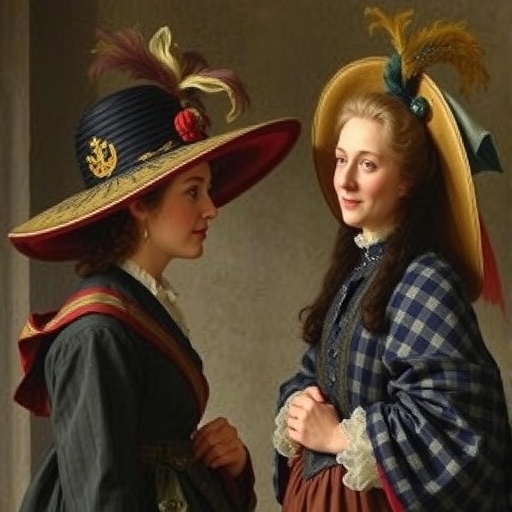
England’s cultural relationship with hats extends far beyond mere fashion, revealing complex social and political nuances that dominated early modern society. In a groundbreaking study published in The Historical Journal by Cambridge University Press, Professor Bernard Capp of the University of Warwick illuminates how hats symbolized far more than personal style during the turbulent 17th and 18th centuries. This exploration reveals hats as potent markers of social hierarchy, political defiance, and personal dignity, challenging conventional interpretations of this everyday accessory.
Historically, hat etiquette—or “hatiquette”—served as a multifaceted language of respect and defiance. Unlike modern Britain, where hat-wearing is optional and largely ornamental, early modern England demanded strict observance of hat customs. Men and boys were required to doff their hats indoors and upon encountering social superiors, reflecting the rigid class structures of the time. Yet during the English Civil War and its aftermath, this convention was subverted as individuals used hat-honour to communicate political allegiance or resistance.
One of the most vivid examples of this phenomenon emerged in 1630 when a defiant oatmeal maker, summoned before England’s highest ecclesiastical court, distinguished between judges who were privy councillors and those who were bishops. By doffing his hat for the former but putting it back on for the latter, whom he disparagingly called “rags of the Beast,” he employed the hat not merely as apparel, but as a semiotic device of political dissent. Such acts gained traction throughout the civil war era, transforming hat-wearing into a charged political statement.
Prominent radicals and revolutionaries frequently wielded hats as symbols of resistance. John Lilburne, a fervent Leveller imprisoned in Newgate in 1646, famously refused to remove his hat as a sign of protest when summoned to the House of Lords. Similarly, proto-communists like William Everard and Gerrard Winstanley, leaders of the Diggers movement, and the Fifth Monarchists, refused to comply with hat-honour protocols when confronted by authority figures, thereby challenging the legitimacy and hierarchical nature of those powers. These deliberate defiance acts illustrate the ideological shifts challenging traditional authority during this volatile period.
Yet the symbolism of hats transcended radicalism and permeated royalist circles as well. Defeated royalists appropriated hat defiance to signal their rejection of revolutionary courts. King Charles I, for example, maintained his hat during his 1649 trial, refusing to acknowledge the court’s legitimacy. Likewise, the son of the earl of Peterborough declined to remove his hat or enter a plea when tried for treason in 1658. The dual appropriation of hats by opposing factions underscores the hat’s versatility as a political tool employed strategically across conflicting ideologies.
Intriguingly, the gesture of hat-doffing was not unidirectional but contextually plastic, even allowing social inferiors to momentarily invert traditional power relations. Some royalist leaders, such as Lord Capel, theatrically removed their hats on execution scaffolds to solicit the crowd’s sympathy, transforming hat removal into a populist display of humility and political theater. Such varied uses reveal the hat’s capacity to communicate nuanced social messages beyond a simple mark of respect.
Professor Capp’s research revealed even more intimate domestic implications, demonstrated through the peculiar case of Thomas Ellwood, a 19-year-old Quaker sympathizer in 1659. His father confiscated all his hats to ground him, enforcing a cultural norm whereby a young man could not practically leave the house bareheaded. This form of discipline highlights the powerful social coercion embedded in hat conventions, illustrating that hats functioned as tools of familial control and moral order as much as public or political symbols.
Contrary to some theories, the declining practice of hat-doffing during later centuries did not correspond directly with the rise of handshaking as a social greeting. Instead, Professor Capp argues, this shift was part of broader transformations in social manners and fashion. The growing popularity of wigs, for instance, made traditional hat-wearing less widespread, while the practical inconvenience of repeatedly removing hats in increasingly crowded urban centers contributed to eroding this custom. These changes reflect a gradual loosening of formal deference mechanisms in English social life.
The hat remained a practical object of protection and personal dignity well into the 18th century, particularly evident in court records depicting highway robbery victims prioritizing their hats above valuable possessions. In one notable 1718 case, William Seabrook was robbed of a substantial amount of money, yet pleaded with his attackers not to take his hat, which they ultimately discarded in the road. Similarly, in 1733, Francis Peters protested when a robber forcibly removed his hat and wig, emphasizing the perceived health risks of going bareheaded. Such anecdotes reveal the hat’s role not just as fashion but as vital physical protection against harsh elements.
Medical treatises from the period advocated rigorously for keeping the head warm to avoid illness, associating bareheadedness with vulnerability to disease. This medical rationale reinforced the social importance of hats beyond their symbolic meanings. For men who shaved their heads to wear periwigs, losing a hat in cold weather risked genuine health consequences, intertwining cultural practices with practical concerns about well-being.
Moreover, to be seen without a hat in the 18th century was to risk social stigmatization as destitute or mentally unwell. Defendants appearing in court were acutely aware of this, sometimes begging for the return of their hats to avoid appearing degraded and pitiable. The hat thereby functioned as a silent yet powerful indicator of personal identity, social standing, and mental stability, reflecting a societal consensus that extended even to marginalized and criminalized populations.
Professor Capp’s work importantly frames the hat as a “versatile linguistic tool,” capable of carrying layered messages through subtle variations such as positioning, removal, or waving. By embedding meaning into such a mundane object, early modern Englishmen were able to articulate and contest social hierarchies, moral values, and political ideologies through everyday gestures, making the hat a rich site of cultural expression.
This research redefines the hat in early modern England as a complex semiotic object that mediated between personal identity, social order, and political upheaval. Beyond its role as a mere accessory, the hat encapsulated conflicts over authority, defiance, health, and class, rendering it a powerful cultural artifact. As social manners evolved and the practicalities of urban life shifted, the hat’s role diminished, but its historical significance provides a compelling window into the intersections of fashion, politics, and society.
Cite Scienmag News
Courtney Benton. (April 10, 2026). Hat Wars of Early Modern England Unveiled: A Fascinating Look into Historical Fashion Conflicts. Scienmag. https://scienmag.com/hat-wars-of-early-modern-england-unveiled-a-fascinating-look-into-historical-fashion-conflicts/
Courtney Benton. "Hat Wars of Early Modern England Unveiled: A Fascinating Look into Historical Fashion Conflicts." Scienmag, 10 April 2026, https://scienmag.com/hat-wars-of-early-modern-england-unveiled-a-fascinating-look-into-historical-fashion-conflicts/. Accessed 3 September 2026.
Courtney Benton. "Hat Wars of Early Modern England Unveiled: A Fascinating Look into Historical Fashion Conflicts." Scienmag. April 10, 2026. https://scienmag.com/hat-wars-of-early-modern-england-unveiled-a-fascinating-look-into-historical-fashion-conflicts/


