


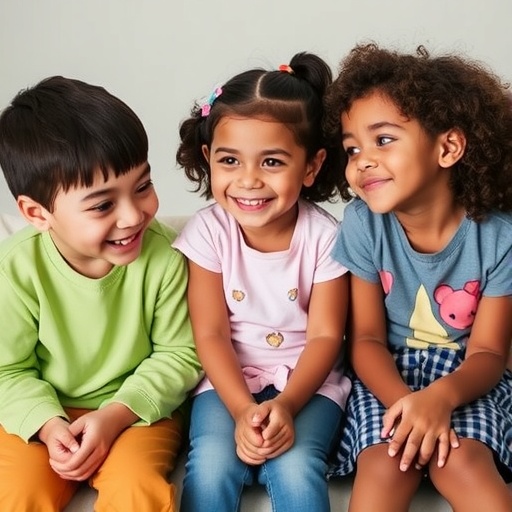
In the intricate social ecosystem of elementary school, the line dividing inclusion and exclusion can be a defining factor for a child’s emotional and psychological development. New research emanating from Concordia University, soon to be published in the esteemed journal Child Development, unravels how the social capital of a child’s friends profoundly shapes their experience of social isolation. This study intricately dissects the nuanced interactions between children’s internal dispositions and the external social structures that determine their belonging or alienation in peer groups.
The investigation focused on a cohort of 252 fifth- and sixth-grade students from Montreal-area schools, aiming to dissect two distinct forms of social isolation. The first form, social withdrawal, is characterized by a child’s voluntary retreat from peer interactions, often driven by inherent personality traits like shyness and social anxiety. The second form, social exclusion, encapsulates the involuntary marginalization imposed by peers, where a child is actively left out of social activities. By delineating these two states, researchers sought to understand how friendships might mitigate or perpetuate these experiences.
Crucially, the study introduces the idea of social capital as an essential lens through which to view friendship influence. Social capital here refers to the benefits a child can access through their social connections—namely inclusion, emotional support, popularity, and trustworthiness within the peer network. Unlike previous research that largely emphasized how a child might assimilate the behaviors and social traits of their friends, this study pivots to consider how the friend’s own social standing impacts the isolated child’s position within the wider social hierarchy.
Over an eight-week observational window, fifth and sixth graders were asked not only to identify their closest friendships but also to nominate peers displaying behaviors associated with withdrawal or exclusion. These peer nominations proved invaluable because they leveraged the authentic and nuanced perspectives of classmates as the most qualified observers of social dynamics, rather than relying solely on adult assessments or self-report measures, which can be biased.
The data paint a compelling picture: social withdrawal tends to be a stable and persistent trait, seemingly insulated from the social capital or popularity of the friends a withdrawn child might have. This suggests that withdrawal is rooted more deeply in internal psychological factors, such as a child’s temperament or emotional regulation abilities, which external social interventions alone may find challenging to alter. Interventions for these children may thus need to prioritize therapeutic approaches that target self-perception, cognitive appraisals, and emotional resilience, potentially employing cognitive-behavioral techniques to nudge children toward increased social engagement.
Conversely, social exclusion exhibits a measurable plasticity in response to friendship dynamics. Children who forge mutual friendships with peers who are well-regarded and accepted by the wider peer group exhibit a significant decrease in experiences of exclusion over time. This reveals a pathway whereby strategically connected friendships can act as buffers or conduits toward greater peer inclusion, effectively altering the social landscape for the excluded child. The findings underscore the social leverage afforded by well-connected friends, who can mediate their companions’ integration into peer networks.
However, the study presents a sobering counterpoint: friendships with less accepted or marginal peers do not translate into a reduction of exclusion but instead seem to reinforce the isolated status quo. While emotional support derived from any friendship remains vital, the social capital of the friend emerges as a defining factor in whether exclusion diminishes. The implication is that inclusion is not solely a function of individual relationships but is deeply embedded in the broader social architecture and the positioning of friends within it.
These insights bear significant implications for intervention strategies aimed at combating childhood social isolation. For children facing active exclusion, group-oriented initiatives that disrupt entrenched peer hierarchies and normalize inclusive behaviors appear promising. Such interventions might strive to cultivate a classroom culture that actively discourages exclusion and rewards inclusive social patterns, fostering micro-communities of acceptance.
In contrast, children prone to withdrawal might benefit from interventions grounded in internal psychological processes rather than solely social restructuring. Targeted approaches could focus on therapies designed to enhance social cognition, emotional regulation, and anxiety reduction, gradually enabling these children to navigate feared social encounters with greater confidence and flexibility.
The study’s methodological rigor—tracking mutual best friendships longitudinally over several weeks—provides robust evidence for the temporality and causal influence of friends’ social acceptance on exclusion experiences. This temporal element enriches our understanding of how social ties evolve and either alleviate or entrench isolation.
Melissa Commisso, PhD, the study’s lead author and current resident at Montreal General Hospital, emphasizes the broader significance of this work: “Peer experiences in childhood are some of the strongest predictors of adult well-being. Unraveling the mechanisms by which friendships shape these outcomes enlightens pathways to more effective interventions, safeguarding mental health trajectories from an early age.”
Co-author William Bukowski, a seasoned psychologist at Concordia’s Department of Psychology, adds that their peer nomination technique harnesses the unique ability of children themselves to serve as social barometers within their groups, providing data that is both ecologically valid and dynamically informative.
The research was supported by the Social Sciences and Humanities Research Council of Canada and conforms with rigorous ethical standards, ensuring reliability and integrity of the findings.
Ultimately, the study positions social capital as a pivotal axis around which social exclusion can be mitigated in school-age children. By elucidating the differential effects of friendship based on the friend’s social standing, this work pioneers a nuanced understanding of childhood peer relations, transcending traditional friend influence models.
As educators, psychologists, and policymakers seek to confront bullying, exclusion, and the silent struggling of withdrawn children, these findings serve as a clarion call to tailor interventions not only to the visible behaviors but to the complex social fabric that these children are enmeshed in, fostering environments where every child can find not just companionship but acceptance.
News Publication Date: 31-Mar-2026
Web References:
https://academic.oup.com/chidev/advance-article/doi/10.1093/chidev/aacag036
References:
Commisso, M., & Bukowski, W. (2026). Social exclusion, but not withdrawal, is diminished by a friend’s level of acceptance: A provisions model. Child Development. DOI: 10.1093/chidev/aacag036
Cite Scienmag News
Courtney Benton. (May 20, 2026). Concordia Study Finds Popular Best Friend Helps Reduce Isolation but Not Withdrawal in Children. Scienmag. https://scienmag.com/concordia-study-finds-popular-best-friend-helps-reduce-isolation-but-not-withdrawal-in-children/
Courtney Benton. "Concordia Study Finds Popular Best Friend Helps Reduce Isolation but Not Withdrawal in Children." Scienmag, 20 May 2026, https://scienmag.com/concordia-study-finds-popular-best-friend-helps-reduce-isolation-but-not-withdrawal-in-children/. Accessed 5 September 2026.
Courtney Benton. "Concordia Study Finds Popular Best Friend Helps Reduce Isolation but Not Withdrawal in Children." Scienmag. May 20, 2026. https://scienmag.com/concordia-study-finds-popular-best-friend-helps-reduce-isolation-but-not-withdrawal-in-children/


