


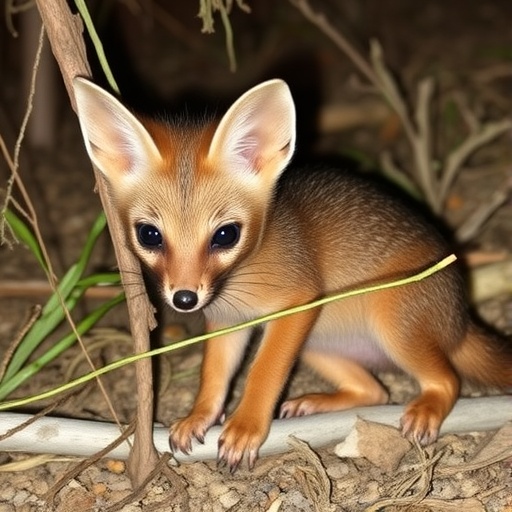
In a groundbreaking development for conservation biology and island ecology, researchers have unveiled the first-ever photographic evidence of the insular dwarf fox (Urocyon sp.) on Mexico’s Cozumel Island. This elusive canid, which has remained virtually unseen since the last reported sighting in 2001, was captured by conservationists on the morning of September 14, 2023. The adult male fox was safely rescued following observations of its disoriented state along the island’s coastal highway and subsequently released into a protected reserve after thorough health evaluations. This discovery not only closes a decades-long gap in the species’ record but also emphasizes urgent conservation priorities for preserving Cozumel’s unique and fragile biodiversity.
The significance of this rediscovery cannot be overstated. Cozumel’s dwarf fox represents an exceptional example of insular dwarfism — a biological phenomenon where species confined to islands evolve smaller body sizes over generations due to limited resources and isolation. Subfossil remains have long hinted at the species’ existence, suggesting their presence may even predate the island’s earliest Mayan inhabitants. Yet, until now, scientists have had only indirect evidence, making the confirmation of a living population a pivotal milestone in understanding evolutionary processes and island ecosystem dynamics.
The fox’s size is estimated at 60 to 80 percent that of its mainland relative, the gray fox (Urocyon cinereoargenteus). This size diminution is a classic signature of insular populations that face restricted food availability and space, alongside minimal predation pressures. The evolutionary divergence seen in the Cozumel fox underscores how isolation can foster unique adaptations, potentially leading to speciation events. However, despite its distinctiveness, the species has not yet been formally described taxonomically, owing to its cryptic nature and the scarcity of physical records.
Ecologically, the Cozumel dwarf fox remains shrouded in mystery. Prior to its recent photographic documentation, virtually nothing was known about its current population numbers, habitat preferences, or ecological role within the island’s ecosystems. This knowledge gap poses a formidable challenge to conservationists aiming to protect this critically endangered canid. The increasing threats posed by habitat alteration, invasive species, and natural disasters compound the urgency for comprehensive ecological surveys and habitat preservation measures.
The rescue operation, undertaken by the Fundación de Parques y Museos de Cozumel, was prompted by public reports of a disoriented canid near kilometer 29 on the island’s coastal highway — a perilous zone for wildlife due to vehicular traffic. After safely capturing and medically assessing the fox, conservationists chose the Laguna Colombia State Reserve as a release site. This area offers a sanctuary with minimal human disturbance and sufficient ecological resources, thereby maximizing the fox’s survival potential post-release.
One of the most poignant voices to emerge from the research community is that of Travis Bayer from Pathos Wildlife, who articulates the silent peril facing rare insular species worldwide. Bayer notes that species extinctions frequently occur unnoticed, especially when animals inhabit remote, understudied habitats. The gradual disappearance of these species, often without dramatic events, underscores the need for proactive conservation efforts based on sound baseline data rather than reactive measures post-decline.
This rediscovery, while far from a conservation triumph, symbolizes a critical second chance: an opportunity to initiate focused research and protection strategies before it is irreversibly lost. Such is the precarious position of the Cozumel dwarf fox—a species that has eluded science and public awareness for so long that its existence teetered on the brink of extinction without widespread alarm.
To impact the species’ survival trajectory positively, the research team has delineated several priority actions. Paramount among them are targeted population surveys to ascertain the fox’s distribution and numbers across the island. Coupled with this is the need for genetic studies that have the potential to clarify its evolutionary history and taxonomic status. Genetic analyses could also inform management strategies by identifying genetic diversity levels, inbreeding risks, and potential subspecies delineation.
Another vital focus is habitat conservation. The southern habitat of Cozumel, known to support the fox, is increasingly fragmented by anthropogenic development and invasive flora and fauna. Protecting and restoring these terrestrial ecosystems are critical to sustaining the fox and maintaining ecological balance. Mitigating human-wildlife conflicts, implementing traffic calming measures near wildlife corridors, and fostering community engagement form additional integral components of a comprehensive conservation framework.
The case of the Cozumel dwarf fox also resonates more broadly within the field of insular biogeography and conservation science. It illustrates the challenges of detecting and monitoring rare species in remote landscapes and emphasizes the importance of long-term ecological investment to avoid silent extinctions. As Bayer concludes, uncertainty about a species’ status is not only a scientific gap but an urgent conservation red flag demanding immediate action.
Finally, this rediscovery stands as a beacon of hope—a testimony to the resilience of nature and the potential of dedicated science and conservation partnerships. Though much remains to be learned about the Cozumel dwarf fox, its recent photographic documentation provides a new foundation upon which future research and protective measures can be built. With concerted effort, this insular canid may yet reclaim its niche within Cozumel’s vibrant ecosystem and persist for generations to come.
News Publication Date: 4-May-2026
Web References:
– Neotropical Biology and Conservation journal: https://neotropical.pensoft.net/
– DOI link to original article: http://dx.doi.org/10.3897/neotropical.21.e187967
References:
Bayer TD, McGreal MA, Chacón D. AR (2026) First photographic evidence of an insular dwarf fox (Urocyon sp.) on the island of Cozumel, Mexico. Neotropical Biology and Conservation 21(2): 123-129. http://dx.doi.org/10.3897/neotropical.21.e187967
Cite Scienmag News
Margaret Porter. (June 8, 2026). Groundbreaking Photos Confirm Survival of Elusive Cozumel Dwarf Fox After 20 Years. Scienmag. https://scienmag.com/groundbreaking-photos-confirm-survival-of-elusive-cozumel-dwarf-fox-after-20-years/
Margaret Porter. "Groundbreaking Photos Confirm Survival of Elusive Cozumel Dwarf Fox After 20 Years." Scienmag, 8 June 2026, https://scienmag.com/groundbreaking-photos-confirm-survival-of-elusive-cozumel-dwarf-fox-after-20-years/. Accessed 6 September 2026.
Margaret Porter. "Groundbreaking Photos Confirm Survival of Elusive Cozumel Dwarf Fox After 20 Years." Scienmag. June 8, 2026. https://scienmag.com/groundbreaking-photos-confirm-survival-of-elusive-cozumel-dwarf-fox-after-20-years/


