


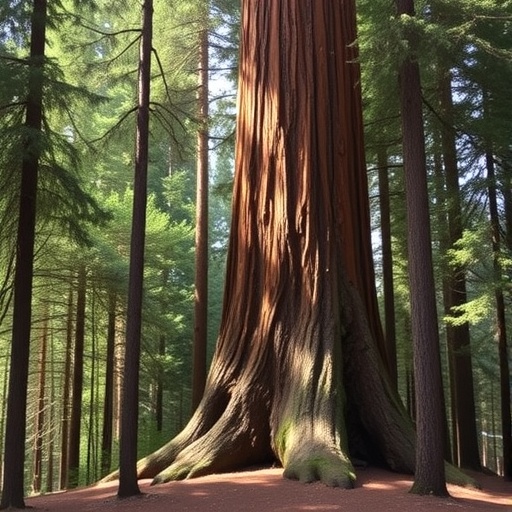
Ancient trees are often treated as living time capsules, celebrated for surviving centuries of drought, storms, disease and human disturbance. But a new study suggests that their evolutionary importance cannot be judged by age alone. In an endangered conifer, researchers found that the genetic value of an ancient tree is shaped more strongly by the history of the population to which it belongs than by the number of years it has been alive. The finding challenges a popular conservation assumption: that the oldest trees are automatically the most important trees to save.
The study, published in Nature Plants, examines how evolutionary history is distributed among individuals in a threatened conifer species. Ancient trees can carry genetic variants that have disappeared from younger generations, particularly when populations have declined sharply. These variants may influence growth, reproduction, resistance to pathogens or tolerance of environmental stress. Yet the presence of rare genetic material in an old tree depends on whether its population has retained ancient lineages, experienced severe bottlenecks or remained connected to other populations over time.
To investigate this question, the researchers compared the evolutionary relationships and genetic characteristics of trees from different populations and age classes. Rather than treating age as a direct measure of genetic uniqueness, they reconstructed patterns of relatedness and population history. Such analyses can reveal whether individuals represent deeply diverged lineages, whether populations have exchanged genes, and whether their ancestors passed through periods of expansion or contraction. The approach moves conservation genetics beyond a simple inventory of the oldest surviving organisms.
The central result is that population history better explained a tree’s evolutionary importance than its chronological age. A very old tree may be genetically similar to many other individuals if it belongs to a population that has remained large and well connected. Conversely, a younger tree may preserve a distinctive evolutionary lineage if it comes from a small, isolated or historically unusual population. In practical terms, a tree that appears less remarkable in the field could hold genetic information found nowhere else in the species.
This distinction matters because endangered conifers are frequently reduced to scattered remnants of once-continuous forests. When populations become fragmented, gene flow—the movement of genetic material through pollen and seeds—can decline. Small populations may also lose alleles through genetic drift, the random change in gene frequencies that becomes especially powerful when only a few individuals remain. At the same time, isolated populations can retain unique variants because they evolve separately from the rest of the species. Their importance is therefore linked to both vulnerability and historical distinctiveness.
The findings also help explain why age-based conservation can produce an incomplete or misleading strategy. Protecting only the oldest trees may preserve visible symbols of longevity while overlooking younger individuals that represent rare genetic branches. A population that contains several moderately aged trees from an isolated lineage could be more valuable for maintaining evolutionary diversity than a larger stand dominated by descendants of a common lineage. Conservation plans must therefore consider where trees came from, how their populations changed and how much genetic exchange has occurred between them.
For forest managers, the study points toward a more precise definition of a “heritage tree.” Physical measurements such as trunk diameter, height and estimated age remain valuable, especially because old trees often provide nesting sites, cavities and other ecological functions. But genetic data can reveal an additional layer of significance. Sampling across populations, identifying unique lineages and estimating demographic history could help determine which trees should receive priority for protection, seed collection, assisted regeneration or inclusion in conservation plantations.
The research has implications beyond one endangered conifer. Many long-lived species are now being managed under rapid climate change, when the ability to adapt may depend on preserving as much genetic variation as possible. Genetic diversity is not evenly distributed across a landscape, and it is not necessarily concentrated in the oldest organisms. By combining tree age with genomic evidence, reproductive information and population history, conservationists can protect not just ancient individuals but the evolutionary processes that produced them.
The message is both scientifically important and visually compelling: an ancient tree may tell a story about survival, but its DNA tells a story about ancestry. The study shows that those stories do not always point to the same individual. In endangered forests, the most valuable tree may be the oldest survivor—or it may be a younger tree carrying the last genetic signature of a vanished population. Recognizing that difference could transform how conservationists decide what to protect before more of these irreplaceable lineages disappear.
Cite Scienmag News
Gavin Prescott. (August 11, 2026). Population history, not age, drives ancient trees’ evolutionary importance in endangered conifer. Scienmag. https://scienmag.com/population-history-not-age-drives-ancient-trees-evolutionary-importance-in-endangered-conifer/
Gavin Prescott. "Population history, not age, drives ancient trees’ evolutionary importance in endangered conifer." Scienmag, 11 August 2026, https://scienmag.com/population-history-not-age-drives-ancient-trees-evolutionary-importance-in-endangered-conifer/. Accessed 3 September 2026.
Gavin Prescott. "Population history, not age, drives ancient trees’ evolutionary importance in endangered conifer." Scienmag. August 11, 2026. https://scienmag.com/population-history-not-age-drives-ancient-trees-evolutionary-importance-in-endangered-conifer/


