


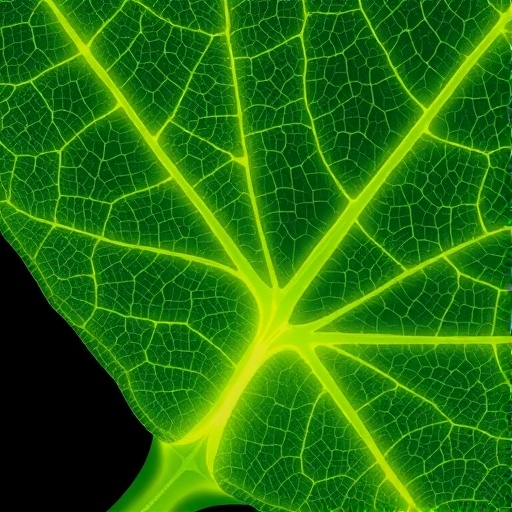
A new three-dimensional look inside sorghum leaves is revealing how crops may be redesigned to use less water without sacrificing the carbon dioxide they need for photosynthesis. Using high-resolution micro-computed tomography, or microCT, researchers have mapped the connections between leaf pores, internal air spaces, veins and photosynthetic tissue with unprecedented detail. Their findings suggest that sorghum leaves can compensate for having fewer stomata—the microscopic openings through which gases move—by reorganizing the ventilation system beneath the surface.
The study, published in Plant Physiology, was led by James Fischer, a postdoctoral researcher in the laboratory of Andrew Leakey at the University of Illinois Urbana-Champaign. The team examined sorghum, a productive and drought-resilient cereal crop that is increasingly important in regions where water availability is unpredictable. By combining advanced imaging with machine-learning analysis, the researchers produced labeled three-dimensional models showing how the leaf’s internal anatomy governs the movement of carbon dioxide and water vapor.
Leaves must constantly balance two competing demands. During photosynthesis, carbon dioxide enters through stomata and travels through microscopic air channels to photosynthetic cells, where it is converted into sugars. At the same time, water vapor escapes through those same pores. For every molecule of carbon dioxide captured by photosynthesis, hundreds of water molecules can be lost to the atmosphere. On hot, bright days, this tradeoff can become especially severe, forcing crops to close their stomata and limiting growth even when sunlight is abundant.
“Minimizing how many water molecules escape while CO2 is going into the leaf” is a central goal of crop engineering, Leakey explained. His laboratory and the U.S. Department of Energy-funded Center for Advanced Bioenergy and Bioproducts Innovation have developed sorghum plants with fewer stomata as a potential strategy for reducing water loss. Fewer pores could, in principle, lower the rate of transpiration, often described as a plant’s form of sweating. However, researchers needed to understand whether reducing stomatal density would also make it harder for carbon dioxide to reach the cells where photosynthesis occurs.
That question could not be answered reliably from conventional microscope images alone. Traditional microscopy typically produces thin, two-dimensional sections, while the relevant structures are arranged through a complex three-dimensional network. Air spaces branch around veins and photosynthetic tissues, and their shape, size and connectivity influence how quickly gases diffuse through the leaf. The researchers therefore turned to microCT, a technique that uses a series of X-ray projections to reconstruct an intact sample in three dimensions.
The imaging was carried out at the Advanced Photon Source at Argonne National Laboratory, a U.S. Department of Energy facility whose powerful particle accelerator produces highly focused X-ray beams. These beams are much more intense and precise than those used in standard medical CT scanners, allowing scientists to resolve tiny biological structures. The sorghum leaves were scanned in a way that preserved the spatial relationships among stomata, veins and internal air spaces. Machine-learning tools then helped identify and classify the anatomical features across the resulting high-resolution datasets.
The researchers expected leaves with fewer stomata to create a more difficult route for carbon dioxide. With fewer entry points, they reasoned, gas might have to travel farther through a narrower and more tortuous network before reaching photosynthetic cells. Instead, the three-dimensional models showed that the leaves compensated by developing larger air spaces beneath the stomata. These expanded spaces maintained an equivalent conductance for carbon dioxide through the leaf, despite the reduction in pore number. In practical terms, the plants appeared able to reduce potential water loss without creating a comparable penalty for carbon dioxide delivery.
The result challenges a simple assumption that fewer stomata must automatically restrict photosynthesis. Leaf anatomy is not a passive structure; it can adjust in ways that preserve gas exchange. The finding is particularly important for crop engineers because it suggests that stomatal density should not be considered in isolation. The size and arrangement of the internal air spaces may be equally important, and breeding or engineering strategies could target both traits together to improve water-use efficiency.
The study also uncovered an unexpected difference between the two surfaces of the sorghum leaf. Stomata on the upper surface were frequently positioned above veins rather than in the spaces between them. In many leaves, stomata are arranged over regions between veins, where open internal air spaces can provide a direct route toward photosynthetic tissue. Their placement over veins in sorghum indicates that the upper and lower surfaces may perform different physiological roles, potentially influencing carbon dioxide uptake, heat dissipation and water loss in distinct ways.
The researchers are now investigating why this unusual organization occurs and whether it can be used to develop crops that remain productive during drought. A more complete understanding of the leaf’s internal “ventilation system” could help scientists design plants that capture carbon dioxide efficiently while limiting transpiration. Such advances may become increasingly valuable as higher temperatures and irregular rainfall place additional pressure on agriculture. For now, the microCT maps provide a detailed anatomical blueprint showing that the path from a leaf pore to a photosynthetic cell is far more dynamic—and potentially more engineerable—than previously understood.
News Publication Date: 30-Jul-2026
Web References: https://academic.oup.com/plphys/article/201/3/kiag414/8715739
References: Plant Physiology, DOI: 10.1093/plphys/kiag414
Cite Scienmag News
Alan Morgan. (August 11, 2026). High-resolution X-ray imaging reveals leaf interiors, guiding efforts to reduce water loss. Scienmag. https://scienmag.com/high-resolution-x-ray-imaging-reveals-leaf-interiors-guiding-efforts-to-reduce-water-loss/
Alan Morgan. "High-resolution X-ray imaging reveals leaf interiors, guiding efforts to reduce water loss." Scienmag, 11 August 2026, https://scienmag.com/high-resolution-x-ray-imaging-reveals-leaf-interiors-guiding-efforts-to-reduce-water-loss/. Accessed 4 September 2026.
Alan Morgan. "High-resolution X-ray imaging reveals leaf interiors, guiding efforts to reduce water loss." Scienmag. August 11, 2026. https://scienmag.com/high-resolution-x-ray-imaging-reveals-leaf-interiors-guiding-efforts-to-reduce-water-loss/


