


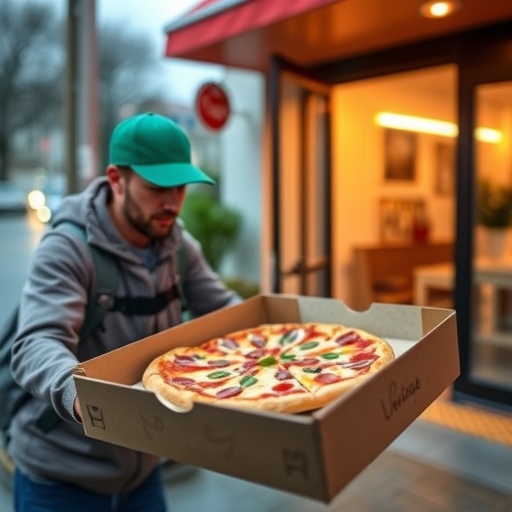
BALTIMORE, Aug. 3, 2026 — The next time a pizza order arrives late, the delay may influence more than your dinner. It could determine which businesses survive, how much platforms earn, and whether shoppers choose quality over convenience. New research suggests that impatience is reshaping consumer markets in ways that challenge one of the central assumptions of digital commerce: that faster delivery automatically creates more competition and gives consumers more choice.
The study, published in the INFORMS journal Marketing Science, examined how delivery speed affects consumer decision-making and the structure of local markets. Researchers analyzed nearly 98,000 pizza-delivery orders placed by more than 6,800 consumers at 51 independently owned pizzerias in a major Northern Italian city. The orders, recorded between 2010 and 2011, provided a detailed view of how customers weigh delivery time against price, location and product quality.
The researchers found that waiting time is not simply another feature consumers consider alongside cost and quality. For many customers, it functions as a powerful psychological penalty. The median consumer valued a 50 percent reduction in delivery time at more than 20 percent of the order price. In practical terms, a customer might prefer a faster pizza from a more expensive or lower-quality restaurant rather than wait longer for a cheaper or better-rated alternative.
This impatience can weaken the comparison-shopping process that economists traditionally associate with competitive markets. When consumers are highly sensitive to delay, they may search fewer alternatives, switch between sellers less often and become less responsive to price differences. A nearby restaurant can therefore capture orders even when it charges more or offers an inferior product. Rather than forcing every seller to compete aggressively on price and quality, speed can create a protective advantage for businesses that happen to be located close to customers.
“Our findings challenge the common assumption that faster delivery simply intensifies rivalry,” said Chaewon Seol of Purdue University, one of the study’s authors. “Instead, impatience fragments the market, protecting lower-quality providers that rely on proximity while limiting the reach of higher-quality ones.” The result is a market in which geographic distance and delivery time can matter more than the characteristics of the product itself.
The researchers describe this outcome as a form of softened price competition. If customers are unwilling to wait, a low-price restaurant farther away may be unable to attract them, while a nearby business can maintain demand without matching the lower price. The same mechanism can reduce substitution among sellers: consumers who would normally move to another pizzeria may remain with the fastest option because the perceived cost of waiting is too high.
However, the study also identifies a critical technological threshold at which the market changes direction. When delivery technology reduces waiting times by more than 75 percent, proximity loses much of its value. Customers can then access a wider set of sellers without facing a substantial delay. Under those conditions, high-quality pizzerias gain market share, while many low- and mid-quality establishments leave the market. Faster delivery still influences consumer behavior, but it no longer primarily protects nearby firms from stronger competitors.
“When delivery time falls by more than 75%, the pattern reverses: market share concentrates among high-quality pizzerias, and many low- and mid-quality establishments exit,” said Federico Rossi of Purdue University. “This is because proximity to the customer is no longer an advantage for some of those lower-quality sellers.” The finding suggests that technological innovation can initially shelter weaker businesses but eventually expose them to more intense competition once speed improvements become large enough.
Online platforms may also benefit directly from consumers’ willingness to pay for time. The researchers found that offering a premium service that delivers orders 10 percent faster, for a fee equal to 10 percent of the basic menu price, can increase platform profits by 18.7 percent. The result illustrates how delivery speed can be converted into a form of price discrimination: customers with a stronger aversion to waiting can pay more to reduce delivery time, while less impatient customers continue using the standard service.
The implications extend far beyond pizza. E-commerce companies, grocery services, pharmacies and other businesses that depend on delivery may need to treat time as a strategic market variable rather than merely an operating expense. “For platforms and marketing decision-makers, understanding the dual role of delivery speed is essential,” said Sara Valentini of Bocconi University. Elisa Montaguti of the University of Bologna added that strategies treating impatience only as a cost to be minimized may overlook the competitive advantages it creates. The study shows that a faster delivery promise can rearrange consumer demand, alter pricing power and determine which firms remain visible in an increasingly impatient online economy.
News Publication Date: Aug. 3, 2026
Web References: https://pubsonline.informs.org/doi/10.1287/mksc.2024.0885
References: Seol, Chaewon; Rossi, Federico; Valentini, Sara; and Montaguti, Elisa. “Consumer Impatience, Technological Innovation, and Market Structure.” Marketing Science. Published June 4, 2026. DOI: 10.1287/mksc.2024.0885
Cite Scienmag News
Courtney Benton. (August 11, 2026). Pizza Delivery Study Could Transform How Businesses View Delivery Services Beyond Food. Scienmag. https://scienmag.com/pizza-delivery-study-could-transform-how-businesses-view-delivery-services-beyond-food/
Courtney Benton. "Pizza Delivery Study Could Transform How Businesses View Delivery Services Beyond Food." Scienmag, 11 August 2026, https://scienmag.com/pizza-delivery-study-could-transform-how-businesses-view-delivery-services-beyond-food/. Accessed 4 September 2026.
Courtney Benton. "Pizza Delivery Study Could Transform How Businesses View Delivery Services Beyond Food." Scienmag. August 11, 2026. https://scienmag.com/pizza-delivery-study-could-transform-how-businesses-view-delivery-services-beyond-food/


