


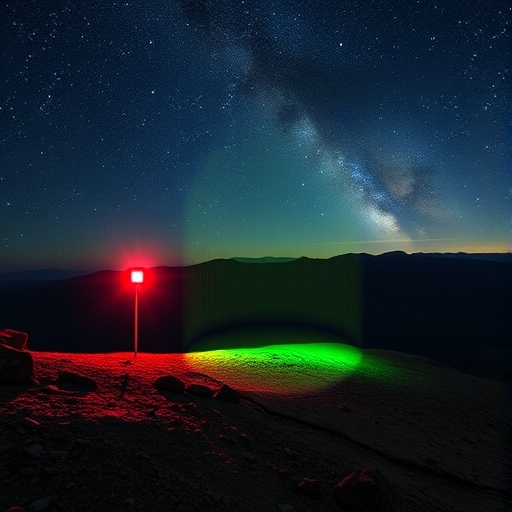
A new study reports that Earth’s upper atmosphere naturally hosts electron Bernstein waves—an elusive class of plasma oscillations—observed directly using a ground-based radar system. The findings, from researchers led by Wang and colleagues, offer a rare look at how energy and structure are sustained in the ionosphere without relying on artificial transmitters. Instead of searching for externally driven signals, the team identified wave signatures consistent with Bernstein-mode behavior emerging from the ionospheric plasma itself.
Electron Bernstein waves arise in magnetized, collisionless plasmas when electrons oscillate in discrete harmonics shaped by the local magnetic field. In the ionosphere, where densities and magnetic geometry vary with altitude and time, these waves can become visible when the radar’s observing frequency and beam geometry overlap the plasma conditions that support them.
Using a carefully tuned radar configuration, the researchers detected narrow spectral features and phase characteristics that matched theoretical expectations for Bernstein waves. The signal’s temporal evolution suggested that the waves were not random noise but coherent oscillations linked to local plasma parameters. By comparing the observed dispersion trends with models, the team strengthened the case that the wave mode was truly Bernstein rather than a more common ionospheric fluctuation.
The study also highlights how ground-based instruments can probe fine-scale ionospheric dynamics. Traditional radar interpretations often prioritize ion-acoustic or electromagnetic modes; here, the analysis framework incorporated electron-scale plasma physics. This approach enabled the researchers to infer properties such as the effective electron response and the influence of magnetic-field-aligned plasma structure.
Importantly, the detected waves occurred naturally, implying that ionospheric processes—such as turbulence, particle precipitation, or background electrodynamic forcing—may repeatedly generate Bernstein-mode oscillations. That makes the phenomenon not only of academic interest but also relevant to understanding the ionosphere as a continuously active plasma environment.
For space-weather researchers, the work could improve models of how energy cascades through the ionospheric plasma. Electron Bernstein waves can interact with other wave populations, potentially affecting particle transport and local conductivity. While the study does not yet map all pathways, it provides observational constraints that future simulations can target.
With this radar-based evidence, the ionosphere moves closer to being treated as a laboratory where electron-scale wave modes can be tracked from Earth. As more facilities adopt similar analysis strategies, natural Bernstein waves may become a recurring “missing piece” in the observational toolkit of plasma geophysics—fueling the kind of viral science news that turns subtle space physics into tangible, measurable signals.
Cite Scienmag News
Violet Maxwell. (July 28, 2026). Ground Radar Detects Natural Electron Bernstein Waves in Earth’s Ionosphere. Scienmag. https://scienmag.com/ground-radar-detects-natural-electron-bernstein-waves-in-earths-ionosphere/
Violet Maxwell. "Ground Radar Detects Natural Electron Bernstein Waves in Earth’s Ionosphere." Scienmag, 28 July 2026, https://scienmag.com/ground-radar-detects-natural-electron-bernstein-waves-in-earths-ionosphere/. Accessed 4 September 2026.
Violet Maxwell. "Ground Radar Detects Natural Electron Bernstein Waves in Earth’s Ionosphere." Scienmag. July 28, 2026. https://scienmag.com/ground-radar-detects-natural-electron-bernstein-waves-in-earths-ionosphere/


