


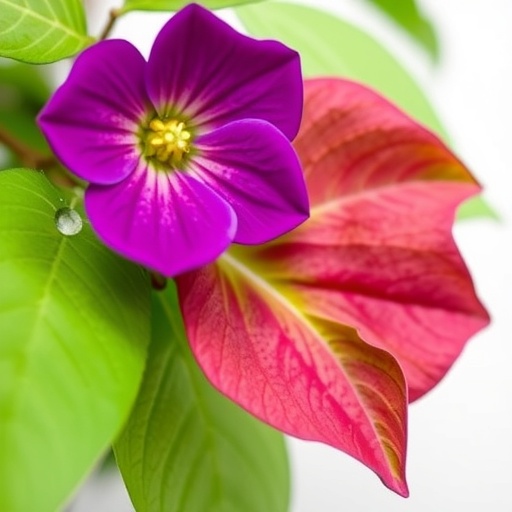
A familiar garden flower is emerging as an unlikely contender in the race to make textile dyeing cleaner. Researchers Das, Hossain, Rahman and colleagues have examined how colorants derived from Mirabilis jalapa, commonly known as the four-o’clock flower, could be paired with natural mordant sources to reduce the environmental burden of textile processing. Published in Scientific Reports, the study addresses a problem that has become increasingly difficult for the fashion and manufacturing industries to ignore: conventional dyeing can produce large volumes of chemically contaminated wastewater, consume substantial amounts of water and energy, and release persistent compounds into aquatic ecosystems.
Textile coloration is technologically complex because a dye must do more than simply stain a fiber. It must disperse through the processing bath, interact with the surface and internal structure of the material, resist washing, and remain reasonably stable when exposed to light, heat and perspiration. Synthetic dyes were developed partly because they offer predictable shades and strong performance, but many formulations rely on petroleum-derived chemicals, salts, reducing agents and auxiliary compounds. After dyeing, residues can remain in wastewater, where they may interfere with light penetration, oxygen balance and aquatic life. The new research explores whether plant-based pigments can provide a safer route while retaining enough technical performance for practical textile use.
Mirabilis jalapa is particularly interesting because its vividly colored flowers contain betalain pigments. These water-soluble compounds are responsible for red-violet betacyanins and yellow-orange betaxanthins found in several plant species. Unlike many widely used synthetic colorants, betalains are obtained from renewable biological material and can be extracted using comparatively mild processes. Their chemistry also makes them visually striking, but it creates a challenge: natural pigments can be sensitive to pH, temperature, oxygen, light and prolonged storage. A green dyeing system therefore requires more than identifying a colorful plant; it must control extraction, application and stabilization at every stage.
The researchers’ approach centers on combining the floral colorants with natural mordant sources. In textile chemistry, a mordant is a substance that helps a dye bind to a fiber. It can alter the charge, acidity and surface chemistry of the textile, while also changing the final hue and improving resistance to washing or light. At the molecular level, mordant components may form bridges or coordination interactions between pigment molecules and functional groups in fibers such as cotton, wool or other natural substrates. This interaction can prevent the colorant from being removed easily during rinsing. Natural mordants, including materials rich in tannins or mineral components, are being investigated as alternatives to some conventional metallic salts.
The appeal of such a system lies in its potential to connect several sustainability goals at once. Plant colorants can be sourced from renewable biomass, while natural mordants may be obtained from agricultural residues, botanical extracts or other low-impact materials. If these inputs can be processed without harsh solvents and applied under moderate conditions, the overall dyeing pathway could reduce dependence on hazardous auxiliaries. It may also create opportunities for local production, particularly in regions where Mirabilis jalapa grows readily as an ornamental or naturalized plant. Turning an abundant plant resource into a value-added textile ingredient could support circular-economy models, although responsible cultivation and sourcing would remain essential.
A central technical question is how the extraction conditions affect pigment quality. Water temperature, extraction time, acidity, particle size and the ratio between plant material and solvent can all influence the concentration and composition of the resulting dye liquor. Excessive heat may accelerate pigment degradation, while unsuitable pH conditions can shift color or cause fading. Once extracted, the colorant must be transferred evenly to the textile surface. The researchers’ work is therefore relevant not only to natural-dye enthusiasts but also to engineers seeking reproducible processing parameters. Industrial adoption depends on consistent shade development from one batch to the next, something that is often difficult when raw materials vary according to season, soil, maturity and storage.
The interaction between the plant dye and the mordant is equally important. A mordant may intensify a color, move it toward a different shade or improve its resistance to laundering. However, more mordant is not automatically better. Excessive quantities can increase chemical loading in wastewater, alter fabric handle and reduce the environmental advantages of the process. The most promising formulations must balance color depth, fastness, fiber integrity and wastewater quality. By examining M. jalapa alongside natural mordant sources, the study contributes to a broader effort to replace the assumption that sustainability requires sacrificing performance. Instead, it treats the dye bath as a carefully engineered chemical system in which renewable ingredients must be optimized together.
The research also highlights why “natural” should not be treated as a synonym for automatically harmless or industrially viable. Plant-based extracts can degrade, vary in composition and require land, water and energy for production. Some natural substances can also affect aquatic organisms if discharged at high concentrations. A credible green textile process must therefore be evaluated across its full life cycle, including cultivation, harvesting, extraction, transport, dyeing and disposal. Measuring color strength, shade uniformity, wash fastness, light fastness and resistance to perspiration is essential, but so is assessing the toxicity and biodegradability of the residual dye bath. The value of the study lies in bringing these practical and environmental considerations into the same conversation.
For textile manufacturers, the most significant question is whether a flower-derived colorant can move beyond laboratory demonstrations and operate within real production constraints. Industrial dyeing requires reliable supply chains, rapid processing, compatibility with existing machinery and compliance with quality standards. It also demands predictable behavior when fabrics differ in fiber composition, pretreatment or surface finish. The work on Mirabilis jalapa provides a foundation for that transition by examining a plant source and mordant strategy through the lens of textile processing rather than decorative experimentation alone. Further research will be needed to scale extraction, stabilize the pigments, test broader fiber types and determine whether the complete system delivers measurable reductions in environmental impact.
The study arrives as consumers, regulators and brands intensify pressure to confront pollution in the global apparel industry. Its central message is simple but scientifically consequential: the future of textile coloration may depend on combining biological resources with precise chemical control. Mirabilis jalapa will not replace every synthetic dye overnight, and natural pigments still face serious challenges involving stability, consistency and scale. Yet the research shows why overlooked plants can become important starting points for industrial innovation. By pairing the flower’s betalain-rich colorants with naturally derived mordants, scientists are developing a pathway toward textile processing that is more renewable, potentially less hazardous and better aligned with circular manufacturing. What begins as a brightly colored garden plant could become part of a much larger transformation in how fabrics are dyed.
Cite Scienmag News
Violet Maxwell. (August 13, 2026). Green Textile Processing Advances Using Mirabilis jalapa Colorants and Natural Mordants. Scienmag. https://scienmag.com/green-textile-processing-advances-using-mirabilis-jalapa-colorants-and-natural-mordants/
Violet Maxwell. "Green Textile Processing Advances Using Mirabilis jalapa Colorants and Natural Mordants." Scienmag, 13 August 2026, https://scienmag.com/green-textile-processing-advances-using-mirabilis-jalapa-colorants-and-natural-mordants/. Accessed 4 September 2026.
Violet Maxwell. "Green Textile Processing Advances Using Mirabilis jalapa Colorants and Natural Mordants." Scienmag. August 13, 2026. https://scienmag.com/green-textile-processing-advances-using-mirabilis-jalapa-colorants-and-natural-mordants/


