Water-ice clouds are among the most familiar sights in the Solar System beyond Earth. They shimmer over the poles of Saturn’s rings, veil the equatorial zones of Mars and drift through the atmospheres of gas giants. Yet for all their ubiquity, the way these clouds form is far from simple. On both Earth and Mars, water vapour does not usually freeze into ice on its own. It needs help: a pre-existing particle, typically a speck of mineral dust, on which the vapour can condense and grow. This process, known as heterogeneous nucleation, has long been treated as a prerequisite for ice cloud formation in the thin, cold Martian atmosphere. A new modelling study, highlighted in a News and Views commentary in Nature Geoscience, now suggests that on Mars at least, nature has found a way around that requirement.
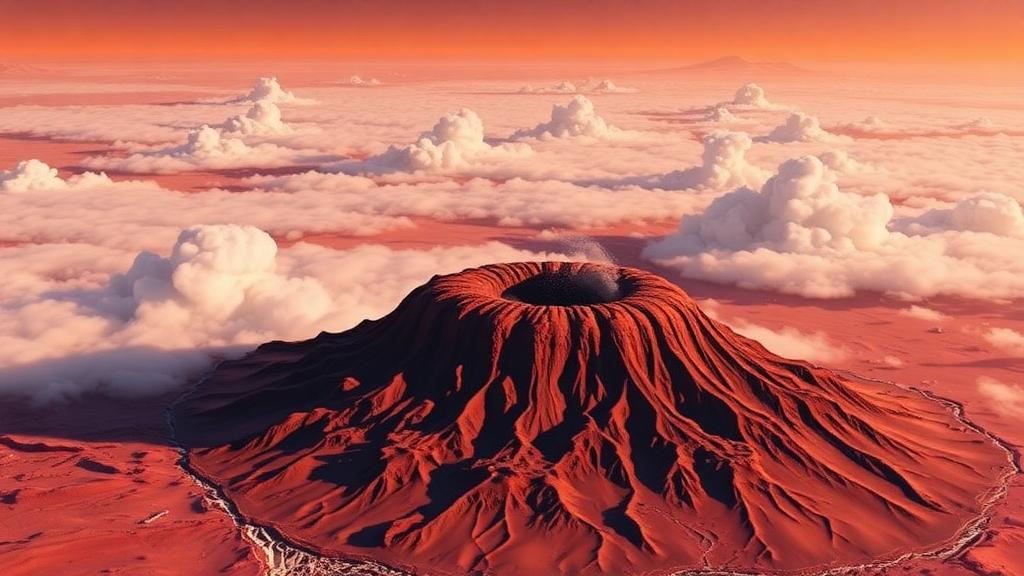
The study in question, led by Jorge Hernández-Bernal and colleagues, focuses on one of the most spectacular and enigmatic cloud structures on Mars: the Arsia Mons Elongated Cloud, often abbreviated as AMEC. Arsia Mons is one of the giant Tharsis volcanoes near the Martian equator, and every Martian year, around the northern hemisphere’s summer solstice, an extraordinarily long, narrow cloud begins to form on its western flank. The cloud can stretch for well over a thousand kilometres, appearing each morning and dissipating as the day warms, repeating this cycle for months. Ground-based observers and spacecraft have documented it repeatedly, and earlier work by the same team established its morning-side formation and its remarkable regularity. What the new simulations add is an explanation for how the cloud’s ice crystals come into being in the first place.
The key ingredient, according to the atmospheric simulations, is gravity waves. These are not the gravitational waves detected from colliding black holes, but rather ripples in the atmosphere itself, generated when air is forced to flow over topography. On Mars, the towering shield volcanoes of Tharsis act as formidable obstacles. As the atmosphere flows over Arsia Mons, it is displaced upward, then sinks and oscillates, creating a train of waves that propagates downwind. Where the wave motion lifts air parcels, the air expands and cools adiabatically. In the Martian atmosphere, which is far thinner and colder than Earth’s, this wave-driven cooling can be rapid and severe, plunging local temperatures to extremes that ordinary large-scale circulation would never reach.
That extreme cooling matters because of the physics of ice nucleation. When water vapour freezes without any foreign surface to condense upon, a process called homogeneous nucleation, it requires very high supersaturation: the air must hold far more water vapour than it can sustain at equilibrium before the first ice crystals spontaneously appear. The saturation ratio needed for homogeneous freezing rises steeply as temperature drops, which is why, in most planetary atmospheres, dust and aerosol particles do the work instead. On Mars, airborne dust is abundant, lifted from the planet’s pervasive dusty surface, and standard models of Martian cloud microphysics assume that water vapour deposits onto these dust grains. The new simulations indicate that over Arsia Mons, the gravity-wave temperature perturbations are cold enough and fast enough to push the vapour past the homogeneous nucleation threshold directly, bypassing the dust entirely.
This is a significant conceptual shift. If ice can nucleate spontaneously in wave-cooled air, then the cloud’s formation is controlled primarily by atmospheric dynamics rather than by the availability of cloud condensation nuclei. The commentary by Milena Corcos, which accompanies the research in Nature Geoscience, frames the result as a challenge to the standard picture of Martian cloud formation. Water-ice clouds across the Solar System typically require pre-existing dust particles to coax water vapour into ice, yet the simulations suggest that gravity waves over a Martian volcano can generate ice clouds through spontaneous nucleation of water vapour alone. In other words, the Arsia Mons cloud may be a rare example of a planetary cloud whose birth is written in the dynamics of the airflow rather than in the chemistry of its aerosols.
The Arsia Mons Elongated Cloud has attracted growing scientific attention in recent years. Previous studies by Hernández-Bernal and collaborators, published in the Journal of Geophysical Research: Planets in 2021 and 2022, characterized the cloud’s morphology, its daily cycle and its seasonal recurrence using both observations and mesoscale modelling. Work by Sánchez-Lavega and colleagues in 2018 documented the cloud’s impressive extent from imaging campaigns. The phenomenon is seasonal, tied to the period around the Martian northern summer solstice, and it forms preferentially on the morning side of the volcano, expanding westward as the local time advances. Its narrow, elongated shape has made it a striking target for telescopic observers on Earth as well as for orbiters such as those operated by the European Space Agency and NASA.
The connection between the cloud and gravity waves is physically intuitive once the Martian environment is considered. Mars’s atmosphere is roughly one hundred times less dense than Earth’s at the surface, and it responds quickly to thermal forcing. The flanks of Arsia Mons rise more than fifteen kilometres above the surrounding plains, so the volcano intersects a substantial fraction of the atmospheric column. Air deflected around and over the edifice generates mountain waves whose amplitude can grow with altitude in the thin air. Earlier theoretical work by Spiga and Forget in 2009 established how strongly mesoscale dynamics, including slope winds and wave motions, shape the local meteorology of the Tharsis volcanoes. The new study builds on that foundation, coupling the wave dynamics explicitly to cloud microphysics and showing that the resulting temperature excursions are sufficient for homogeneous freezing.
The implications extend beyond one spectacular cloud. If gravity waves can trigger spontaneous ice nucleation on Mars, then similar processes may operate elsewhere on the planet, wherever strong topographic forcing and cold ambient conditions coincide. They may also have operated in Mars’s past, when the atmosphere was possibly denser and the water cycle more vigorous, affecting how clouds influenced the planet’s climate and its capacity to warm the surface. More broadly, the result speaks to planetary atmospheres throughout the Solar System. Ice clouds on Earth, Mars and the outer planets are usually nucleated heterogeneously, but the new work demonstrates that dynamical cooling can, under the right conditions, remove the need for seed particles altogether. That distinction matters for climate modelling, because clouds that form homogeneously can differ in crystal size, number and radiative properties from those that form on dust.
There are also observational consequences. Clouds formed by homogeneous nucleation should consist of numerous small ice crystals, whereas heterogeneous nucleation on a limited supply of dust grains tends to produce fewer, larger crystals. The microphysical fingerprint of the Arsia Mons cloud, if it can be measured, would therefore provide a direct test of the modelling. Future orbital observations of the cloud’s particle sizes and its vertical structure, combined with continued mesoscale simulation, could confirm whether spontaneous nucleation is indeed at work. As Corcos notes in the commentary, the comparison between observation and modelling of the Arsia Mons Elongated Cloud is now close enough that such tests are within reach, making the cloud a natural laboratory for ice microphysics in an atmosphere very different from our own.
For now, the Arsia Mons Elongated Cloud stands as a reminder that even familiar processes can hold surprises. A planet long thought to have its cloud physics dictated by ubiquitous dust turns out to host, on the flank of one of its great volcanoes, a cloud that may owe its existence to nothing more than the atmosphere waving in the wind. The study, published in Nature Geoscience with commentary by Milena Corcos, reframes a seasonal Martian curiosity as a window into the fundamental physics of ice formation, one that planetary scientists will be watching closely as observations and models continue to converge.
Subject of Research: Gravity-wave-driven spontaneous ice nucleation forming the Arsia Mons Elongated Cloud on Mars
Article Title: Ice clouds born from Martian waves
Article References: Corcos, M. (2026). Ice clouds born from Martian waves. Nature Geoscience, 19(10), 1140-1141. https://doi.org/10.1038/s41561-026-02109-8
Image Credits: AI Generated
DOI: 10.1038/s41561-026-02109-8
Keywords: Mars, ice clouds, gravity waves, Arsia Mons, homogeneous nucleation, cloud microphysics, atmospheric dynamics, planetary science, Tharsis volcanoes, Nature Geoscience, water vapour, mesoscale modelling
Cite Scienmag News
Violet Maxwell. (October 7, 2026). Gravity Waves Over a Martian Volcano May Seed Ice Clouds Without Dust. Scienmag. https://scienmag.com/gravity-waves-over-a-martian-volcano-may-seed-ice-clouds-without-dust/
Violet Maxwell. "Gravity Waves Over a Martian Volcano May Seed Ice Clouds Without Dust." Scienmag, 7 October 2026, https://scienmag.com/gravity-waves-over-a-martian-volcano-may-seed-ice-clouds-without-dust/. Accessed 8 October 2026.
Violet Maxwell. "Gravity Waves Over a Martian Volcano May Seed Ice Clouds Without Dust." Scienmag. October 7, 2026. https://scienmag.com/gravity-waves-over-a-martian-volcano-may-seed-ice-clouds-without-dust/