


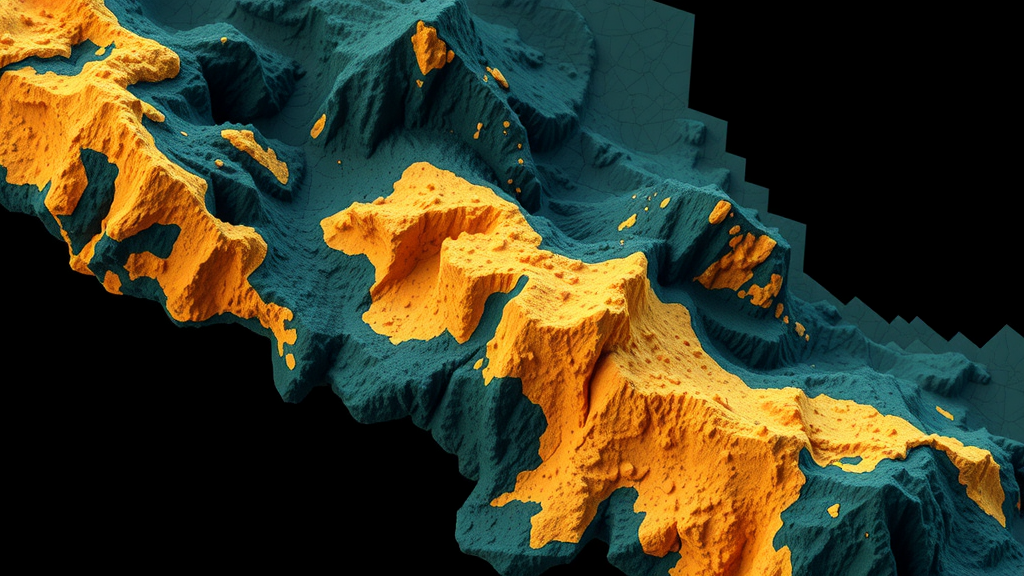
Beneath the grasslands of northern Xinjiang, one of China’s most important copper and nickel mining districts is getting a technological upgrade that could reshape how the mining industry hunts for buried ore. Researchers have unveiled a new artificial intelligence framework, called LSR-GAD, that can flag faint, deeply buried signs of mineralization from geophysical data even when almost no drilling information is available to teach the algorithm what to look for. Applied to the Kalatongke deposit in the Central Asian Orogenic Belt, the method identified a high-probability anomaly near survey line 805 at roughly one kilometer depth, and its predicted location lines up with a gabbroic interval intersected by borehole ZK2017-6, offering an independent check that the machine’s intuition matches geological reality.
The problem the researchers set out to solve is one of the most stubborn in modern exploration geophysics. Geophysical signals from deep ore bodies arrive at the surface attenuated and weak, their low amplitudes easily drowned out by near-surface geological background. Conventional inversion techniques that translate raw electromagnetic, magnetic, and gravity measurements into three-dimensional models of the subsurface suffer from non-uniqueness: many different underground configurations can produce nearly identical surface readings. When the target is a subtle mineralized body rather than a large, conductive massive sulfide, the ambiguity becomes severe. Human interpreters and standard machine learning tools alike struggle to decide which faint blips in an inversion volume are genuine exploration targets and which are artifacts.
What makes the challenge doubly hard is the label problem. Machine learning classifiers typically need thousands of labeled examples to learn reliably, but in mineral exploration the only trustworthy labels come from expensive deep drilling. At Kalatongke, the research team had just 906 labeled samples drawn from boreholes to constrain a volume of 2,023,623 three-dimensional inversion voxels. That means less than half of one tenth of one percent of the data carried any ground truth. Worse, mineralized intervals are dramatically outnumbered by barren rock, producing a severe class imbalance that causes ordinary classifiers to simply predict the majority class everywhere and miss the ore entirely.
LSR-GAD, short for a label-scarce reliability-aware graph anomaly detection framework, attacks both problems at once. The core idea is to represent the three-dimensional inversion volume as a graph rather than a stack of independent pixels. Each inversion voxel becomes a node in the graph, carrying its electrical, magnetic, and gravity inversion properties as features. A graph sample and aggregate network, known as GraphSAGE, then encodes local spatial relationships by aggregating information from neighboring nodes. This neighborhood aggregation matters because ore bodies are spatially continuous objects, not random scatterings of anomalous voxels; a voxel surrounded by other weakly anomalous voxels is far more likely to be part of a real mineralized zone than an isolated outlier, and the graph structure lets the model learn that context directly.
To cope with the scarcity of labels, the framework combines the small number of labeled borehole samples with unlabeled anchor nodes, allowing the network to extract useful structure from the vast unlabeled portion of the data while still being anchored by what little ground truth exists. The class imbalance is handled through a weighted binary cross-entropy loss, which penalizes errors on the rare mineralized class more heavily than errors on the abundant barren class, effectively telling the model that missing an ore body is a far costlier mistake than a false alarm in barren rock. Synthetic experiments and ablation tests confirmed that each ingredient contributes: removing the graph structure, the sample weighting, or the regularization each degraded the continuity of predicted targets and increased missed detections under sparse-label conditions.
Perhaps the most consequential design choice is the explicit treatment of uncertainty. Rather than producing a single brittle prediction, the framework incorporates Monte Carlo dropout, a technique in which the network’s dropout layers remain active at inference time so that many slightly different versions of the model each contribute a prediction. From this ensemble of predictions, the method estimates predictive probability, standard deviation, and entropy for every voxel. High probability with low variance marks confident exploration targets; high probability with high variance flags regions where the model is guessing. This turns the output from a binary map into a risk-aware decision tool, letting exploration managers weigh where to spend scarce drilling budgets against quantified confidence rather than blind faith in a black box.
Scale presented one final engineering hurdle. A million-scale voxel volume cannot be pushed through a graph network in one piece, so the team developed an anchor-graph-based block-wise inference strategy that partitions the volume into manageable blocks for prediction while preserving the benefits of the graph representation. This makes the approach practical for real exploration datasets, which routinely span kilometers of depth and lateral extent at fine spatial resolution. The combination of graph-based spatial reasoning, semi-supervised learning, class-rebalancing, uncertainty estimation, and scalable inference is what allows LSR-GAD to function reliably in exactly the regime where conventional supervised methods collapse: deep, subtle targets with almost no labels.
The Kalatongke case study demonstrates the framework on a genuinely difficult target. Kalatongke is a magmatic copper-nickel sulfide district hosted in the Central Asian Orogenic Belt, a vast accretionary collage where Permian mafic intrusions carried sulfide melts rich in copper and nickel. Known ore bodies have been extensively drilled, but the next generation of discoveries lies deeper and subtler, in concealed intrusions whose geophysical signatures are faint and entangled with background geology. The team integrated electrical, magnetic, and gravity inversion models, letting the classifier exploit the fact that a genuine mineralized body should leave coherent, mutually consistent traces across multiple physical properties rather than an artifact confined to a single dataset.
Trained on the 906 labeled samples, the model generated a full probability and uncertainty map of the survey volume. The stand-out result is the high-probability anomaly near line 805 at approximately 1.0 kilometer depth, which corresponds spatially to the gabbroic interval encountered in borehole ZK2017-6. Because that agreement was achieved with a tiny training set, it suggests the framework can generalize from limited ground truth in ways that matter for greenfield exploration, where deep drilling data simply does not yet exist. The authors position the output explicitly as a risk-management tool: probability and uncertainty layers guide drill targeting, and each new borehole feeds back into the training set, progressively sharpening the model as a district matures.
Beyond one deposit, the study points toward a broader shift in how geoscience handles sparse, expensive labels. Deep learning is spreading rapidly through geophysics, but most successful applications sit in data-rich domains; mineral exploration, with its handful of boreholes against millions of unlabeled voxels, has remained a hostile environment for standard supervised learning. By fusing multi-source geophysical data on a graph, rebalancing the loss, and quantifying its own uncertainty, LSR-GAD offers a reusable template for intelligent exploration of complex concealed ore bodies, whether the target is nickel-copper sulfide, rare earths, or energy-critical metals. As demand for critical minerals accelerates worldwide, tools that can squeeze reliable guidance from minimal ground truth may become as essential to explorers as the magnetometer itself.
Subject of Research: A label-scarce reliability-aware graph anomaly detection framework for identifying deep subtle mineralization anomalies from multi-source geophysical inversion data, applied to the Kalatongke Cu-Ni deposit in the Central Asian Orogenic Belt.
Article Title: LSR-GAD for Reliable Detection of Deep Subtle Mineralization Anomalies under Label Scarcity: A Case Study of the Kalatongke Deposit in the Central Asian Orogenic Belt
Article References: Lv, P., Zhou, N., Chen, W., & Han, S. (2026). LSR-GAD for Reliable Detection of Deep Subtle Mineralization Anomalies under Label Scarcity: A Case Study of the Kalatongke Deposit in the Central Asian Orogenic Belt. Natural Resources Research. https://doi.org/10.1007/s11053-026-10765-1
Image Credits: AI Generated
DOI: 10.1007/s11053-026-10765-1
Keywords: graph neural network, mineral exploration, label scarcity, geophysical inversion, Kalatongke deposit, uncertainty quantification, Monte Carlo dropout, GraphSAGE, multi-source data fusion, copper-nickel sulfide, Central Asian Orogenic Belt, machine learning
Cite Scienmag News
Blake Davidson. (September 12, 2026). Graph-Based AI Finds Hidden Copper and Nickel Deposits with Almost No Training Data. Scienmag. https://scienmag.com/graph-based-ai-finds-hidden-copper-and-nickel-deposits-with-almost-no-training-data/
Blake Davidson. "Graph-Based AI Finds Hidden Copper and Nickel Deposits with Almost No Training Data." Scienmag, 12 September 2026, https://scienmag.com/graph-based-ai-finds-hidden-copper-and-nickel-deposits-with-almost-no-training-data/. Accessed 4 October 2026.
Blake Davidson. "Graph-Based AI Finds Hidden Copper and Nickel Deposits with Almost No Training Data." Scienmag. September 12, 2026. https://scienmag.com/graph-based-ai-finds-hidden-copper-and-nickel-deposits-with-almost-no-training-data/


