


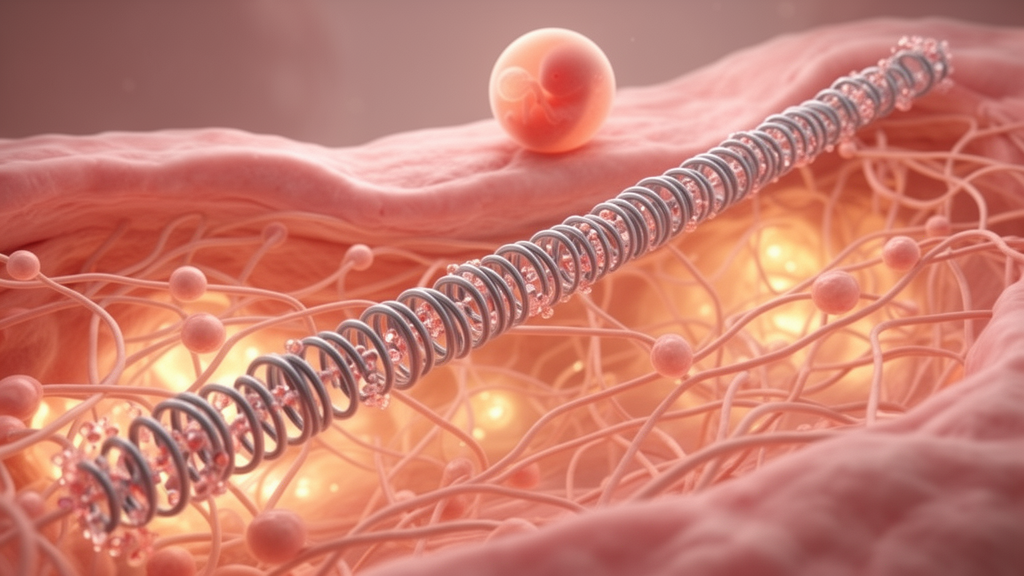
Inside every muscle cell of the heart and skeleton sits one of the largest proteins ever described: titin, a molecular giant that spans the entire contractile unit and dictates its elastic properties. In smooth muscles, such as those lining the wall of the uterus, titin’s presence has been debated for four decades. A new study published in iScience now shows that the uterus expresses both a truncated smooth muscle titin, known as smitin, and a low-abundance full-length titin isoform that carries the C-terminal kinase domain, and that deleting this region in uterine smooth muscle disrupts the finely tuned contractility needed for embryos to implant in the right place at the right time.
Infertility remains a global problem. In the United States, roughly 12 percent of women struggle to conceive or to carry a pregnancy to term, and even after in vitro fertilization and embryo transfer, implantation failure and pregnancy loss are common. When an embryo settles in the wrong place, the consequences can be dire: ectopic pregnancies threaten the life of the mother, while misplaced embryos within the uterus can cause placenta previa and obstruct the birth canal. Despite these clinical stakes, the mechanics of how smooth muscle contractions position embryos have remained poorly understood, because smooth muscle contractile units lack the well-characterized sarcomere architecture of skeletal and cardiac muscle.
The research team, led by Michael Gotthardt at the Max Delbrück Center, revisited titin expression in the uterus using modern tools. Because striated muscle titin isoforms can reach four megadaltons, they require specialized low-resolution agarose gel electrophoresis for separation, whereas the roughly one-megadalton smitin isoform can be resolved by conventional polyacrylamide gels. By overloading agarose gels with uterus lysate and then confirming the identity of the giant band with targeted mass spectrometry, the researchers detected peptides spanning the complete titin amino acid sequence, all the way through to the M-band exons at the protein’s C-terminus. This established, unambiguously, that a full-length titin isoform exists in the uterus, albeit at levels far below those in skeletal muscle and roughly an order of magnitude lower than smitin itself.
To visualize where the protein resides, the team used fluorescence lifetime imaging on uterine smooth muscle cells isolated from mice engineered to carry a fluorescent tag at titin’s C-terminus. The tagged protein displayed a perinuclear and filament-associated pattern that alternated with smooth muscle actin staining, consistent with titin’s integration into the cytoskeletal network that links dense bodies and contractile filaments in smooth muscle cells.
With expression confirmed, the investigators turned to genetics. They crossed mice carrying loxP-flanked M-band exons 1 and 2 of the titin gene with a transgenic line expressing Cre recombinase under the smooth muscle myosin heavy chain promoter, thereby excising the kinase-encoding region specifically in smooth muscle. The knockout animals appeared entirely normal under baseline conditions, with normal body weight, heart weight, estrous cycles, and uterine histology. Ovulation, fertilization, and blastocyst development also proceeded normally. Yet when the researchers looked at implantation, using Evans Blue dye that stains sites of increased stromal vascular permeability, a striking phenotype emerged: in only about 40 percent of knockout females were blastocysts properly localized at embryonic days 4.5 and 5.5. The remaining animals showed reduced numbers of implantation sites, crowding of embryos, or abnormal distribution. Crucially, the number of blastocysts available for implantation was identical between knockout and control animals, meaning the defect lay in the uterus, not the embryo.
The consequences rippled through pregnancy. Uterus-to-bodyweight ratios failed to rise normally after day 5.5, placental weights at term were increased, suggesting compensatory placental adaptation to the suboptimal spacing of embryos, and average litter size at birth fell to less than half that of controls. Heterozygous animals and Cre-positive controls implanted normally, excluding unintended effects of the transgene or germline recombination.
Transcriptomic profiling at day 3.5 revealed that the most deregulated genes clustered in oxytocin signaling and myometrial contraction and relaxation pathways, including Camk2a, Itpr2, Rock1, and Rgs1. This pointed the team toward functional testing. In ex vivo ring myography, uterine rings from knockout animals responded to increasing concentrations of oxytocin with markedly greater peak force, more than 1.8-fold higher maximal contraction rates, and significantly increased area under the force curve starting at just 0.1 nanomolar oxytocin. Remarkably, resting wall tension was unchanged between genotypes, indicating that passive, elastic properties were preserved. This makes biological sense: with full-length titin present at more than two orders of magnitude lower levels than in striated muscle, its contribution to myometrial stiffness is small.
When the researchers tracked uterine wall motion in tissue strips labeled with the fluorescent dye DiI, they uncovered an apparent paradox. Knockout uteri generated more force than controls but displayed fewer movement peaks and more spatially confined displacements after oxytocin stimulation, in both longitudinal and circular fiber directions. The knockout uterus, in other words, does not lack contractile capacity; it lacks coordination. Western blots and laser-capture microdissection proteomics resolved this further: core contractile proteins such as ACTA2, MYH11, and myosin light chain were unchanged within the isolated myometrium, meaning the hypercontractility arose from signaling and coupling reprogramming rather than from extra myofilament content. Instead, the myometrium showed a hyperexcitable profile, with reduced calcium-handling pumps ATP1A2 and SERCA3, loss of the hyperpolarizing SK3 channel, elevated S100G, and increased prostaglandin transporter SLCO2A1, alongside reinforced matrix-remodeling signals including MMP3, DDR2, and integrin beta 3.
The proteomic data also exposed a collapse in a selective autophagy module anchored at titin’s kinase region. Loss of the M-band exons reduced NBR1 while increasing p62/SQSTM1, with MuRF1 unchanged, and triggered compensatory activation of redox pathways marked by TXNIP elevation and KEAP1 reduction, together with an increase in the ubiquitin ligase adaptor FBXO32. The authors interpret the titin M-band in the uterus as a mechanotransductive hub that restrains excitability and synchronizes peristalsis, ensuring embryos are spaced evenly along the uterine horns rather than acting as the main structural determinant of stiffness. They caution that a direct physical interaction between uterine titin and the NBR1/p62 module, and autophagy flux measurements, remain to be demonstrated in future experiments.
The translational implications are tantalizing. In humans, excessive or poorly coordinated uterine contractions around the time of embryo transfer are associated with reduced IVF success, and the authors propose that variants in the TTN gene or its interactors could contribute to unexplained infertility. Biomarkers based on autophagy adaptor levels or extracellular matrix signatures might eventually identify women at risk of implantation failure, and pharmacological strategies to restore calcium buffering, redox balance, or relaxation signaling could optimize peri-implantation uterine motility. Important caveats remain: mice have a bicornuate uterus with two horns, whereas humans have a single cavity with different implantation dynamics, and no direct human evidence yet links TTN variants to implantation failure. Still, by connecting a defined structural element of smooth muscle to the choreography of embryo positioning, the study opens an entirely new molecular window onto one of the most critical and least understood steps of early pregnancy.
Subject of Research: The role of the smooth muscle titin filament system in uterine contractility and embryo implantation
Article Title: The smooth muscle titin filament system regulates uterus contractility and implantation
Article References: The smooth muscle titin filament system regulates uterus contractility and implantation. (n.d.). https://doi.org/10.1016/j.isci.2026.117888
Image Credits: AI Generated
DOI: Not provided
Keywords: titin, smooth muscle, uterus, embryo implantation, myometrium, infertility, IVF, oxytocin, mechanotransduction, autophagy, calcium handling, peristalsis
Cite Scienmag News
Denise Maddox. (October 15, 2026). Giant Protein Titin Found to Steer Uterine Contractions and Embryo Implantation. Scienmag. https://scienmag.com/giant-protein-titin-found-to-steer-uterine-contractions-and-embryo-implantation/
Denise Maddox. "Giant Protein Titin Found to Steer Uterine Contractions and Embryo Implantation." Scienmag, 15 October 2026, https://scienmag.com/giant-protein-titin-found-to-steer-uterine-contractions-and-embryo-implantation/. Accessed 15 October 2026.
Denise Maddox. "Giant Protein Titin Found to Steer Uterine Contractions and Embryo Implantation." Scienmag. October 15, 2026. https://scienmag.com/giant-protein-titin-found-to-steer-uterine-contractions-and-embryo-implantation/


