


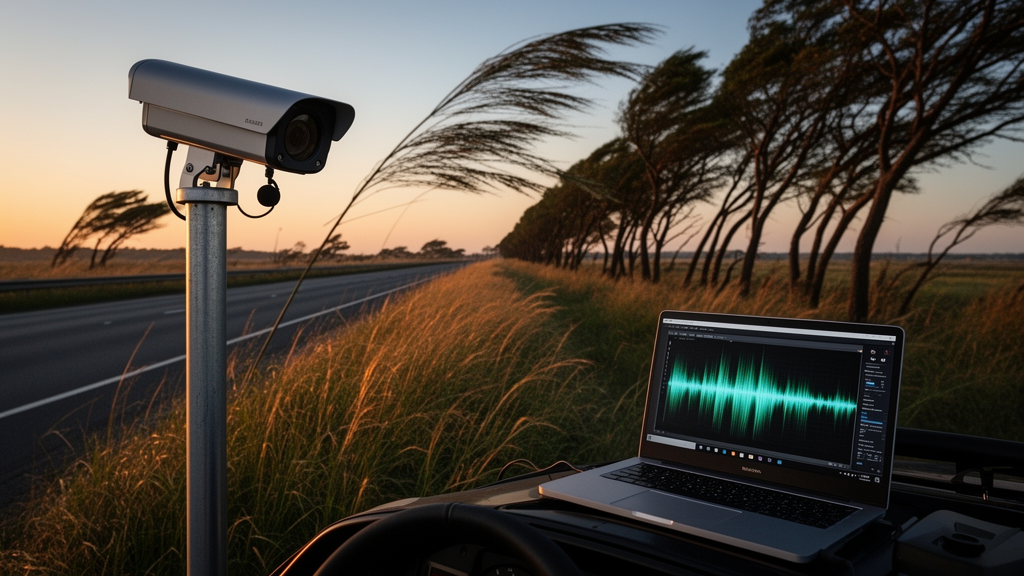
Every day, millions of traffic surveillance cameras line highways and city roads, silently recording video of passing vehicles. But most of these devices capture something else that until now has gone largely unnoticed: sound. A team of researchers in Nanjing, China, has shown that the ordinary microphones inside these cameras can be turned into wind sensors, allowing an artificial intelligence system to essentially listen to the wind and judge how hard it is blowing. Their creation, called the Intelligent Wind Ear, could give road operators a cheap new way to spot dangerous crosswinds before they cause accidents.
The problem the researchers set out to solve is real and serious. Strong crosswinds can push vehicles out of their lanes, tip over high-sided trucks, and trigger chain-reaction crashes. Yet wind along a roadway is notoriously difficult to measure well. Ground weather stations provide accurate point measurements but are sparse and expensive to install in large numbers. Doppler radar and lidar can map wind fields in three dimensions, but near the ground their readings are contaminated by reflections from vehicles, bridges, and buildings. Satellites offer global coverage but revisit the same spot too infrequently for real-time warnings, while numerical weather prediction models are computationally expensive and struggle with the small, turbulent scales that matter at a tunnel portal or an exposed bridge deck.
The insight behind the Intelligent Wind Ear is that the hardware for a denser observing network already exists. Surveillance camera networks are deployed at high density along transportation corridors, and their embedded microphones continuously record environmental audio, including the sound of the wind itself. As wind speed rises, the airflow interacting with the camera body, microphone housing, mounting bracket, and nearby objects generates more intense aerodynamic noise through turbulent pressure fluctuations, vortex shedding, boundary-layer turbulence, and flow separation. Stronger winds produce larger waveform fluctuations in time, more energy at high frequencies, broader frequency bands, and denser, more complex spectral stripes in the audio spectrograms. These patterns are not just empirical quirks; they are physically interpretable signatures of wind-driven aeroacoustics.
Turning this raw insight into a working sensor required overcoming a formidable obstacle: traffic noise. Horns produce short, loud, high-frequency pulses, while passing vehicles add steady low-frequency rumble that can swamp the weaker acoustic signals of light winds. The team’s solution was to build what they call wind-sound fingerprints, multidimensional representations that fuse four frequency-domain features extracted from the audio: Mel-frequency cepstral coefficients, which mimic aspects of human hearing; the Mel spectrogram, which captures how energy spreads across frequency bands; Chroma features, which map the spectrum onto twelve pitch classes and reveal periodic structure; and spectral contrast, which measures differences between spectral peaks and valleys. The four feature maps are resized, normalized, and concatenated into a single wide spectrogram-like image that serves as the input to the recognition model.
At the heart of the system sits WindEarNet, a deep learning architecture designed specifically for this task. The fused wind-sound fingerprint is first processed by a VGG-19 convolutional network, whose stacked small convolutional kernels excel at capturing local spectral textures, band structures, and fine time-frequency details. The resulting representations then flow through two stacked bidirectional gated recurrent unit layers, which read the acoustic sequence in both forward and backward directions to capture short-term variations associated with gusts, turbulence, and transient traffic noise. A fully connected layer and softmax classifier finally map the learned features to one of five wind speed levels, ranging from calm conditions below 4 meters per second up to the strongest category at or above 16 meters per second. The researchers deliberately chose classification over continuous regression, arguing that assigning winds to intervals is more robust given the uncertainties of field measurement and surveillance audio.
To train and test the system, the team assembled a remarkable dataset: roughly 100 hours of audio recorded by 25 operational traffic surveillance cameras of four different commercial models, mounted 4.5 to 12 meters above intersections and roadside locations across Nanjing. Crucially, the recordings included realistic urban clutter such as vehicles, electric bicycles, honking, sudden braking, conversations, and rainfall. Wind speed labels came from anemometers, either portable propeller instruments or cup anemometers at highway weather stations, placed within 50 meters of each camera, recording one-minute maximum wind speeds that were matched to the corresponding audio clips. The data were split so that no camera appeared in more than one subset, ensuring the model was always tested on devices it had never heard during training.
The results were benchmarked against an unusually thorough field of competitors. The researchers combined five convolutional feature extractors with multiple temporal modeling approaches, including recurrent networks, long short-term memory, gated recurrent units, and Transformers, in single- and two-layer configurations, producing 59 baseline models trained under identical conditions. WindEarNet held its own, achieving a best-run accuracy of 81.5 percent on the test dataset, with a mean of 81.1 plus or minus 0.3 percent across repeated runs, statistically indistinguishable from the strongest rivals. Confusion matrices revealed a clear pattern: accuracy was excellent at low wind levels, roughly 93 to 99 percent for the calmest category, but dropped for the two strongest levels, where most errors involved confusing adjacent high-wind categories with each other. The analysis pinpointed 13 to 16 meters per second as a fuzzy interval where acoustic signatures of neighboring wind speeds overlap.
When features matter most, the model pays attention to the right things. An explainability analysis using SHapley Additive exPlanations showed that spectral contrast contributed the most to predictions across most wind levels, followed by the Mel spectrogram, with the features’ relative importance shifting as winds strengthened. Under calm conditions, subtle changes in spectral energy distribution carried the signal, while at high wind speeds the model leaned heavily on spectral contrast. The real test, however, came from the field. During two typhoon events in September 2024, Bebinca and Pulasan, the system processed 890 minutes of surveillance audio from an urban road and two highways. WindEarNet achieved 77.9 percent accuracy across all five wind levels, and, importantly for safety applications, detected high-wind conditions at or above 12 meters per second with a detection rate of 88.1 percent and a false positive rate of just 4.2 percent.
The field deployment also exposed honest limitations. Accuracy at the calmest wind level fell from 99.2 percent in the test dataset to 82.1 percent in the real world, a degradation the researchers traced to weak wind-induced acoustic responses being drowned by traffic noise and voices, confirmed by measurable shifts in energy and spectral statistics between the two datasets. The intermediate Level 4 proved hardest to recognize at 66.0 percent, though most of those errors landed in adjacent categories rather than distant ones. The authors caution that their evaluation, drawn largely from typhoon-related events at ordinary roadside sites, does not yet establish performance at wind-prone locations such as bridge decks, tunnel portals, or coastal roads, where terrain reshapes local wind fields in ways that may produce unfamiliar acoustic signatures.
Even so, the implications are striking. The Intelligent Wind Ear requires no new hardware investment, runs a single inference in about 0.07 seconds, and transforms infrastructure that already blankets the road network into a distributed wind-sensing fabric. The researchers are careful to position it as a complement rather than a replacement: the wind levels it reports describe roadside wind intensity, not vehicle-specific risk, since actual danger also depends on wind direction relative to the road, vehicle type and speed, and road geometry. Future work aims at physics-guided learning that embeds aeroacoustic knowledge into the model, targeted data augmentation for the fuzzy 13-to-16-meter-per-second band, and multimodal fusion with anemometers, radar, and video. If those steps succeed, the humble traffic camera may soon do double duty, watching the road while listening to the sky.
Subject of Research: Acoustic recognition of roadside wind speed levels from traffic surveillance camera audio for crosswind hazard monitoring
Article Title: Intelligent wind ear: traffic surveillance audio-based wind speed level recognition for crosswind hazard monitoring
Article References: Intelligent wind ear: traffic surveillance audio-based wind speed level recognition for crosswind hazard monitoring. (n.d.). https://doi.org/10.1016/j.rineng.2026.113347
Image Credits: AI Generated
DOI: 10.1016/j.rineng.2026.113347
Keywords: crosswind, wind speed recognition, traffic surveillance, deep learning, audio features, wind-sound fingerprint, VGG-19, BiGRU, road safety, environmental sensing, typhoon, intelligent transportation
Cite Scienmag News
Blake Davidson. (October 15, 2026). AI Listens to Traffic Cameras to Hear Dangerous Roadside Winds. Scienmag. https://scienmag.com/ai-listens-to-traffic-cameras-to-hear-dangerous-roadside-winds/
Blake Davidson. "AI Listens to Traffic Cameras to Hear Dangerous Roadside Winds." Scienmag, 15 October 2026, https://scienmag.com/ai-listens-to-traffic-cameras-to-hear-dangerous-roadside-winds/. Accessed 15 October 2026.
Blake Davidson. "AI Listens to Traffic Cameras to Hear Dangerous Roadside Winds." Scienmag. October 15, 2026. https://scienmag.com/ai-listens-to-traffic-cameras-to-hear-dangerous-roadside-winds/


