


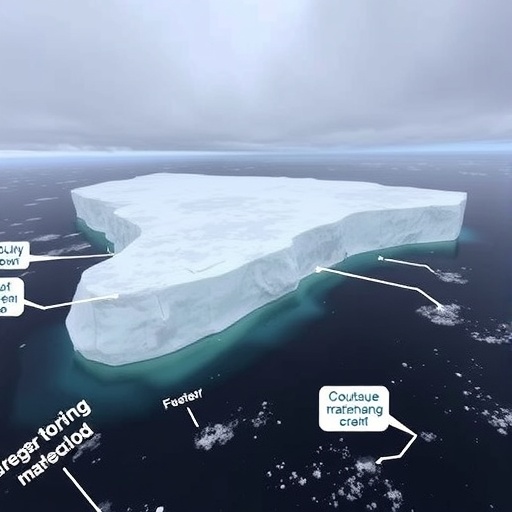
In a groundbreaking study published in Communications Earth & Environment, researchers have unveiled the profound effects that giant icebergs exert on the biogeochemical cycling within the Southern Ocean. This research delves into the dynamic interactions between massive ice structures and the ocean’s chemical, biological, and physical processes, revealing complexities that challenge previous assumptions about polar marine ecosystems. The Southern Ocean, a critical driver of global climate patterns and carbon cycling, is now shown to be intricately influenced by the movements and disintegration of these colossal icebergs, reshaping regional nutrient fluxes and ecological dynamics in unprecedented ways.
The study hinges on the observation that giant icebergs, some spanning hundreds of kilometers, are not passive entities drifting across the ocean but active agents that modulate nutrient distributions and biological productivity. As these icebergs calve from the Antarctic ice shelves and journey into the open ocean, their behavior disrupts existing water masses, mixes layers, and triggers localized biogeochemical responses. Researchers combined satellite tracking, oceanographic surveys, and advanced modeling techniques to capture the multi-scale impacts of iceberg drift and meltwater release on Southern Ocean nutrient availability, primary production, and carbon sequestration.
One of the most striking revelations from the research is the iceberg-driven stirrings in the ocean’s vertical structure. As giant icebergs traverse diverse oceanographic regimes, their keels scrape the seafloor, resuspending sediments rich in iron and other micronutrients essential for phytoplankton growth. This physical disturbance fertilizes otherwise nutrient-poor surface waters, effectively turning the iceberg wake into hotspots of biological activity. These biologically productive zones have cascading effects on food webs and biochemical cycles, enhancing carbon uptake at critical times in the seasonal cycle.
Furthermore, meltwater emanating from the icebergs introduces freshwater into the salty Southern Ocean, altering its stratification and density-driven circulation patterns. This meltwater input not only freshens the surface layers but also modifies the light environment, enabling more robust photosynthetic activity. By modulating the ocean’s physical and chemical environment on both temporal and spatial scales, giant icebergs emerge as pivotal players influencing ocean-atmosphere CO₂ exchange and regional climate feedbacks.
The researchers carefully mapped iceberg trajectories using satellite imagery over multiple seasons, correlating iceberg size, velocity, and melt rates with shifts in biogeochemical markers obtained from oceanographic cruises. This multi-disciplinary approach revealed that larger and slower-moving icebergs tend to exert the most significant influence on nutrient cycling, sustaining prolonged and intense phytoplankton blooms downstream. These blooms, in turn, impact higher trophic levels, potentially altering ecosystem structure and resilience in polar marine habitats.
Intriguingly, the study also shows that iceberg behavior is highly sensitive to climate-driven changes in atmospheric and oceanic conditions. Warming air temperatures and shifting wind patterns influence iceberg calving rates, meltwater dispersion, and drift paths. Such changes could either enhance or diminish the nutrient fertilization effect, depending on the interplay between iceberg dynamics and the changing Southern Ocean environment. This introduces a crucial feedback mechanism by which climate change directly affects biological productivity and carbon cycling through iceberg-mediated processes.
One of the technical challenges addressed by the authors was integrating the iceberg-induced biogeochemical impacts into regional climate and ocean system models. Conventional models often oversimplify iceberg processes or ignore them altogether, leading to gaps in predicting carbon fluxes and ecosystem responses. By incorporating detailed iceberg melt and scouring parameterizations derived from empirical observations, the team was able to simulate more realistic Southern Ocean biogeochemical cycles. These enhanced models provide valuable insights for global climate projections, emphasizing the need to consider iceberg dynamics in Earth system modeling frameworks.
The implications of this research extend beyond polar oceanography, touching on global carbon budgets and climate mitigation strategies. The Southern Ocean plays an outsized role in sequestering atmospheric CO₂, and understanding the factors that regulate this capacity is essential for accurate climate forecasting. Giant icebergs, through their surprisingly influential role, underscore the complexity of feedbacks in marine carbon cycling, suggesting that future changes in Antarctic ice dynamics could have far-reaching consequences for global climate regulation.
Another notable finding from the study concerns the spatial variability of iceberg impacts. Not all regions within the Southern Ocean respond uniformly to icebergs. The interaction between iceberg size, drift trajectory, underlying bathymetry, and oceanographic context creates heterogeneous zones of nutrient enrichment and biological response. This heterogeneity highlights the importance of localized observations and targeted sampling in understanding polar marine biogeochemistry and suggests that broad-brush assessments may overlook critical spatial nuances.
The study also advances methodological frontiers by linking remote sensing technologies with high-resolution in situ measurements. By utilizing satellites equipped with synthetic aperture radar and optical instruments, researchers tracked iceberg morphology changes and meltwater plumes in near real-time. Concurrently, deployment of autonomous underwater vehicles and research vessels provided fine-scale chemical and biological data filling knowledge gaps left by satellite observations. This integrated methodological approach sets a new standard for studying dynamic polar environments undergoing rapid transformation.
Moreover, the research offers critical perspectives on the future of Antarctic ecosystems under continued climate stress. As ice shelves retreat and calving events increase, the frequency and size distribution of giant icebergs are expected to shift. Understanding how these changes propagate through biogeochemical networks is paramount for predicting ecosystem health and productivity. The team’s findings suggest that while some biological systems may benefit from enhanced nutrient inputs, others could face stress from altered water column properties, potentially disrupting delicate ecological balances.
Beyond scientific implications, the social and policy relevance of this work is significant. The Southern Ocean is a major fishing ground and a component of global food security systems. Variations in primary productivity driven by iceberg activity could impact fish stocks and other marine resources, affecting economic activities dependent on healthy ocean ecosystems. This research, therefore, informs governance frameworks concerning Antarctic marine protection, fisheries management, and climate adaptation policies.
Technically, the interplay of iceberg keel depth with seafloor topography emerged as a key determinant of iceberg-induced biogeochemical change. The deeper and more rugged the bathymetry, the greater the potential for sediment resuspension and nutrient flux enhancement. This biomechanical interaction provides a physical basis linking ice dynamics to ocean chemistry, a relationship that has been underrecognized despite its importance for nutrient cycling in polar regions.
In sum, the study by Taylor et al. marks a paradigm shift in our understanding of polar ocean biogeochemistry by elevating the role of giant icebergs from passive remnants of ice shelf calving to active modulators of marine ecosystems and global biogeochemical cycles. By coupling extensive observational data with sophisticated modeling, the research reveals a vibrant and complex picture of iceberg-ocean interactions, demonstrating that these icy giants are pivotal climate and ecosystem engineers in one of Earth’s most remote and climatically influential regions.
This work opens new avenues for scientific exploration, highlighting the necessity for ongoing monitoring of iceberg behavior and its biogeochemical consequences in the rapidly changing Southern Ocean. It suggests that as the climate continues to warm and Antarctic ice dynamics evolve, giant icebergs will play an increasingly critical role in shaping the future of ocean health, carbon storage capabilities, and planetary climate feedback mechanisms. The study stands as a compelling testament to the interconnectedness of Earth’s cryosphere, ocean, and atmosphere in the Anthropocene era.
Cite Scienmag News
Violet Maxwell. (April 20, 2026). Giant Icebergs Drive Southern Ocean Biogeochemical Shifts. Scienmag. https://scienmag.com/giant-icebergs-drive-southern-ocean-biogeochemical-shifts/
Violet Maxwell. "Giant Icebergs Drive Southern Ocean Biogeochemical Shifts." Scienmag, 20 April 2026, https://scienmag.com/giant-icebergs-drive-southern-ocean-biogeochemical-shifts/. Accessed 3 September 2026.
Violet Maxwell. "Giant Icebergs Drive Southern Ocean Biogeochemical Shifts." Scienmag. April 20, 2026. https://scienmag.com/giant-icebergs-drive-southern-ocean-biogeochemical-shifts/


