


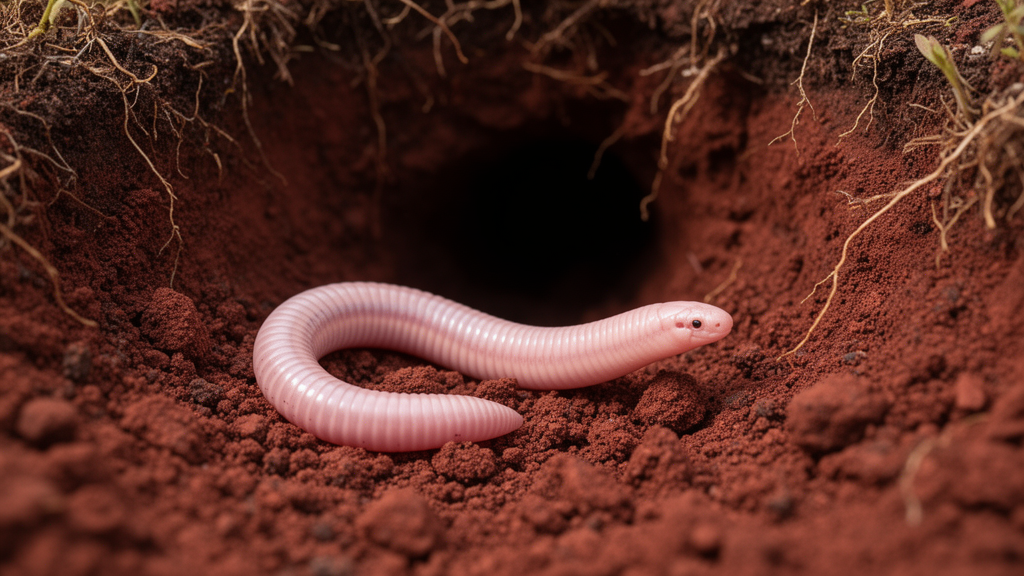
Beneath the red soils and sandy riverbanks of northeastern Brazil lives a reptile most people will never see. Leposternon polystegum, a worm-lizard in the amphisbaenian family, spends nearly its entire life underground, hunting soil invertebrates through tunnels it excavates with a reinforced, shovel-like head. That secretive lifestyle has long frustrated biologists: museum records are sparse, field surveys rarely detect the animals, and the maps drawn from such patchy data may say more about where scientists have looked than where the species actually lives. A new study published in Frontiers of Biogeography tackles that problem with an unusual statistical toolkit borrowed from fuzzy logic, and the results redraw the species’ potential range in ways that cut across the boundaries of Brazil’s most familiar biomes.
The research team, led by Jady Eleutério with collaborators including José C. Guerrero, compiled 502 occurrence records for L. polystegum from museum databases, the Global Biodiversity Information Facility, the speciesLink platform, and specialized literature. These records spanned four major Brazilian biomes: the Amazon, the Atlantic Forest, the Caatinga, and the Cerrado, with the bulk of confirmed sightings concentrated in the country’s northeast. Rather than treating each record as a simple pin on a map, the researchers overlaid a grid of 181,221 hexagonal cells, each roughly 6.1 kilometers across, covering the whole of South America. Cells containing confirmed records were coded as presences; everything else was treated as background, an honest acknowledgment that for a burrowing animal, absence of evidence is emphatically not evidence of absence.
The choice of a continent-wide modeling extent was deliberate. Restricting a model to the area where a species has already been found can artificially truncate the environmental space being sampled, producing maps that simply echo the sampling effort. By calibrating across South America, the team allowed environmentally analogous regions far beyond the known range to be evaluated on their own merits, a strategy biogeographers recommend for poorly sampled taxa whose true distributions are likely underestimated.
Into that grid the researchers poured 33 candidate predictor variables drawn from four families of data. Climatic layers came from the CHELSA and ENVIREM datasets and included standard bioclimatic descriptors such as annual mean temperature, precipitation seasonality, and growing degree days, along with evapotranspiration and a climatic moisture index. Hydrographic predictors, derived from HydroSHEDS, measured the number of nearby rivers, the count of large rivers, and distances to the nearest watercourse. Topographic variables captured mean altitude, terrain roughness, and the north-south and east-west orientation of the land. Finally, a spatial predictor built from a polynomial trend surface analysis encoded broad geographic structure in latitude and longitude, allowing the model to separate environmentally driven patterns from variation tied simply to where on the continent a site sits.
Not all of those variables survived the winnowing. The team applied a five-step selection protocol designed to keep the final model parsimonious and statistically defensible. First, pairwise Spearman correlations removed redundant predictors correlated above 0.7. Then variance inflation factors screened out multicollinear variables exceeding a threshold of 10. A false discovery rate correction controlled for Type I errors across the many individual tests, with significance assessed by Rao’s score test. Finally, stepwise multivariate logistic regression, run separately within each factor group before recalibration into an integrated model, retained only the variables that genuinely improved fit. Eleven predictors made the cut, a mix of climatic, hydrographic, topographic, and spatial terms.
The heart of the method lies in how the model expresses its output. Conventional species distribution models produce probabilities of occurrence, but those probabilities are entangled with the species’ prevalence in the dataset. When a species is rare or poorly sampled, as fossorial reptiles almost always are, raw probabilities can be misleadingly low everywhere. The favorability function developed by Real and colleagues converts the logistic probability into a favorability score that is independent of prevalence, using the formula F = [P/(1−P)] / [(n1/n0) + (P/(1−P))], where P is the predicted probability and n1 and n0 are the numbers of presences and absences. Within this fuzzy logic framework, suitability is a continuous gradient rather than a hard-edged yes or no, which suits organisms whose real ecological boundaries are graded and diffuse. A favorability value of 0.5 serves as the neutral threshold, mathematically equivalent to a probability equal to the species’ prevalence, allowing every cell on the map to be compared on equal footing.
The final combined model performed well. It achieved an area under the receiver operating characteristic curve of 0.825 and explained 76.8 percent of the deviance in the occurrence data, with predicted favorability approaching 0.991 in the most suitable cells. Variation partitioning, which splits the explained variation among predictor groups, showed that the variables jointly accounted for 54.8 percent of total variation. Spatial structure dominated the pure fractions, explaining 29.9 percent on its own, followed by climate at 22.9 percent. Topography and hydrography contributed smaller unique shares, at 1.3 percent and 0.8 percent respectively, and overlaps between groups were negligible.
The coefficient estimates told a coherent ecological story. The spatial trend surface carried the largest positive coefficient, 0.931, and the highest Wald statistic, 28.162; interpreted as an odds ratio of 2.537, each unit increase in the spatial trend raised the odds of occurrence by roughly 154 percent. That strong spatial signal likely bundles together historical processes, dispersal limitations, and the uneven geography of sampling itself. Among the environmental terms, the mean temperature of the wettest quarter emerged as a significant positive driver, while the maximum temperature of the warmest month and growing degree days above zero degrees Celsius had negative effects, suggesting the species favors thermally stable conditions and avoids extremes. On the hydrographic side, the number of nearby large rivers increased favorability while distance to the nearest large river decreased it, pointing to the importance of riparian zones where friable, moisture-retentive soils ease burrowing and support dense communities of the soil invertebrates that make up the bulk of the species’ diet.
When the favorability scores were mapped across South America, the highest values concentrated in semiarid northeastern Brazil, particularly in regions of moderate elevation with stable humidity and proximity to major rivers, and extended along coastal areas consistent with the known records. Strikingly, the zones of high favorability did not respect the boundaries of the Amazon, Cerrado, Caatinga, or Atlantic Forest as drawn on conventional vegetation maps. Instead, suitability flowed continuously across the transition zones where these biomes grade into one another. The authors interpret this as evidence that the distribution of fossorial reptiles is filtered by soil properties and microclimatic stability rather than by the aboveground vegetation that defines ecoregions, a phenomenon they describe as hidden biogeography. Soil moisture and thermal regimes buffer surface-level climatic variability, so the underground world a worm-lizard inhabits can remain favorable even as the landscape above shifts from cerrado scrub to caatinga thorn forest.
The findings carry practical weight beyond the species itself. Because favorability modeling decouples suitability from prevalence, it offers a robust framework for mapping other data-poor, cryptic taxa whose ranges are routinely underestimated, and the authors suggest that future iterations incorporating direct soil measurements could sharpen predictions further. The continuous favorability maps can guide field surveys toward underexplored transition zones, help identify priority areas for conserving fossorial biodiversity in South America, and remind ecologists that some of the continent’s most important biogeographical patterns may be running, quite literally, just beneath their feet.
Subject of Research: Fuzzy logic species distribution modeling of the fossorial reptile Leposternon polystegum in Brazil
Article Title: Revealing hidden patterns in the potential distribution of Leposternon polystegum (Duméril, 1851) ( Amphisbaenia , Amphisbaenidae ) using fuzzy logic modeling
Article References: Eleutério, J. P., Santos-Jr, A. P., Guerrero, J. C., & Ribeiro, S. (2026). Revealing hidden patterns in the potential distribution of Leposternon polystegum (Duméril, 1851) (Amphisbaenia, Amphisbaenidae) using fuzzy logic modeling. Frontiers of Biogeography, 19, Article e179470. https://doi.org/10.21425/fob.19.179470
Image Credits: AI Generated
Keywords: Leposternon polystegum, amphisbaenian, fuzzy logic, species distribution modeling, favorability function, biogeography, Caatinga, Cerrado, fossorial reptiles, variation partitioning, Neotropics, soil moisture
Cite Scienmag News
Margaret Porter. (October 16, 2026). Fuzzy Logic Reveals Hidden Map of Brazil’s Underground Worm-Lizard. Scienmag. https://scienmag.com/fuzzy-logic-reveals-hidden-map-of-brazils-underground-worm-lizard/
Margaret Porter. "Fuzzy Logic Reveals Hidden Map of Brazil’s Underground Worm-Lizard." Scienmag, 16 October 2026, https://scienmag.com/fuzzy-logic-reveals-hidden-map-of-brazils-underground-worm-lizard/. Accessed 16 October 2026.
Margaret Porter. "Fuzzy Logic Reveals Hidden Map of Brazil’s Underground Worm-Lizard." Scienmag. October 16, 2026. https://scienmag.com/fuzzy-logic-reveals-hidden-map-of-brazils-underground-worm-lizard/


