


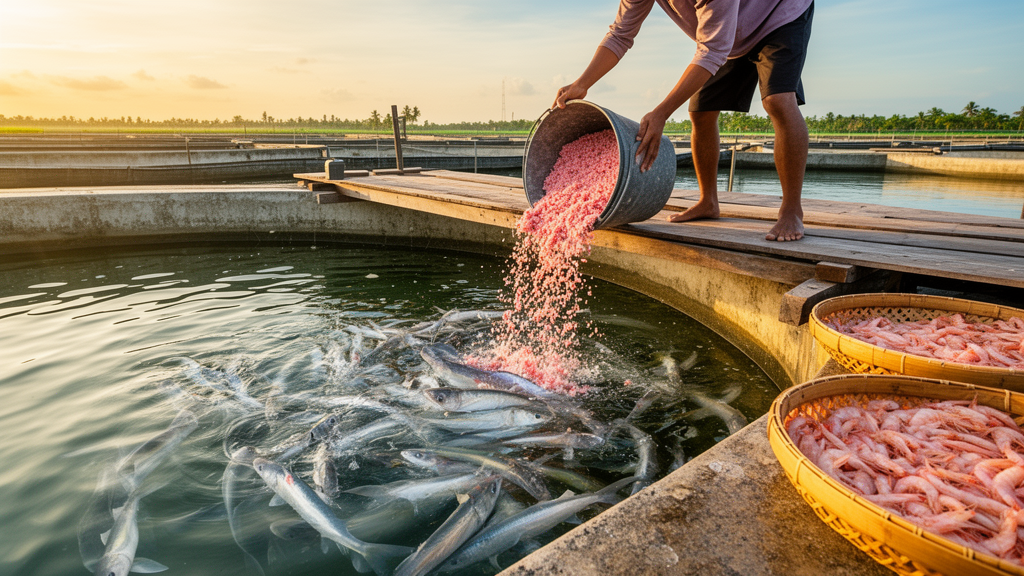
The rising cost and shrinking supply of fishmeal have long been a bottleneck for the global aquaculture industry, and few sectors feel the squeeze more acutely than milkfish farmers in Southeast Asia. Now, a study from the Philippines suggests that an abundant and often discarded byproduct of shrimp processing could offer a practical solution. Researchers at the University of the Philippines Visayas have shown that shrimp head meal, a protein-rich powder made from the heads left over after shrimp are processed, can replace up to a quarter of the fishmeal in diets for milkfish fry without compromising growth, feed efficiency, or survival. The findings, published in Acta Ichthyologica et Piscatoria, could reshape how one of the region’s most important farmed fish is fed during its most vulnerable life stage.
Milkfish, Chanos chanos, is the most widely farmed aquaculture species in the Philippines and a cornerstone of food security across Southeast Asia. In 2024, the country produced more than 357,000 tonnes of milkfish, accounting for 16.1 percent of its total aquaculture output. Yet despite its economic importance, milkfish farming faces persistent challenges, including high feed costs, poor growth performance, and low survival rates during nursery rearing. Feed represents between 60 and 70 percent of production costs, with protein sources such as fishmeal and soybean meal being the most expensive dietary components. As wild fish stocks decline and demand for aquafeed protein rises, finding affordable and sustainable alternatives has become a priority for researchers and farmers alike.
The research team, led by scientists at the Institute of Aquaculture, College of Fisheries and Ocean Sciences, University of the Philippines Visayas, turned to shrimp head meal as a candidate ingredient. Shrimp processing generates substantial quantities of waste, particularly heads, which are rich in protein but also contain chitin, a structural polysaccharide from crustacean exoskeletons that can interfere with nutrient digestibility when included at high levels in fish diets. The researchers obtained shrimp heads of the Pacific white shrimp, Penaeus vannamei, from a local processing facility, washed and sun-dried them, removed appendages and debris, and ground the material into a uniform powder. They then formulated five experimental diets in which shrimp head meal replaced sardine fishmeal at 0, 25, 50, 75, and 100 percent, with all other ingredients held constant.
The 60-day feeding trial was conducted at the Multi-Purpose Hatchery of the University of the Philippines Visayas in Miagao, Iloilo, using a completely randomized design with three replicates per treatment. Milkfish fry with an initial mean body weight of 0.081 grams were stocked at 20 individuals per 100-liter container in a flow-through water system with continuous aeration. The fry were fed three times daily at rates adjusted as they grew, and water quality parameters, including temperature, pH, and dissolved oxygen, remained within recommended ranges throughout the trial. Sampling at 15-day intervals allowed the researchers to track survival, growth, and feed intake while adjusting rations accordingly.
The results were striking in their clarity. Fry fed the diet containing 25 percent shrimp head meal replacement achieved the highest weight gain of any treatment, at 1,151.3 percent, along with the highest survival rate at 71.7 percent. Both metrics were statistically comparable to the control diet containing no shrimp head meal. Specific growth rate and feed conversion efficiency also remained stable between the control and the 25 percent replacement group, indicating that the fry were utilizing nutrients just as efficiently as those eating conventional fishmeal-based feed. Protein efficiency ratio, a measure of how effectively dietary protein is converted into body tissue, was similarly unaffected at this moderate inclusion level.
However, the picture changed dramatically at higher inclusion levels. Fry fed diets in which shrimp head meal replaced 50, 75, or 100 percent of fishmeal showed significant reductions in weight gain, feed conversion efficiency, and survival. The 100 percent replacement group fared worst, with weight gain of just 572.7 percent, feed conversion efficiency of 32.2 percent, and survival of 56.7 percent. These declines point to fundamental limitations in the nutritional profile of shrimp head meal when used as a major protein source, rather than as a supplementary ingredient.
Carcass analysis revealed an intriguing pattern beneath these growth differences. Fish fed higher levels of shrimp head meal showed increased crude protein content in their bodies, reaching 85.2 to 85.5 percent in the 50 and 75 percent replacement groups compared to 81.7 percent in the control. At the same time, crude lipid levels declined progressively, from 4.72 percent in the control to just 3.18 percent in the 100 percent replacement group. This suggests a shift in nutrient partitioning, whereby available dietary protein is preferentially directed toward tissue synthesis rather than stored as fat. While leaner fish might seem desirable, reduced lipid deposition can limit energy reserves and disrupt metabolic balance in rapidly growing fry.
Nutrient retention data reinforced this interpretation. Protein retention was highest in the 75 percent replacement group at 9.37 percent and in the 50 percent group at 8.50 percent, both significantly greater than the control’s 1.62 percent. Conversely, lipid retention fell sharply with increasing shrimp head meal inclusion, from 61.5 percent in the control to just 19.2 percent in the 100 percent group. The researchers attribute this pattern to the combination of chitin-related digestibility constraints and amino acid imbalances in shrimp head meal. Compared with fishmeal, shrimp by-products typically contain lower levels of essential amino acids such as methionine and lysine, both of which are critical for growth and protein synthesis in milkfish. Previous research has demonstrated that methionine deficiency can directly impair growth in juvenile milkfish, and that successful aquafeed formulation requires balanced amino acid profiles and adequate digestibility.
The study’s authors suggest that the increased protein retention alongside reduced growth may reflect a metabolic adjustment. When dietary lipid or available energy is insufficient, fish can divert amino acids toward energy production rather than somatic growth, leading to higher protein retention in tissues but reduced growth efficiency due to increased protein catabolism. This energy imbalance, combined with the digestibility constraints imposed by chitin, likely explains why higher shrimp head meal inclusion levels failed to sustain the growth performance achieved at moderate levels.
From a practical standpoint, the findings offer clear guidance for milkfish farmers and feed formulators. Shrimp head meal can effectively replace up to 25 percent of fishmeal in nursery diets without compromising performance, providing a cost-effective and locally sourced alternative that aligns with circular aquaculture principles by converting waste streams into valuable resources. The researchers recommend further work on processing methods such as de-chitinization, enzymatic hydrolysis, or fermentation to improve the nutritional value of shrimp head meal at higher inclusion levels. They also call for detailed amino acid and fatty acid profiling, long-term feeding trials across life stages and species, and economic analyses to quantify the cost savings and sustainability benefits for commercial aquaculture. In a region where both shrimp processing and milkfish farming are economically significant, the prospect of turning one industry’s waste into another’s feed ingredient represents a compelling step toward more sustainable food production.
Subject of Research: Use of shrimp head meal as a fishmeal substitute in milkfish fry aquaculture feeds
Article Title: Shrimp head meal as a practical fishmeal substitute in diets for milkfish, Chanos chanos ( Actinopterygii , Gonorynchiformes , Chanidae ), fry
Article References: Batilong, L. S., Ranara, C. T. B., Lumayno, S. D. P., Tanay, D. D., del Castillo, C. S., Failaman, A. N., & Traifalgar, R. F. M. (2026). Shrimp head meal as a practical fishmeal substitute in diets for milkfish, Chanos chanos (Actinopterygii, Gonorynchiformes, Chanidae), fry. Acta Ichthyologica et Piscatoria, 56, 247-254. https://doi.org/10.3897/aiep.56.184586
Image Credits: AI Generated
Keywords: aquaculture, milkfish, shrimp head meal, fishmeal substitute, feed sustainability, chitin, protein retention, Philippines, Chanos chanos, nursery culture, feed conversion efficiency, circular economy
Cite Scienmag News
Sloane Callahan. (October 16, 2026). Shrimp Head Meal Could Slash Fishmeal Costs in Milkfish Farming, Study Finds. Scienmag. https://scienmag.com/shrimp-head-meal-could-slash-fishmeal-costs-in-milkfish-farming-study-finds/
Sloane Callahan. "Shrimp Head Meal Could Slash Fishmeal Costs in Milkfish Farming, Study Finds." Scienmag, 16 October 2026, https://scienmag.com/shrimp-head-meal-could-slash-fishmeal-costs-in-milkfish-farming-study-finds/. Accessed 16 October 2026.
Sloane Callahan. "Shrimp Head Meal Could Slash Fishmeal Costs in Milkfish Farming, Study Finds." Scienmag. October 16, 2026. https://scienmag.com/shrimp-head-meal-could-slash-fishmeal-costs-in-milkfish-farming-study-finds/


