


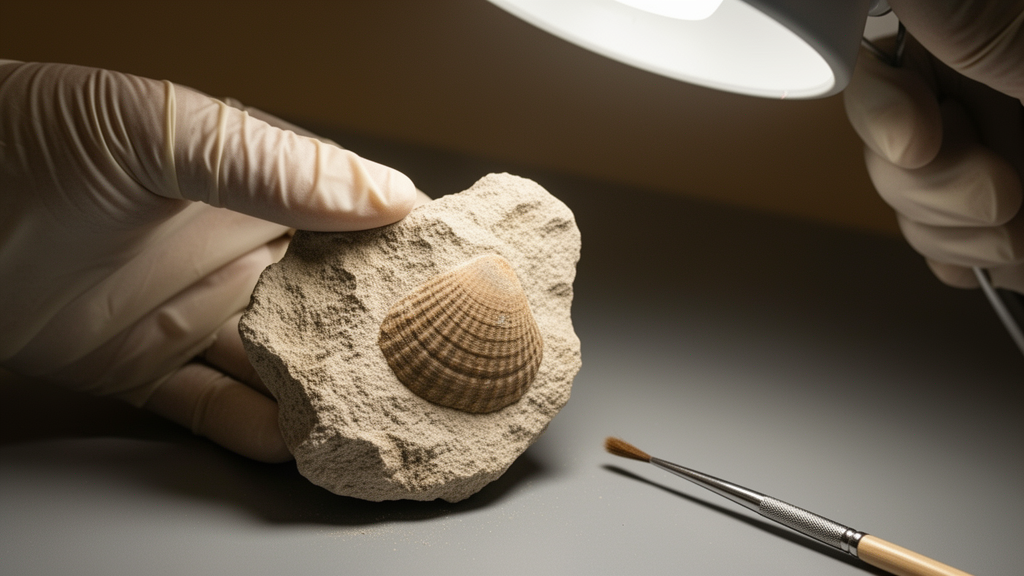
Some of the strangest snails that ever lived spent their adult lives clamped onto the stems and calyxes of crinoids, the stalked sea lilies that carpeted Paleozoic seafloors. These limpet-shaped gastropods, known informally as platycerates, flourished from the Ordovician to the Permian, yet their evolutionary relationships have puzzled paleontologists for more than a century. A new study published in Zitteliana by an international team of researchers has now examined exceptionally well-preserved specimens from Sweden and the United States, and the results are shaking up how scientists classify this entire group of ancient mollusks.
The research focuses on four species of the genus Orthonychia, including a brand-new species named Orthonychia yutaroi, which comes from the Late Ordovician Boda Limestone of central Sweden and is the oldest well-preserved member of the genus known to date. The team also restudied Orthonychia enorme from the Silurian of Gotland, Orthonychia parva from the Pennsylvanian Finis Shale of Texas, and an unnamed Orthonychia species from the Mississippian Imo Formation of Arkansas. What makes these specimens so valuable is that several preserve their earliest shell stages, the protoconchs, in remarkable detail under scanning electron microscopy.
The protoconch, the larval shell formed before the animal settles onto the seafloor, is a treasure trove of information for gastropod biologists. Its coiling pattern and dimensions can reveal whether a species produced free-swimming, plankton-feeding larvae, a mode of development called planktotrophy, or whether it hatched as a miniature adult from a yolk-rich egg. For decades, paleontologists assumed that the openly coiled, fish-hook-like protoconchs of Orthonychia were so distinctive that they defined an entire order of gastropods, the Cyrtoneritimorpha, which was proposed as the fossil sister group of modern nerites.
The new material overturns that tidy picture. While Orthonychia parva indeed sports the classic openly coiled, worm-like larval shell, the newly described juvenile specimens of Orthonychia enorme from Gotland possess tightly coiled protoconchs with up to roughly two and a half whorls. This is the first report of tightly coiled protoconchs in Orthonychia, and it means that both shell states coexist within a single genus. If the presence of an openly coiled protoconch was supposed to be the defining feature of the order Cyrtoneritimorpha, that order can no longer stand as a natural, monophyletic group.
The authors therefore propose a bold taxonomic move: the orders Cyrtoneritimorpha and Cycloneritimorpha should be treated as synonyms of the broader subclass Neritimorpha. In other words, the distinction between gastropods with openly and tightly coiled larval shells, long treated as a deep evolutionary divide, may simply reflect variation within lineages rather than a fundamental split. The team also notes that the Devonian genus Pragoserpulina, which until now sat in its own monotypic family, is morphologically so close to the Orthonychia species described here that the two genera, and their respective families, may eventually need to be merged.
Measurements of shell width at a standardized length of 100 micrometers provided an independent line of evidence about larval ecology. This metric serves as a proxy for embryonic shell size, egg size, and yolk content: small values point to planktotrophic larvae that must feed in the water column, while large values indicate non-planktotrophic development. The platycerate specimens averaged just 75 micrometers, with a range of 66 to 82 micrometers, whereas Carboniferous euomphaloid gastropods measured in the same study averaged 140 micrometers, ranging from 117 to 160 micrometers. The contrast is stark and consistent with the protoconch morphology itself.
The implications reach far beyond taxonomy. Because living members of basal gastropod clades such as Patellogastropoda, Cocculiniformia, and Vetigastropoda obligatorily lack planktotrophic larvae, the presence of planktotrophy in platycerates rules out any close relationship with those groups. Instead, the new data corroborate the long-standing hypothesis that platycerates belong to the Neritimorpha, a conclusion further supported by their calcitic shell microstructure, which resembles that of Paleozoic and Mesozoic naticopsid neritimorphs, and by the neritoid shape of many platycerate shells.
Perhaps the most intriguing evolutionary story concerns the fate of the openly coiled protoconch itself. During the Paleozoic Era, this fragile, elongated larval shell type gradually vanished from the fossil record, disappearing entirely by the Late Triassic except in some holoplanktonic modern lineages. Previous researchers linked this decline to the so-called Paleozoic plankton revolution, a period of escalating predation pressure in the water column that would have made a long, uncoiled, vulnerable larval shell a deadly liability. The new findings suggest that openly and tightly coiled protoconchs were scattered across multiple Paleozoic gastropod clades, and that natural selection acted against the openly coiled morphology independently in each lineage rather than wiping out a single branch of the family tree.
The study also sheds light on the peculiar lifestyle of these snails. Platycerates are famous for their association with crinoids, and many specimens have been found still attached to their hosts, leading paleontologists to interpret their unusual, limpet-like or tube-like shells as adaptations to a sedentary, probably parasitic or commensal existence. The juvenile Orthonychia parva specimens from Texas show a striking ontogenetic sequence: a tiny embryonic bulb, a straight larval tube, a coiled larval stage that the authors interpret as preparation for settling, and then a sudden widening of the shell that likely marks the moment the young snail took up residence on a crinoid. In Gotland, some Orthonychia enorme shells even serve as the cores of cauliflower-shaped oncoids, microbial nodules that grew around them on the Silurian seafloor.
By combining classical systematics with modern imaging and quantitative larval ecology, this study demonstrates how much hidden information can still be extracted from fossils collected more than a century ago, including type specimens first illustrated by Gustaf Lindström in 1884. The platycerates, once dismissed as taxonomically intractable curiosities of crinoid-infested Paleozoic seas, are now emerging as a key group for understanding how larval strategies, predation regimes, and symbiotic lifestyles shaped the deep evolutionary history of one of the most successful animal phyla on Earth.
Subject of Research: Evolutionary morphology and systematics of Paleozoic platycerate gastropods based on protoconch evidence
Article Title: On Paleozoic platycerate gastropods
Article References: Nützel, A., Ebbestad, J. O., Seuss, B., Munnecke, A., Mapes, R. H., & Cook, A. G. (2023). On Paleozoic platycerate gastropods. Zitteliana, 97, 29-51. https://doi.org/10.3897/zitteliana.97.115688
Image Credits: AI Generated
DOI: 10.3897/zitteliana.97.115688
Keywords: Paleozoic, gastropods, Orthonychia, protoconch, Neritimorpha, planktotrophy, crinoids, Silurian, Ordovician, Carboniferous, paleontology, larval ecology
Cite Scienmag News
Gavin Prescott. (October 16, 2026). Ancient Limpet-Like Snails Rewrite the Story of Gastropod Evolution. Scienmag. https://scienmag.com/ancient-limpet-like-snails-rewrite-the-story-of-gastropod-evolution/
Gavin Prescott. "Ancient Limpet-Like Snails Rewrite the Story of Gastropod Evolution." Scienmag, 16 October 2026, https://scienmag.com/ancient-limpet-like-snails-rewrite-the-story-of-gastropod-evolution/. Accessed 16 October 2026.
Gavin Prescott. "Ancient Limpet-Like Snails Rewrite the Story of Gastropod Evolution." Scienmag. October 16, 2026. https://scienmag.com/ancient-limpet-like-snails-rewrite-the-story-of-gastropod-evolution/


