


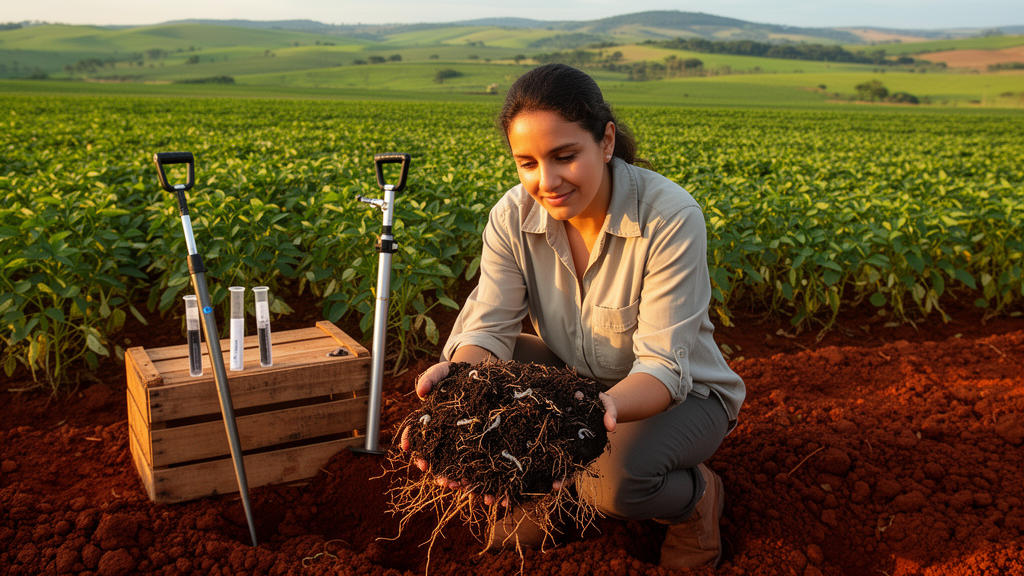
Beneath every soybean field, sugarcane plantation, and cattle pasture in Brazil lies an invisible workforce that keeps agriculture running. Earthworms churn the soil, enchytraeid worms process organic debris, springtails recycle nutrients, and soil mites patrol the dark pores of the earth as voracious predators and decomposers. A sweeping new review published in Neotropical Biology and Conservation has now compiled four decades of field research on these four groups, offering the most comprehensive picture yet of how Brazil’s agricultural transformation is reshaping the fauna that underpin its soils.
The research team, drawing on more than 120 peer-reviewed field studies published up to June 2023, systematically searched eleven specialized scientific databases alongside Google Scholar to assemble density records for earthworms, enchytraeids, collembolans, and soil mites across the country’s diverse landscapes. After applying strict inclusion criteria and discarding studies with unreliable or insufficient data, 102 publications formed the analytical backbone of the review. The researchers converted all abundance figures to a standardized metric of individuals per square meter, allowing direct comparison across studies that had originally used wildly different sampling methods, from hand sorting to chemical extraction to the Tropical Soil Biology and Fertility protocol.
The geographic picture that emerges is strikingly uneven. Nearly half of all studies concentrated in just three southern states: Rio Grande do Sul accounted for 20 percent of the research, Paraná for 19 percent, and Santa Catarina and São Paulo for 8 percent each. The northern Amazonian states of Amazonas and Pará contributed another 15 percent combined, while the remaining states each hosted less than 4 percent of the studies. This clustering reveals a fundamental mismatch between where soil fauna research happens and where the most intensive agriculture occurs. Brazil’s central and southern regions, where cropping frequencies reach 1.25 to 1.70 cycles per year, are not necessarily the same places where scientists have been counting worms and mites, suggesting that research sites may have been chosen more for their proximity to universities than for their representativeness of Brazil’s agricultural heartland.
When the researchers examined how land use shapes soil organism densities, the four groups told strikingly different stories. Earthworms showed relatively modest variation across natural vegetation, arable fields, and grassland, with average densities of 158, 107, and 134 individuals per square meter respectively. Springtails, by contrast, reached their highest average abundance in arable fields at 18,660 individuals per square meter, though this figure was heavily inflated by outlier studies; once those were excluded, natural cover sites supported the highest springtail densities at 3,143 individuals per square meter. Enchytraeids followed a pattern more similar to earthworms, with grassland sites averaging 13,154 individuals per square meter but natural cover and arable land showing substantially lower figures. Soil mites defied easy categorization entirely, with some studies reporting densities exceeding 60,000 individuals per square meter in organic-rich arable soils while others found fewer than 500 in comparable settings.
The seasonal dimension added another layer of complexity. Springtails and soil mites both showed clear preferences for the rainy season, with collembolan densities increasing by roughly 158 percent when comparing dry-season to wet-season averages across all studies. In paired comparisons where researchers sampled the same plots in both seasons using identical methods, the rainy-season advantage for springtails persisted at around 46 percent. Earthworms, surprisingly, showed the opposite pattern in the pooled analysis, averaging 202 individuals per square meter in the dry season versus 126 in the rainy season, though direct paired comparisons generally favored the rainy season. Enchytraeids also appeared more abundant in dry conditions overall, but this trend reversed entirely when a single high-density study from an Amazonian research station was excluded from the calculation.
Perhaps the most consequential finding for Brazilian agriculture concerns tillage. In fields where no tillage was practiced, earthworm densities averaged 77 individuals per square meter; where conventional tillage was employed, the figure plummeted to just 26 individuals per square meter. When the analysis was restricted to studies that directly compared tilled and untilled plots within the same fields, the disparity widened further, with no-tillage fields supporting 97 earthworms per square meter against 26 in tilled fields, representing a potential reduction of at least 67 percent. Individual studies reported even steeper declines, with reductions of 72 to 82 percent documented across different seasons and regions. Springtails also declined under tillage in most individual comparisons, with reported decreases ranging from 30 to 70 percent, though the pooled averages were complicated by high variability between studies.
Soil chemistry added further nuance to the picture. Earthworm densities in arable land appeared to increase with rising pH, from around 20 individuals per square meter at pH 4.0 to 4.5 up to 89 individuals per square meter at pH 6.0 to 6.5, yet in grassland the trend reversed, with peak earthworm densities occurring at the more acidic pH range of 4.0 to 5.0. Soil mites showed a tendency toward higher densities at near-neutral pH values between 6.0 and 7.0, though the researchers cautioned that this pattern might be an artifact of study conditions rather than a genuine biological response. Enchytraeids displayed no consistent pH trend at all, with densities varying by more than two orders of magnitude across different studies conducted at similar pH levels but in different Brazilian states.
The review also exposed how dramatically methodological choices can shape apparent ecological patterns. Studies using hand sorting consistently produced different density estimates than those employing the standardized TSBF method or soil core extraction. The timing of sampling, whether during peak growing season or dormant periods, further modulated results. Perhaps most problematically, many density peaks in the compiled dataset could be traced to single studies conducted under unique environmental or agronomic circumstances, such as a coffee plantation with unusually high organic matter or a research station with distinctive soil properties. When the researchers removed these outlier datasets from their analyses, several apparent trends reversed direction entirely, underscoring how fragile the current understanding of Brazilian soil fauna remains.
The researchers frame their findings within the context of Brazil’s ongoing regulatory transformation. Since 2019, the Brazilian Institute of Environment and Renewable Natural Resources has been developing environmental risk assessment frameworks tailored to local conditions, shifting from a hazard-based classification system toward a prospective risk assessment approach for pesticide registration. To establish realistic protection goals for soil organisms under this new framework, regulators need to understand the Normal Operating Range of soil fauna communities in Brazilian landscapes, meaning the natural occurrence and variability of these organisms across different habitats and environmental conditions. The review’s finding that organism densities can vary by up to three orders of magnitude across land uses, soil types, seasons, and farming practices demonstrates that establishing such reference ranges will be far more challenging than in temperate regions where most existing regulatory frameworks were developed.
The study concludes with a call for coordinated action across academia, regulatory bodies, and industry to harmonize sampling methodologies, expand research coverage into underserved regions such as the Caatinga and Cerrado biomes, and build the comprehensive understanding of soil biodiversity needed to inform ecosystem service-oriented environmental policy. With soils hosting an estimated 40 to 60 percent of all described species globally, and with Brazil’s 846 million hectares facing mounting pressure from agricultural expansion, the stakes of getting this right extend far beyond the country’s borders. The invisible workers beneath Brazilian fields may hold keys to sustainable food production, carbon sequestration, and water regulation on a planetary scale, but only if researchers can first agree on how to count them.
Subject of Research: Soil biodiversity and the effects of land use, tillage, season, and soil properties on earthworms, enchytraeids, collembolans, and soil mites in Brazil
Article Title: Brazilian soils: A 40-year review on earthworms, enchytraeids, collembolans and soil mites
Article References: Petersen-Silva, R., Ribeiro, F., Ferreira, I., & Ernst, G. (2026). Brazilian soils: A 40-year review on earthworms, enchytraeids, collembolans and soil mites. Neotropical Biology and Conservation, 21(1), 1-29. https://doi.org/10.3897/neotropical.21.e175492
Image Credits: AI Generated
DOI: 10.3897/neotropical.21.e175492
Keywords: soil biodiversity, earthworms, enchytraeids, collembola, soil mites, Brazil, tillage, agriculture, soil pH, organic matter, seasonal variation, ecosystem services
Cite Scienmag News
Drew Townsend. (October 16, 2026). Forty Years of Data Reveal How Farming Reshapes Brazil’s Hidden Soil Life. Scienmag. https://scienmag.com/forty-years-of-data-reveal-how-farming-reshapes-brazils-hidden-soil-life/
Drew Townsend. "Forty Years of Data Reveal How Farming Reshapes Brazil’s Hidden Soil Life." Scienmag, 16 October 2026, https://scienmag.com/forty-years-of-data-reveal-how-farming-reshapes-brazils-hidden-soil-life/. Accessed 16 October 2026.
Drew Townsend. "Forty Years of Data Reveal How Farming Reshapes Brazil’s Hidden Soil Life." Scienmag. October 16, 2026. https://scienmag.com/forty-years-of-data-reveal-how-farming-reshapes-brazils-hidden-soil-life/


