

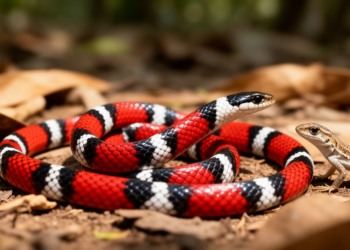
Caatinga snake study finds lizard-heavy diet and one plastic fragment in Brazilian false coral snake
An observational study of 48 Brazilian false coral snake specimens from the Caatinga found lizard prey in all 10 stomachs ...
An observational study of 48 Brazilian false coral snake specimens from the Caatinga found lizard prey in all 10 stomachs ...

Satellite-derived vegetation structure has allowed scientists to map seven distinct ecosystem groups across north-east Brazil, aligning most with the IUCN ...
A landmark survey documents 99 non-native plant species on Brazilian inselbergs, with one-third classified as invasive, revealing how exotic grasses, ...
A fuzzy logic modeling study has mapped the hidden potential distribution of Brazil's elusive worm-lizard Leposternon polystegum, revealing that environmental ...
A population-wide cytogenetic survey of two Brazilian scorpion species has revealed the lowest chromosome counts ever recorded in the family ...
Researchers have built the first sensory wheel for honeys from Brazil's endemic Caatinga biome, linking pollen profiles to the colors, ...
Brazilian researchers used machine learning and Shapley values to predict which non-native plants in the Caatinga dry forest will become ...
Researchers combined terrain, climate, and location data with a random forest algorithm on Google Earth Engine to map the Caatinga ...
A new study of 129 Brazilian municipalities finds that wind and solar power development is statistically linked to urban expansion ...
A twenty-year satellite analysis shows Brazil's Caatinga dry forest has kept its carbon and water balance stable despite warming, with ...

Embark on a thrilling journey of discovery with Scienmag.com—your ultimate source for cutting-edge breakthroughs. Immerse yourself in a world where curiosity knows no limits and tomorrow’s possibilities become today’s reality!