


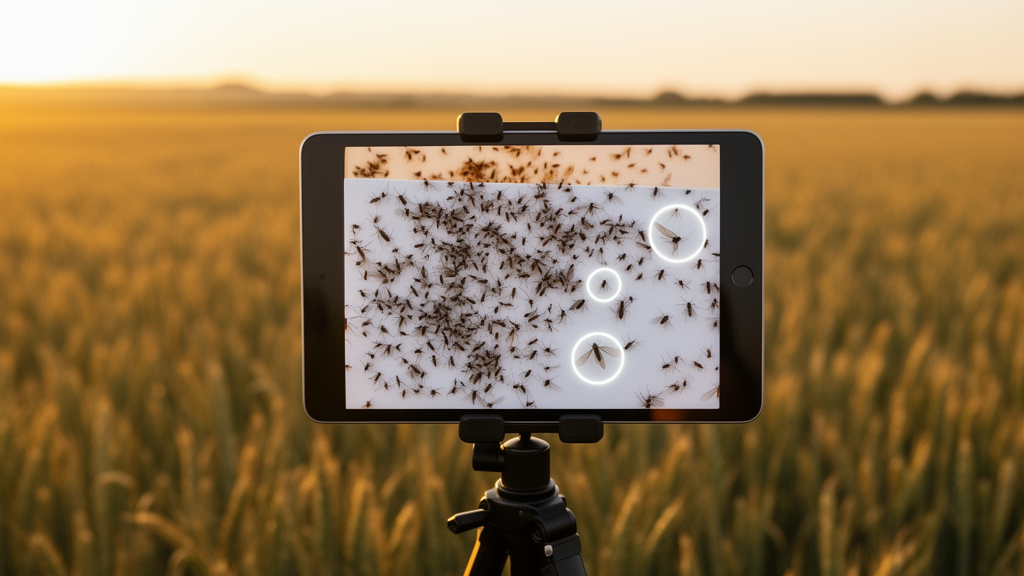
A new computer vision model called PestFG-RTDETR has been designed to detect small agricultural pests in dense images captured by automated traps, according to a study by researchers at Ningbo University in China published in Frontiers in Computer Science. The detector addresses a persistent weakness in automatic pest monitoring: when many tiny insects cluster together in trap photographs, even modern deep learning detectors struggle to separate and classify them accurately.
Trap-based monitoring systems are widely used for automatic pest surveillance, but the images they produce are difficult to analyze. The authors identify four main obstacles: pest bodies are tiny, they appear in clustered distributions, they can be captured in diverse states, and different pest species look similar to one another. These factors make pest detection in captured images a challenging small-object detection problem that conventional detectors handle poorly.
PestFG-RTDETR is built on RT-DETR, a transformer-based detection architecture, and adds three key components. The first is frequency-guided adaptive feature interaction, which combines information across frequency and spatial domains so that fine details of small targets are preserved while broader context is still available. The second is dynamic upsampling, which improves the reconstruction of fine spatial detail as features are enlarged during processing. The third is a lightweight backbone, which reduces the computational cost of the network without sacrificing the features needed for accurate detection.
The researchers also introduce a biologically inspired Copy-Paste augmentation strategy for the training dataset. This technique enriches minority classes, meaning pest categories with few examples, and generates realistic dense pest layouts. By synthesizing crowded scenes that mimic real trap captures, the augmentation gives the detector more varied training material for the conditions where it must perform best.
The performance results are reported at an input resolution of 416 × 416 pixels. At this resolution, PestFG-RTDETR achieves a mean average precision at an intersection-over-union threshold of 0.5, written mAP@0.5, of 61.64 percent, and a stricter metric, mAP@0.5:0.95, of 37.27 percent. Compared with the baseline RT-DETR-R18 model, these figures represent improvements of 4.67 and 6.08 percentage points respectively, while the new model uses 1.55 million fewer parameters. Fewer parameters mean a smaller, more efficient network, which matters for deployment in field monitoring hardware.
The evaluation also includes extensive comparisons with representative two-stage detectors, one-stage detectors, and other transformer-based detectors. According to the authors, PestFG-RTDETR achieves competitive performance across these comparisons, which they interpret as evidence that the proposed design is effective. The mAP@0.5:0.95 metric is particularly demanding because it averages precision across multiple overlap thresholds, rewarding detectors that localize small objects precisely rather than merely finding them approximately.
To test whether the architecture generalizes beyond its original dataset, the team independently trained and evaluated the model on a self-collected rice pest dataset. The results further indicate, the authors report, that the proposed architecture can be applied to another trap-based pest detection scenario. This suggests the design is not narrowly tuned to a single pest collection but can transfer to related monitoring tasks, although the study’s claims rest on the datasets and conditions the authors tested.
The work sits within the broader field of computer vision applied to agriculture, where accurate and efficient detection is described as essential for modern crop protection. Agricultural pests pose a persistent threat to crop yield and quality, the authors note, which is why automatic monitoring systems that can reliably identify pests in captured images are valuable. A detector that is both accurate on small, clustered targets and efficient enough in parameters could support practical pest monitoring pipelines.
The article, titled “PestFG-RTDETR: An Efficient Pest Detector for Small Targets in Dense Trap-Captured Scenes,” was received on 17 July 2026 and accepted on 20 October 2026, and is classified as original research in the Computer Vision section of the journal. The work was carried out by Meng Zhang, Xianliang Jiang, Zijian Le and Guang Jin of Ningbo University, Ningbo, China. The publisher notes that all claims expressed in the article are solely those of the authors and do not necessarily represent those of their affiliated organizations or of the publisher, editors and reviewers.
Subject of Research: A deep learning detector for identifying small agricultural pests in dense trap-captured images
Article Title: PestFG-RTDETR: an efficient pest detector for small targets in dense trap-captured scenes
Article References: Zhang, M., Jiang, X., Le, Z., & Jin, G. (2026). PestFG-RTDETR: An Efficient Pest Detector for Small Targets in Dense Trap-Captured Scenes. Frontiers in Computer Science, 8, 1940983. https://doi.org/10.3389/fcomp.2026.1940983
Image Credits: AI Generated
DOI: 10.3389/fcomp.2026.1940983
Keywords: pest detection, computer vision, RT-DETR, small-object detection, frequency-spatial fusion, trap-captured images, agriculture, deep learning, crop protection, Copy-Paste augmentation, PestFG-RTDETR, efficient
Cite Scienmag News
Alan Morgan. (October 30, 2026). Frequency-guided AI detector spots tiny pests in crowded trap images. Scienmag. https://scienmag.com/frequency-guided-ai-detector-spots-tiny-pests-in-crowded-trap-images/
Alan Morgan. "Frequency-guided AI detector spots tiny pests in crowded trap images." Scienmag, 30 October 2026, https://scienmag.com/frequency-guided-ai-detector-spots-tiny-pests-in-crowded-trap-images/. Accessed 1 November 2026.
Alan Morgan. "Frequency-guided AI detector spots tiny pests in crowded trap images." Scienmag. October 30, 2026. https://scienmag.com/frequency-guided-ai-detector-spots-tiny-pests-in-crowded-trap-images/









