


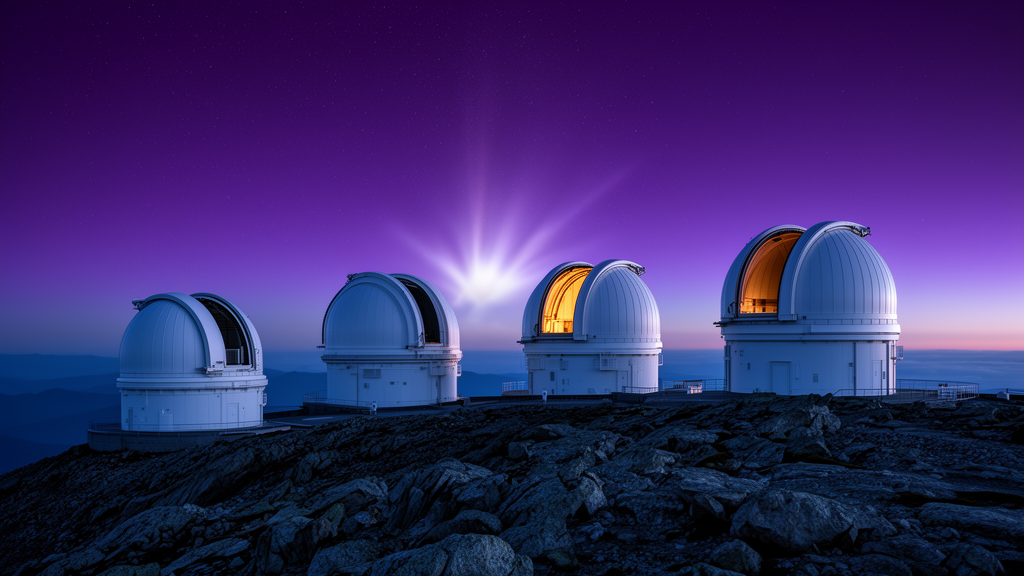
On a high ridge of the Roque de los Muchachos Observatory on the Canary Island of La Palma, an international collaboration of scientists and engineers has completed one of the most sensitive gamma-ray instruments ever built. On 15 October 2026, some 250 researchers and representatives of leading institutions from around the world gathered to inaugurate the Large-Sized Telescope sub-array at CTAO-North, the northern observation station of the Cherenkov Telescope Array Observatory. The ceremony marked the completion of four 23-meter telescopes that together form the low-energy core of what is destined to become the world’s largest and most powerful gamma-ray observatory, a milestone the project’s leaders describe as the culmination of more than fifteen years of international collaboration and technological innovation.
The Large-Sized Telescopes, or LSTs, do not observe gamma rays directly. Instead, they are built to catch the fleeting blue flash of Cherenkov light, the ephemeral glow emitted when a very high-energy gamma ray strikes Earth’s atmosphere and triggers a cascade of relativistic particles traveling faster than light moves through air. Each telescope’s 23-meter-diameter reflector funnels this nanosecond-scale flash onto an ultra-fast camera, allowing astronomers to reconstruct the direction and energy of the original gamma ray. The LSTs are the most sensitive instruments in the world for observing gamma rays at energies between approximately 20 gigaelectronvolts and several teraelectronvolts, a range that covers the transition between what space-based gamma-ray telescopes can see and what ground-based instruments excel at detecting.
That exceptional sensitivity at the lowest gamma-ray energies is what sets the LSTs apart. As very high-energy gamma rays travel across the Universe, they are progressively absorbed by the diffuse fog of optical and infrared photons that fills intergalactic space, the so-called extragalactic background light. The farther away a source lies, the more its gamma rays are attenuated before they reach Earth. The LSTs’ low energy threshold allows scientists to compensate for this absorption by detecting the faintest, lowest-energy gamma rays that still manage to survive the journey, opening a window onto sources at cosmological distances and letting researchers look further back into cosmic history than any previous ground-based gamma-ray facility.
The sub-array’s design also makes it uniquely suited to studying transient phenomena. Many of the most dramatic gamma-ray sources, including gamma-ray bursts, novae, and flaring active galactic nuclei, evolve on timescales of minutes or seconds. The LSTs’ sensitivity to short variability, combined with the statistical power gained from observing the same gamma-ray shower simultaneously from multiple telescopes, gives astronomers the temporal and spectral resolution needed to dissect these rapidly changing events with unprecedented accuracy.
The inauguration crowns a productive history for the project’s prototype. Even during its commissioning phase, the first Large-Sized Telescope, LST-1, has delivered groundbreaking scientific results since 2020. Its observations have included detailed studies of pulsars, the rapidly rotating stellar corpses whose beams of radiation sweep across Earth like cosmic lighthouses, as well as investigations of active galactic nuclei at cosmological distances and rapid follow-up observations of transient phenomena such as novae and gamma-ray bursts. These early results validated the telescope’s novel design and demonstrated that the instrument could achieve the lowest energy threshold ever reached by a ground-based gamma-ray observatory.
With LST-2, LST-3, and LST-4 now joining their pioneer sibling, the four telescopes will operate as a true array. When a gamma-ray shower strikes the atmosphere, each telescope records the Cherenkov flash from a slightly different vantage point. Combining these multiple perspectives substantially improves the array’s sensitivity, sharpens its angular resolution, and refines its energy reconstruction, opening a new level of precision in the study of the gamma-ray Universe. Stereoscopic observation also suppresses the background of cosmic-ray events that mimic gamma rays, a critical advantage when hunting for the faintest and most distant sources.
Professor Masahiro Teshima, Principal Investigator of the LST Collaboration and Spokesperson of the CTAO Consortium, emphasized the scientific promise of the completed sub-array. According to Teshima, the completion of the LST sub-array is the culmination of more than fifteen years of international collaboration and technological innovation, and the telescopes will allow scientists to explore some of the most extreme environments in the Universe, including supermassive black holes, neutron stars, the possible origins of cosmic rays, and the nature of dark matter. These targets represent some of the most fundamental open questions in modern astrophysics and particle physics, and the LSTs are designed to attack them from the low-energy frontier of the gamma-ray spectrum.
One of the most ambitious goals of the new sub-array is to reach back to the early Universe. The LSTs will provide a unique opportunity to probe the cosmos at an epoch roughly 12 billion years ago, when the Universe was less than two billion years old. Their sensitivity to the lowest-energy gamma rays will enable the detection and study of bright very high-energy gamma-ray bursts at high redshift, potentially extending gamma-ray observations to sources at redshifts of around z of approximately 4. Because gamma-ray bursts are among the most energetic explosions since the Big Bang, catching their high-energy emission from such vast distances would give cosmologists a new probe of star formation, black hole growth, and the physical conditions prevailing in the young Universe.
The LST sub-array is a key component of the broader Cherenkov Telescope Array Observatory, which will ultimately deploy more than 60 telescopes of three types across two hemispheres. In addition to the Large-Sized Telescopes, the observatory will operate Medium-Sized Telescopes and Small-Sized Telescopes, each optimized for a different portion of the enormous energy range from 20 GeV to 300 TeV. CTAO-North, at the Roque de los Muchachos Observatory on La Palma in Spain, and CTAO-South, at the Paranal Observatory in Chile’s Atacama Desert, together will give the observatory full-sky coverage. Over the coming years, the LSTs will undergo commissioning and integration into CTAO operations alongside the other telescopes planned for both arrays, addressing fundamental questions in astrophysics, particle physics, and cosmology, from the origin of cosmic rays to searches for deviations from Einstein’s theory of relativity.
The project’s scale extends beyond its optics. The CTAO is a Big Data undertaking that will generate hundreds of petabytes of data each year, roughly 12 petabytes after compression, and it is committed to operating as the first gamma-ray observatory of its kind to function as an open, proposal-driven facility providing public access to its high-level science data and software products. The LST project itself was made possible by a strong international partnership involving institutions from Brazil, Bulgaria, the Czech Republic, Croatia, France, Germany, Italy, Japan, Poland, Spain, and Switzerland, while the CTAO ERIC, the organization in charge of construction and operation, includes members from across Europe along with the European Southern Observatory, with further countries engaged as Strategic Partners or Third Parties. As the four gleaming reflectors on La Palma begin their coordinated watch on the night sky, astronomers anticipate a decade in which the most violent, distant, and enigmatic events in the cosmos will be observed with a clarity never before achievable from the ground.
Subject of Research: Inauguration of the Large-Sized Telescope sub-array at the Cherenkov Telescope Array Observatory's northern site for very high-energy gamma-ray astronomy
Article Title: A new era in exploring the extreme universe: The large-sized telescope sub-array is inaugurated on CTAO-north
Article References: A new era in exploring the extreme universe: The large-sized telescope sub-array is inaugurated on CTAO-north. (n.d.). Original publication
Image Credits: AI Generated
DOI: Not provided
Keywords: CTAO, Large-Sized Telescope, gamma-ray astronomy, Cherenkov light, La Palma, Roque de los Muchachos Observatory, gamma-ray bursts, active galactic nuclei, dark matter, cosmic rays, high-energy astrophysics, early Universe
Cite Scienmag News
Grant Pearson. (October 16, 2026). Four Giant Telescopes Now Hunt the Universe’s Most Violent Explosions. Scienmag. https://scienmag.com/four-giant-telescopes-now-hunt-the-universes-most-violent-explosions/
Grant Pearson. "Four Giant Telescopes Now Hunt the Universe’s Most Violent Explosions." Scienmag, 16 October 2026, https://scienmag.com/four-giant-telescopes-now-hunt-the-universes-most-violent-explosions/. Accessed 16 October 2026.
Grant Pearson. "Four Giant Telescopes Now Hunt the Universe’s Most Violent Explosions." Scienmag. October 16, 2026. https://scienmag.com/four-giant-telescopes-now-hunt-the-universes-most-violent-explosions/


