

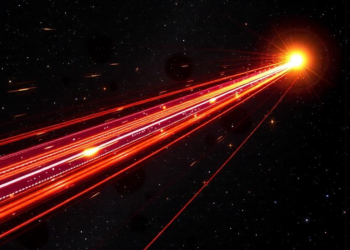
A 42-Light-Year X-Ray Tail Tracks Cosmic Rays on a Directed Journey Through the Galaxy
Joint observations by China's Einstein Probe and LHAASO have revealed a 42-light-year-long X-ray tail from a pulsar wind nebula, showing ...
Joint observations by China's Einstein Probe and LHAASO have revealed a 42-light-year-long X-ray tail from a pulsar wind nebula, showing ...

A sixteen-year archive of Swift X-ray observations of the narrow-line Seyfert 1 galaxy Ark 564 shows tightly coupled soft and ...
Using 4.5 years of data, the LHAASO observatory has detected very-high-energy gamma-ray emission from five nearby giant molecular clouds, opening ...
A compact convolutional neural network developed by Indian researchers outperforms standard machine learning for Cherenkov telescope gamma-ray classification while training ...
A comprehensive new review of super-critical accretion explains how stellar-mass black holes and neutron stars exceed the Eddington limit through ...
A population synthesis of the youngest Galactic neutron stars finds that magnetars make up about half of all neutron stars ...
This study identifies Cygnus X-3, a compact binary in the constellation Cygnus, as the most powerful particle accelerator known, producing ...
Black holes, enigmatic cosmic objects surrounded by extreme gravitational fields, continue to challenge astronomers’ understanding of high-energy astrophysical processes. One ...
The universe, in its unfathomable vastness, continues to surprise and challenge our understanding with phenomena that stretch the very limits ...
In the ever-evolving landscape of high-energy astrophysics, one of the most captivating questions remains the nature of the compact objects ...

Embark on a thrilling journey of discovery with Scienmag.com—your ultimate source for cutting-edge breakthroughs. Immerse yourself in a world where curiosity knows no limits and tomorrow’s possibilities become today’s reality!