


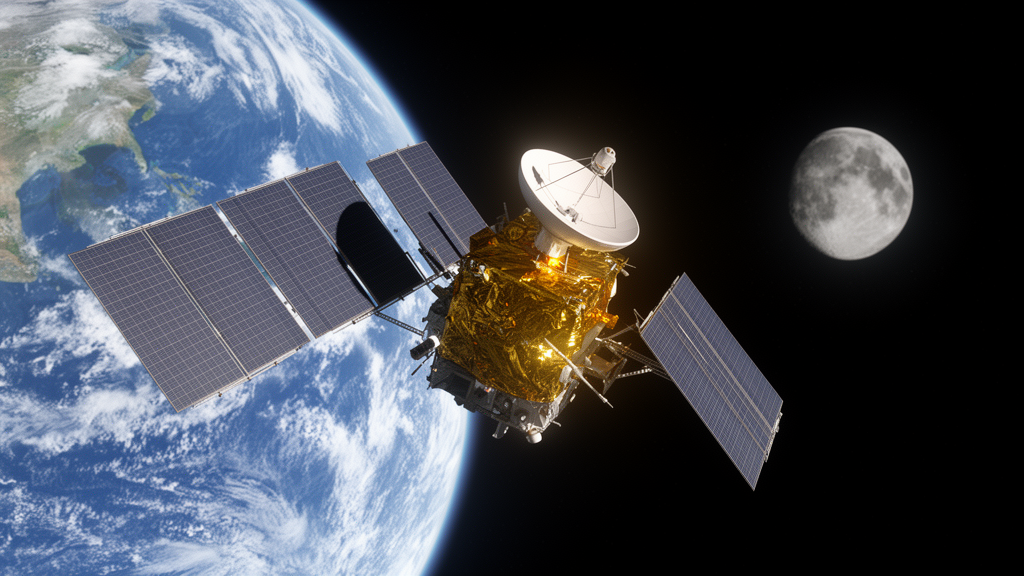
In August 2024, the European Space Agency’s Jupiter Icy Moons Explorer, better known as JUICE, executed a maneuver no spacecraft had ever attempted before: a combined lunar-Earth gravity assist, or LEGA, that bent its trajectory toward the outer solar system. The spacecraft swept past the Moon at a closest approach of just 752 kilometers on 19 August 2024, then skimmed past Earth the following day at an altitude of 6,839 kilometers. While the flyby’s primary purpose was navigational, it also handed scientists something priceless: the first chance to point JUICE’s ultraviolet spectrograph at extended planetary targets and prove that the instrument is ready for its decade-long mission at Jupiter.
The instrument in question, JUICE-UVS, is an imaging spectrograph sensitive to extreme- and far-ultraviolet light between 50 and 204 nanometers, built by the Southwest Research Institute as the fifth in a family of six UV spectrographs flown on planetary missions. Light enters through one of three apertures: a main airglow port, a smaller high-resolution port tucked behind a deployable door, and a pinhole solar port offset by 60 degrees that attenuates the Sun’s glare so the instrument can eventually observe at 5 astronomical units from the Sun. An off-axis paraboloidal mirror focuses incoming light onto a slit measuring 0.1 degrees by 7.3 degrees, after which a toroidal diffraction grating spreads the UV spectrum across a microchannel plate detector coated with UV-sensitive cesium iodide. Because the optics and housing are all machined from aluminum 6061, the system is athermal, holding its focus without active temperature control.
Before the LEGA encounter, the team had verified basic performance by observing UV-bright stars and the faint glow of interplanetary hydrogen and helium. But stars are point sources, and a full characterization of the instrument’s response across all wavelengths and all positions in its field of view demands extended targets with discrete spectral features spanning the entire bandpass. That is precisely what the Moon and Earth delivered. During the lunar flyby, JUICE-UVS captured sunlight reflected from the Moon’s surface beginning roughly two minutes after the field of view crossed the terminator onto the sunlit hemisphere. Light levels rose so quickly that only the first 30-second exposure could use the main aperture; the rest of the sequence shifted to the high-resolution port to avoid overwhelming the detector.
The lunar data served two calibration purposes at once. First, the team summed counts over the 155 to 197 nanometer range, deliberately avoiding the intensely bright Lyman-alpha line at 121.6 nanometers and a reflected solar oxygen line at 130.4 nanometers where the flux temporarily saturated the detector’s ability to process every photon. The resulting map traced a narrow strip across craters including Kapteyn E, Langrenus W and Langrenus N, revealing sharp contrasts between sunlit and shadowed terrain. Because the spacecraft’s motion carried the slit mostly along its length rather than across it, the mapped region was narrow, but matching the observed crater positions to their known locations confirmed that the instrument pointing model used by the mission is accurate. The team could even resolve the shadow inside the 12.5-kilometer-wide Langrenus N crater.
Second, the lunar spectra provided a check on the instrument’s effective area, the quantity that converts raw counts into physical brightness. After correcting for exposure time, slit solid angle, viewing geometry using the Lommel-Seeliger photometric function, and dividing by a solar spectrum measured the same day by NASA’s TIMED/SEE instrument, the researchers obtained far-ultraviolet reflectance spectra for two regions: terrain near Langrenus crater and a patch of Mare Fecunditatis. Comparing these with published spectra from LAMP, the Lyman Alpha Mapping Project on NASA’s Lunar Reconnaissance Orbiter, showed excellent agreement at wavelengths below 165 nanometers. A possible absorption feature near 170 nanometers, seen in most LAMP spectra but absent from the JUICE data, remains an open question, potentially reflecting real differences in surface properties, calibration uncertainties in either instrument, or the roughly 16 percent uncertainty in the solar reference spectrum over that interval.
The Earth flyby offered an even richer calibration target. For nearly 35 minutes, JUICE-UVS observed from the nightside at an altitude of about 13,550 kilometers, across the dawn terminator, and onto the brilliant dayside, finishing with a view of the sunlit limb. Earth’s dayglow spectrum is crowded with emission lines from hydrogen, helium, oxygen and nitrogen at precisely known wavelengths, making it an ideal ruler for wavelength calibration. Using a high-resolution pixel list exposure of the dayside, the team fitted Gaussian profiles to a set of strong, unblended emission lines at multiple positions along the slit, then interpolated the results into a two-dimensional wavelength solution best described by a fifth-order polynomial. The measured pixel size varies from about 0.07 nanometers at the edges of the bandpass to about 0.11 nanometers near the center, consistent with pre-launch calibration.
The airglow measurements themselves carried scientific weight. Tracking the brightness of hydrogen Lyman-alpha and the two neutral oxygen emissions at 130.4 and 135.6 nanometers, the team found nightside values closely matching a classic 1991 compilation by R. R. Meier, while dayside peaks reached 21 kilorayleighs at 130.4 nanometers and 4.4 kilorayleighs at 135.6 nanometers. The 135.6-nanometer value exceeded contemporaneous measurements from TIMED’s Global Ultraviolet Imager, and the discrepancy is instructive rather than alarming: as the instrument’s boresight swung away from nadir, it sampled longer atmospheric columns. The optically thin 135.6-nanometer emission kept brightening with increasing off-nadir angle, while the optically thick 130.4-nanometer emission plateaued, driving the ratio of the two lines below the nadir-pointed reference value. This viewing-geometry effect, first modeled in the 1990s from Dynamics Explorer 1 data, is exactly the diagnostic JUICE-UVS will exploit at Jupiter’s moons.
Three days after the flyby, a 360-degree spacecraft roll gave UVS one final Earth observation: a 7.5-degree swath covering altitudes between roughly 2 and 15 Earth radii. The image captured the Earth’s extended hydrogen geocorona glowing in Lyman-alpha, along with the Pleiades and UV-bright stars in Taurus. The measured stellar positions matched catalog predictions almost perfectly, and the geocoronal brightness profile agreed with decades of prior observations. Searches for high-altitude helium and oxygen emissions came up empty at detectable levels. Together, these checks validated the instrument’s wavelength scale, effective area, and pointing with a completeness that stars alone could never provide.
Most importantly, the LEGA campaign was a dress rehearsal for Jupiter. During future flybys of Ganymede, Europa and Callisto, UVS will perform disk scans and limb stares to map surface ice, tenuous atmospheres, and extended hydrogen and oxygen coronas. The oxygen line ratio technique demonstrated at Earth will distinguish O2-dominated atmospheres from those containing water vapor or atomic oxygen, the same method that revealed a localized water atmosphere on Ganymede’s subsolar point. The lunar map, acquired from an altitude within the range planned for real flybys, previews the instrument’s mapping resolution of roughly 4 to 6 kilometers from 1,100 kilometers up. One technique remains undemonstrated: absorption spectroscopy via stellar and solar occultations, which the team has flagged as the highest-priority UVS activity for the final Earth gravity assist in January 2029. With the instrument confirmed healthy and its calibration sharpened, JUICE-UVS now waits, pointed toward a 2031 arrival at the largest planet in the solar system.
Subject of Research: Ultraviolet spectrograph observations and in-flight calibration of ESA's JUICE spacecraft during the 2024 lunar-Earth gravity assist
Article Title: Ultraviolet observations of the Earth and Moon during the JUICE Lunar-Earth flyby
Article References: Molyneux, P. M., Davis, M. W., Giles, R. S., Greathouse, T. K., Retherford, K. D., Versteeg, M. H., Ferrell, S. A., Becker, T. M., Gladstone, G. R., Trantham, B. J., Kammer, J. A., Freeman, M. A., & Persyn, S. C. (2026). Ultraviolet observations of the Earth and Moon during the JUICE Lunar-Earth flyby. Annales Geophysicae, 44(2), 1093-1108. https://doi.org/10.5194/angeo-44-1093-2026
Image Credits: AI Generated
DOI: 10.5194/angeo-44-1093-2026
Keywords: JUICE, JUICE-UVS, ultraviolet spectroscopy, lunar-Earth gravity assist, Moon, Earth airglow, geocorona, instrument calibration, Jupiter icy moons, ESA, Southwest Research Institute, Ganymede
Cite Scienmag News
Grant Pearson. (October 15, 2026). JUICE Spacecraft Turns Its Ultraviolet Eye on Earth and Moon in Historic Flyby. Scienmag. https://scienmag.com/juice-spacecraft-turns-its-ultraviolet-eye-on-earth-and-moon-in-historic-flyby/
Grant Pearson. "JUICE Spacecraft Turns Its Ultraviolet Eye on Earth and Moon in Historic Flyby." Scienmag, 15 October 2026, https://scienmag.com/juice-spacecraft-turns-its-ultraviolet-eye-on-earth-and-moon-in-historic-flyby/. Accessed 15 October 2026.
Grant Pearson. "JUICE Spacecraft Turns Its Ultraviolet Eye on Earth and Moon in Historic Flyby." Scienmag. October 15, 2026. https://scienmag.com/juice-spacecraft-turns-its-ultraviolet-eye-on-earth-and-moon-in-historic-flyby/


