


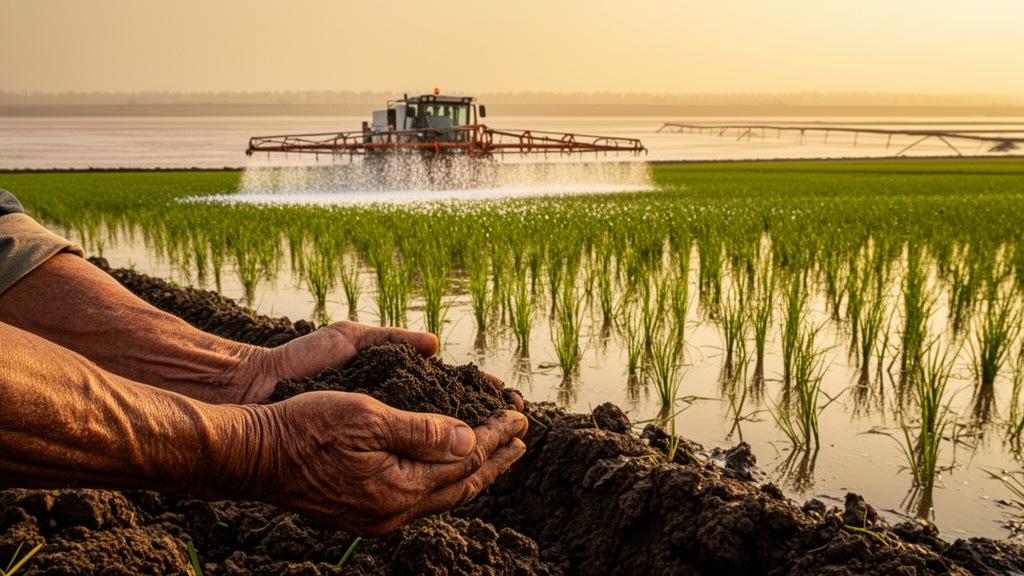
Deep beneath the irrigated fields of northwestern China, an invisible ledger of toxic metals is being written one harvest at a time. A new study of nearly 500 soil samples from the Yellow River Basin has revealed that the single strongest predictor of where potentially hazardous elements accumulate is not industry, not traffic, and not geology — it is the nitrogen content of the soil itself, a direct fingerprint of decades of intensive fertilization. The finding, published in Frontiers in Soil Science, offers one of the most detailed portraits yet of how agricultural practice quietly reshapes the chemistry of farmland in one of the world’s most important food-producing regions.
The research team, led by scientists from the Ningxia Academy of Agricultural and Forestry Sciences and collaborating institutions in China and Egypt, collected 487 topsoil samples from a 4,670-square-kilometer irrigation district spanning the cities of Yinchuan, Shizuishan, Wuzhong, and Zhongwei. Using a stratified random design that balanced farmland sites with adjacent forest and grassland plots, they measured concentrations of seven potentially hazardous elements: arsenic, cadmium, chromium, copper, nickel, lead, and zinc. Every sample was digested under strict EPA protocols and analyzed with graphite furnace atomic absorption spectrophotometry and inductively coupled plasma atomic emission spectrometry, with certified reference materials confirming recoveries between 96 and 105 percent.
The results paint a picture of contamination that is anything but uniform. Cadmium, the most spatially erratic of the seven metals, showed a coefficient of variation of roughly 56 percent, while arsenic and lead varied by more than a third across the landscape. Mean cadmium concentrations reached 0.32 milligrams per kilogram — more than three times the regional background of 0.097 — and just above the national screening threshold of 0.30 milligrams per kilogram set by China’s GB 15618-2018 standard. Lead, zinc, chromium, copper, and nickel all exceeded their respective background values as well, though most remained comfortably below regulatory limits, suggesting the contamination is real but not yet at crisis levels.
To untangle what was driving this patchwork of pollution, the researchers deployed two complementary computational tools. The first, an Optimal Parameters-based Geographical Detector (OPGD), quantifies how much of the spatial variation in metal concentrations can be explained by each of eleven environmental variables — from soil pH and texture to elevation, vegetation cover, and population density. The second, Positive Matrix Factorization (PMF), is a receptor model that mathematically deconstructs the measured concentrations into distinct source signatures, assigning each metal a proportional origin.
The OPGD results delivered the study’s most striking revelation. Total nitrogen, a proxy for long-term fertilizer and manure inputs, explained 79.6 percent of the spatial variability in the metal dataset — the highest Q-statistic of any factor tested. For chromium alone, nitrogen accounted for a Q-value of 0.796, while copper and zinc followed closely at 0.612 and 0.627 respectively. Soil texture, particularly the relative proportions of sand, silt, and clay, emerged as the second most important control, reflecting how fine particles adsorb and retain metal ions. Organic matter, elevation, and population density played secondary roles, and vegetation cover contributed surprisingly little.
But the story grew more intricate when the researchers examined factor interactions. Clay content alone explained only 13 percent of arsenic’s spatial pattern, yet when combined with soil organic matter, the joint explanatory power leapt to 81 percent — a nonlinear enhancement that suggests arsenic is held in place by a coupled mechanism of organic complexation and adsorption onto fine particles. Similarly, the interaction between elevation and organic matter explained 89 percent of chromium’s variability, pointing to terrain-driven redistribution working in tandem with organic retention. These synergies reveal that no single environmental lever controls metal fate; instead, soil chemistry operates as an interlocking system.
The PMF analysis then answered the question of where the metals actually come from. Five distinct source profiles emerged, together explaining more than 90 percent of the total variance. Cadmium was overwhelmingly tied to agricultural inputs — phosphate fertilizers and pesticides — accounting for 77 percent of its factor profile. Zinc and copper clustered around industrial emissions, with loadings of 56 and 38 percent respectively, concentrated near manufacturing hubs in Shizuishan and Wuzhong. Chromium and nickel traced back to geogenic parent material, reflecting the natural lithology of the Yellow River alluvial plain. Lead, with a striking 89 percent loading on a single factor, pointed squarely at traffic residues — a legacy of historical leaded gasoline alongside modern brake and tire wear. Arsenic, at 79 percent of a mixed anthropogenic factor, suggested combined inputs from irrigation water and diffuse industrial discharge.
When the team overlaid these source maps with the OPGD-derived risk layers, a composite hazard index revealed four contamination zones across the irrigation district. Low-risk areas, dominated by forest and grassland, sat far from human influence. Moderate-risk transitional zones gave way to high-risk farmland where cadmium and lead levels were elevated, and very-high-risk clusters appeared near industrial and urban centers where fertilizer use, traffic emissions, and industrial discharge converged. Cross-correlation between the independently derived PMF factor scores and OPGD risk layers yielded coefficients between 0.62 and 0.81, providing strong statistical validation that the two models were capturing the same underlying reality.
The spatial pattern of risk was anything but random. Hotspots concentrated in the central and lower western reaches of the irrigation district, with a prominent secondary cluster in the southeast. Arsenic and lead risks were largely confined to the central-western section, while nickel — the most broadly distributed contaminant — formed three distinct clusters spanning the central-western, central-eastern, and southeastern regions. Cadmium, chromium, and zinc hotspots clustered in the upstream portion of the irrigation system, where water enters the network first and presumably carries the highest dissolved loads.
What makes this study particularly consequential is what it implies about the future of food security in irrigated agroecosystems worldwide. The Yellow River Basin irrigates roughly 15 percent of China’s farmland and supports nearly 12 percent of its population, and the researchers note that comparable systems — the Indo-Gangetic Plain, the Nile Delta, the Murray–Darling Basin — face similar pressures from fertilizer dependence and industrial emissions. The finding that total nitrogen, a manageable agronomic variable, exerts the strongest statistical control over metal distribution suggests that precision fertilization, reduced over-application, and the adoption of low-cadmium phosphate sources could meaningfully slow contamination before it reaches irreversible thresholds. The authors caution that their hazard maps reflect contamination intensity rather than bioavailability or ecological toxicity, and they recommend future work incorporating DTPA-extractable metal fractions, soil enzyme assays, and human health risk models to translate spatial patterns into actionable exposure estimates. For now, the message is clear: the nitrogen farmers apply to boost yields is also writing a chemical record in the soil, and reading that record may be the key to keeping the Yellow River’s breadbasket productive for generations to come.
Subject of Research: Spatial drivers and source apportionment of potentially hazardous elements in irrigated Yellow River Basin soils
Article Title: Spatial heterogeneity, source contributions, and hazard mapping of potentially hazardous elements in irrigated soils of the Yellow River Basin, Northwest China
Article References: Xu, H., Liu, X., Chen, S., Luo, L., Wenfan, W., Ma, L., AbdelRahman, M. A. E., & Sabra, D. M. (2026). Spatial heterogeneity, source contributions, and hazard mapping of potentially hazardous elements in irrigated soils of the Yellow River Basin, Northwest China. Frontiers in Soil Science, 6, Article 1966899. https://doi.org/10.3389/fsoil.2026.1966899
Image Credits: AI Generated
DOI: 10.3389/fsoil.2026.1966899
Keywords: heavy metals, soil contamination, Yellow River Basin, cadmium, fertilizer, PMF, OPGD, spatial heterogeneity, irrigated agriculture, source apportionment, hazard mapping, Ningxia
Cite Scienmag News
Violet Maxwell. (October 16, 2026). Fertilizer Nitrogen Emerges as the Strongest Driver of Toxic Metal Buildup in Yellow River Farmland. Scienmag. https://scienmag.com/fertilizer-nitrogen-emerges-as-the-strongest-driver-of-toxic-metal-buildup-in-yellow-river-farmland/
Violet Maxwell. "Fertilizer Nitrogen Emerges as the Strongest Driver of Toxic Metal Buildup in Yellow River Farmland." Scienmag, 16 October 2026, https://scienmag.com/fertilizer-nitrogen-emerges-as-the-strongest-driver-of-toxic-metal-buildup-in-yellow-river-farmland/. Accessed 16 October 2026.
Violet Maxwell. "Fertilizer Nitrogen Emerges as the Strongest Driver of Toxic Metal Buildup in Yellow River Farmland." Scienmag. October 16, 2026. https://scienmag.com/fertilizer-nitrogen-emerges-as-the-strongest-driver-of-toxic-metal-buildup-in-yellow-river-farmland/


