


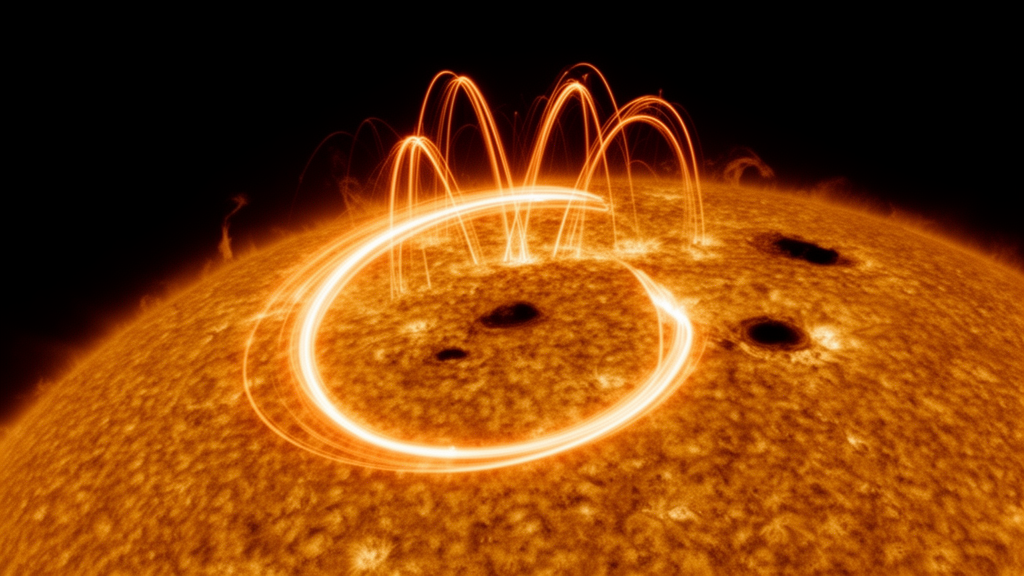
Solar flares are famous for their drama, but some of the most revealing lessons about the Sun come from modest events that refuse to behave the way textbooks say they should. A new study published in the journal Solar Physics examines one such event: a confined C2.2-class flare that erupted on 16 August 2022 in active region NOAA 13078. Although the flare was small by solar standards, its appearance changed dramatically depending on which wavelength of light scientists used to observe it, and that discrepancy has forced researchers to rethink how flare ribbon shapes should be interpreted.
Flare ribbons are the bright, elongated bands that sweep across the solar surface when a flare ignites. For decades, solar physicists have treated these ribbons as footprints of magnetic reconnection, the process by which stressed magnetic field lines snap into new configurations and release enormous amounts of energy. The classic picture involves two parallel ribbons straddling a polarity inversion line, the boundary where magnetic polarity on the solar surface flips from one sign to the other. When ribbons take on more exotic shapes, such as circles, rings, or curved arcs, researchers often infer equally exotic magnetic topologies above them, such as three-dimensional null points where magnetic field strength vanishes and reconnection can proceed with unusual efficiency.
The new analysis, led by Shilpa Patra of the National Institute of Technology Delhi with collaborators including Kamlesh Bora and Lakshmi Pradeep Chitta of the Max Planck Institute for Solar System Research in Göttingen, shows that this inference can be dangerously misleading. The team combined observations from NASA’s Solar Dynamics Observatory, whose Atmospheric Imaging Assembly captured the flare in multiple ultraviolet and extreme-ultraviolet channels, with high-resolution H-alpha imaging from the New Vacuum Solar Telescope in China and magnetic field measurements from SDO’s Helioseismic and Magnetic Imager. They then reconstructed the three-dimensional coronal magnetic field using a non-force-free field extrapolation technique, which models magnetic structures that are not in perfect pressure balance with their surroundings.
What they found was striking. In the lower layers of the solar atmosphere, probed by the AIA 1600 Å channel and by ground-based H-alpha observations, the flare looked like a textbook compact two-ribbon event, with its emission concentrated around the polarity inversion line at the heart of the active region. But when the researchers turned to the AIA 304 Å channel, which samples cooler plasma at chromospheric and transition-region temperatures, the same flare revealed an entirely different face: a C-shaped ribbon with a long, extended tail stretching away from the compact flaring core and connecting it to nearby pores and plage, the fainter magnetic regions surrounding the sunspots.
At first glance, such a morphology would seem to scream for a special magnetic explanation. Circular and C-shaped ribbons have historically been associated with coronal null-point topologies, in which reconnection at a three-dimensional null point produces a characteristic ring of brightening with remote footpoints. If the C-shape were genuine evidence of such a topology, it would place this tiny flare in the same category as much larger and more energetic events. But the magnetic field extrapolation told a different story. While the reconstructed field did contain a coronal null point at higher altitude, the footpoints of its fan and spine structures, the surfaces and lines of magnetic field that converge on a null, did not line up with the observed flare ribbons or with the extended tail brightening. The large-scale null-point topology, in other words, was almost certainly not the cause of the C-shaped ribbon.
Instead, the evidence points to something more subtle and, in its own way, more interesting. The extended tail of the C-shaped ribbon appears to develop through the progressive brightening of connected, low-lying magnetic loops rather than through a separate reconnection episode. The extrapolated field successfully reproduced the low-lying magnetic connectivity associated with the active-region filament, a channel of dense, cool plasma suspended above the polarity inversion line, as well as an arch filament system, a bundle of low loops still in the process of emerging through the photosphere. Crucially, the reconstruction also captured loops linking the positive-polarity sunspot to surrounding negative-polarity pores and plage. As the flare progressed, these loops lit up one after another, painting the appearance of an extended tail without any fundamental change in the magnetic topology.
The pre-flare phase added further texture to the picture. Before the main impulsive emission, the team observed localized ultraviolet and extreme-ultraviolet brightenings alongside loops visible in the hotter AIA channels. Those hot channels revealed a sigmoid-like structure, an S-shaped feature often interpreted as the observational signature of a twisted magnetic flux rope, associated with the same low-lying magnetic system that hosted both the filament and the arch filament system. This suggests that the energy for the flare was stored and released within a compact, sheared magnetic complex rather than in a grand, multi-scale coronal architecture.
The fate of the filament itself provides another cautionary tale about interpreting solar observations. During the flare, the H-alpha filamentary material became less visible in places, but the researchers concluded that this dimming most likely resulted from heating of the plasma, enhanced background emission, and changes in opacity rather than from the complete disappearance or eruption of the filament. In other words, what looked like a vanishing filament was really a filament changing its costume. This distinction matters enormously for space weather forecasting, because erupting filaments are the seed structures of coronal mass ejections, the billion-ton clouds of magnetized plasma that can disturb Earth’s magnetic field and disrupt satellites and power grids. A confined flare that merely heats its filament poses a very different hazard than one that launches it into interplanetary space.
The broader lesson of this study is one of humility for the entire field. Ribbon morphology, long treated as a reliable observational proxy for magnetic reconnection and coronal topology, turns out to be strongly wavelength-dependent, and complex ribbon shapes do not necessarily imply specific large-scale magnetic configurations. Different atmospheric diagnostics sample different layers and temperatures, and each can paint a different portrait of the same event. A C-shaped ribbon seen in one channel may be nothing more than the sequential lighting of ordinary low-lying loops seen in another. As solar physicists prepare for the data-rich era of next-generation instruments, including high-resolution telescopes on the ground and in space, this confined C2.2 flare serves as a reminder that the Sun’s magnetic architecture must be read carefully, layer by layer, before drawing conclusions from any single snapshot. Sometimes the most instructive flares are the ones that stay home.
Subject of Research: Wavelength-dependent flare ribbon morphology and magnetic topology of a confined C2.2 solar flare
Article Title: Multi-Wavelength View of a Confined C2.2 Flare: From Compact Two-Ribbon Emission to a Tailed C-Shaped Ribbon Morphology
Article References: Patra, S., Bora, K., Chitta, L. P., Pandey, V. S., Chen, Y., & Singh, S. (2026). Multi-Wavelength View of a Confined C2.2 Flare: From Compact Two-Ribbon Emission to a Tailed C-Shaped Ribbon Morphology. Solar Physics, 301(10), Article 159. https://doi.org/10.1007/s11207-026-02749-4
Image Credits: AI Generated
DOI: 10.1007/s11207-026-02749-4
Keywords: solar flare, flare ribbons, magnetic reconnection, solar physics, active region, polarity inversion line, coronal null point, SDO/AIA, H-alpha imaging, magnetic field extrapolation, arch filament system, confined flare
Cite Scienmag News
Grant Pearson. (October 16, 2026). One Small Solar Flare, Two Very Different Stories: Decoding a C-Shaped Ribbon on the Sun. Scienmag. https://scienmag.com/one-small-solar-flare-two-very-different-stories-decoding-a-c-shaped-ribbon-on-the-sun/
Grant Pearson. "One Small Solar Flare, Two Very Different Stories: Decoding a C-Shaped Ribbon on the Sun." Scienmag, 16 October 2026, https://scienmag.com/one-small-solar-flare-two-very-different-stories-decoding-a-c-shaped-ribbon-on-the-sun/. Accessed 16 October 2026.
Grant Pearson. "One Small Solar Flare, Two Very Different Stories: Decoding a C-Shaped Ribbon on the Sun." Scienmag. October 16, 2026. https://scienmag.com/one-small-solar-flare-two-very-different-stories-decoding-a-c-shaped-ribbon-on-the-sun/


