


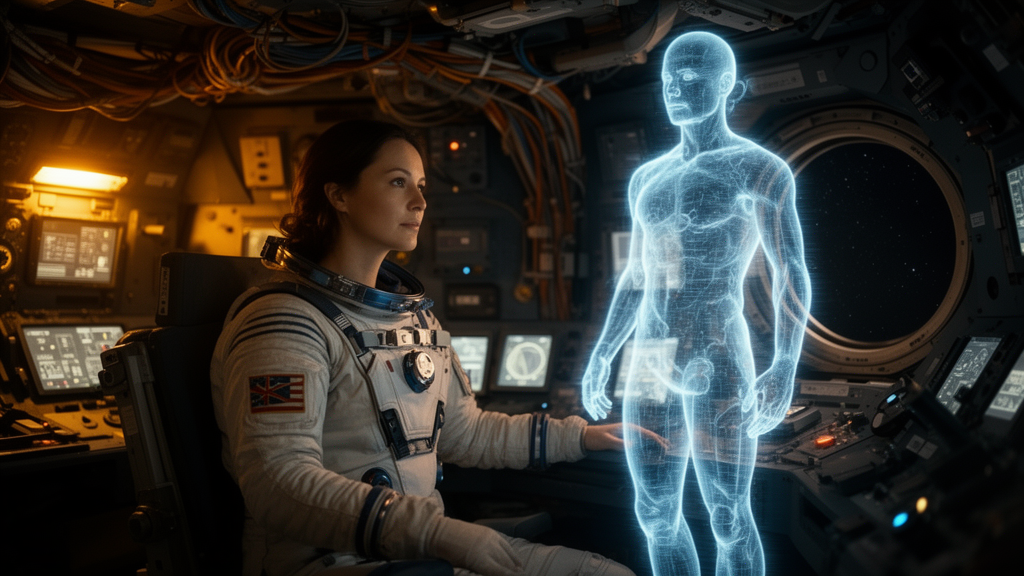
When astronauts venture beyond low Earth orbit, one of the most stubborn obstacles will not be propulsion or radiation but silence. Communication delays between Mars and Earth can stretch to 22 minutes one way, and NASA has determined that once round-trip delays exceed roughly five minutes, critical responsibilities must shift from mission control to the crew and systems aboard the spacecraft. A new framework published in Frontiers in Aerospace Engineering proposes a way to make that shift feasible: a distributed digital twin architecture that models not just the spacecraft and its astronauts individually, but the interactions between them—the trust, coordination, and team dynamics that ground controllers normally provide from Earth.
The research, led by Patrick K. Pischulti of the University of Colorado Boulder together with Min Young Hwang and Christopher McComb of Carnegie Mellon University and Katya Arquilla of CU Boulder, introduces what the team calls an Interaction Digital Twin, or IDT. Digital twins are virtual replicas of physical systems that mirror their structure, behavior, and context, updated in real time through bidirectional data flows. The concept, originally developed in manufacturing, has been adopted across healthcare, smart cities, and aerospace to answer
The distinction between system autonomy and crew autonomy sits at the heart of why the researchers felt an entirely new modeling layer was needed. Digital twins have already proven their worth in aerospace contexts by allowing engineers to monitor the health of spacecraft components, diagnose faults before they become critical, predict future states of hardware, and optimize operations without waiting for ground-based analysis. But these applications treat the human operator as, at best, a peripheral element or, at worst, an afterthought. The authors surveyed the existing literature and identified three recurring patterns that fall short of what deep space missions demand: efforts that twin a single human without modeling the environment that person inhabits, efforts that twin crowds or groups without capturing individual-level interactions, and efforts that twin human-to-human exchanges alongside environmental models but only in non-aerospace settings where participants are not collaborating toward a unified objective. None of these approaches, the researchers argue, adequately addresses the synergies NASA has identified between a human and a system, between a crew and a system, and among the members of a human team.
The consequences of this gap become clearer when one considers what mission control actually does during a typical mission. Beyond monitoring telemetry, flight controllers build and continuously evolve nominal operating procedures based on their observations of how crew members interact with each other and with their equipment, and how those interactions produce outcomes. This adaptive, relationship-aware form of oversight is something no purely hardware-focused digital twin can replicate. When a crew is 22 light-minutes from home, the loss of these time-critical cognitive and coordination functions cannot be compensated by faster hardware models alone. The framework proposed in the paper therefore treats the interaction itself as the thing being twinned, elevating it to what the authors describe as a first-class, inference-capable element within the architecture rather than a byproduct of separately modeling people and machines.
The distributed nature of the architecture deserves particular attention. Rather than concentrating all computational intelligence in a single monolithic model, the framework distributes twin responsibilities across multiple nodes with bidirectional information flow between them. Three complementary types of twins operate in concert: conventional Digital Twins representing habitat systems, Human Digital Twins representing individual crew members, and Interaction Digital Twins capturing the emergent phenomena that arise when people and systems engage with one another. These emergent phenomena include team cohesion, trust calibration, coordination patterns, and adaptive autonomy—the subtle, dynamic qualities that determine whether a crew functions smoothly or fractures under stress. By modeling these phenomena explicitly, the framework can in principle support inference about team state, not just system state, allowing onboard software to recognize when workload is unevenly distributed, when trust in an automated system has drifted too high or too low, or when coordination between crew members is degrading.
A practical consequence of this design is that aspects of command and control migrate onboard the vehicle. The authors describe this as giving the crew mission-control-like capabilities during periods of communication delay. In their vision, a Vehicle Systems Manager—an entity that understands and synthesizes the results of the twinned interactions—would augment nominal operations even when Earth is effectively out of reach for real-time consultation. This does not mean eliminating ground control, but rather ensuring that the crew retains the analytical depth normally provided by flight controllers when the delay makes that support impractical. The concept aligns with NASA’s long-standing recognition that even small communication delays in the range of seconds, such as those experienced on the International Space Station, can measurably harm performance, increase workload, and erode situational awareness.
The intellectual lineage of the digital twin concept helps explain why this extension is significant. Grieves, who originated the concept in the manufacturing sector, defined a digital twin as a set of virtual information constructs that fully describes a potential or actual physical manufactured product. Since that introduction, the idea has spread into advanced manufacturing, human health and medicine, smart cities, and aerospace. The medical community offers a particularly instructive analogy: clinicians use digital twins to perform interventions aimed at answering what-if questions, such as predicting how a patient would respond to a treatment without actually administering the drug. The Interaction Digital Twin applies the same logic to team dynamics—allowing mission planners and onboard systems to ask what-if questions about crew coordination, workload allocation, and trust before committing to a course of action during a mission.
To ground the framework in real mission needs, the authors began with a systematic review of NASA’s own published requirements. The 2009 Design Reference Architecture documents for human exploration of Mars, produced by NASA headquarters, remain among the most recent and comprehensive descriptions of the capabilities and operations needed for a human deep space mission. Beyond the traditional engineering concerns of propulsion and in-situ power generation, those documents emphasized the importance of information support provided by the habitat system—monitoring and diagnosing the habitat’s environmental health and delivering actionable insights to the crew. NASA noted that such capabilities are essential for reducing individual crew member stress, decreasing cognitive workload, and mitigating the downstream effects these factors have on team dynamics and overall mission performance. This causal chain, from information support to stress reduction to workload management to team stability, is precisely the chain the Interaction Digital Twin is designed to strengthen.
Building on the Mars objective established in the Design Reference Architecture, NASA developed the Moon to Mars mission plan to define concrete steps for achieving travel beyond low Earth orbit. The NASA Marshall Space Center expanded the agency’s reference architecture for this plan by elaborating on Ground Rules and Assumptions in conjunction with functional allocations for habitat design. While that document focuses primarily on the autonomy of an uncrewed habitat, it also details expectations of increased support from the habitat system for humans during the crewed portion of the flight, including aiding crew awareness. The framework’s authors treated these documents as a requirements specification, deriving from them the criteria that a digital twin architecture must satisfy to genuinely support crew autonomy rather than merely automate spacecraft functions.
The application scenario chosen to demonstrate the framework is an Artemis Phase II mission, which places the architecture in the context of NASA’s near-term lunar ambitions rather than a distant Mars voyage. This choice is strategically meaningful. Artemis Phase II operations will already involve communication conditions and operational complexity that stress current mission control paradigms, making the scenario a realistic proving ground for interaction-level twinning. The demonstration shows how the framework extends system-level modeling to support cognitive workload management, information sharing, and human-autonomy teaming—the practice of pairing human operators with automated agents in ways that leverage the strengths of both. Human-autonomy teaming has been an active area of research in aerospace and other safety-critical domains, but embedding it within a digital twin architecture that also captures team cohesion and trust calibration represents a notable synthesis.
The research team itself reflects the interdisciplinary nature of the challenge. Pischulti and Arquilla are based in the Ann and H. J. Smead Aerospace Engineering Sciences department at the University of Colorado Boulder, while Hwang and McComb bring expertise from Carnegie Mellon University’s Department of Mechanical Engineering. The collaboration between aerospace engineering and mechanical engineering groups mirrors the framework’s own philosophy: that human teaming constructs and technical system models must be developed together rather than in isolation. The paper was published as an original research article in the Intelligent Aerospace Systems section of Frontiers in Aerospace Engineering on March 27, 2026, appearing in Volume 5 of the journal.
Looking ahead, the implications of treating interactions as twinnable, inferable entities extend beyond spaceflight. Any domain where human teams operate alongside complex systems under constraints on communication or oversight—deep-sea operations, remote disaster response, autonomous shipping—faces analogous challenges in sustaining coordination without real-time expert support. The framework’s insistence that emergent phenomena like trust and cohesion can be modeled, monitored, and reasoned about onboard suggests a future in which the soft dynamics of teamwork become as quantifiable and actionable as the hard telemetry of a spacecraft’s power system. For the Moon to Mars campaign specifically, the work offers a concrete architectural answer to a question NASA has posed repeatedly in its exploration roadmaps: how to preserve the full richness of mission control’s judgment when the crew must carry that judgment alone.
Subject of Research: A distributed digital twin architecture that models team interactions and dynamics to support crew autonomy in deep space missions
Article Title: “Interaction Twin in the middle”: a distributed digital twin architecture to model team interactions and dynamics for deep space missions
Article References: Pischulti, P. K., Hwang, M. Y., McComb, C., & Arquilla, K. (2026). “Interaction Twin in the middle”: a distributed digital twin architecture to model team interactions and dynamics for deep space missions. Frontiers in Aerospace Engineering, 5, Article 1736392. https://doi.org/10.3389/fpace.2026.1736392
Image Credits: AI Generated
DOI: 10.3389/fpace.2026.1736392
Keywords: digital twin, crew autonomy, deep space exploration, human-system interaction, team dynamics, NASA, Artemis, human-autonomy teaming, distributed architecture, cognitive workload, behavioral health, Mars missions
Cite Scienmag News
Mallory Mcbride. (October 16, 2026). Digital Twins That Model Crew Teamwork Could Give Astronauts Mission Control-Like Autonomy in Deep Space. Scienmag. https://scienmag.com/digital-twins-that-model-crew-teamwork-could-give-astronauts-mission-control-like-autonomy-in-deep-space/
Mallory Mcbride. "Digital Twins That Model Crew Teamwork Could Give Astronauts Mission Control-Like Autonomy in Deep Space." Scienmag, 16 October 2026, https://scienmag.com/digital-twins-that-model-crew-teamwork-could-give-astronauts-mission-control-like-autonomy-in-deep-space/. Accessed 16 October 2026.
Mallory Mcbride. "Digital Twins That Model Crew Teamwork Could Give Astronauts Mission Control-Like Autonomy in Deep Space." Scienmag. October 16, 2026. https://scienmag.com/digital-twins-that-model-crew-teamwork-could-give-astronauts-mission-control-like-autonomy-in-deep-space/


