


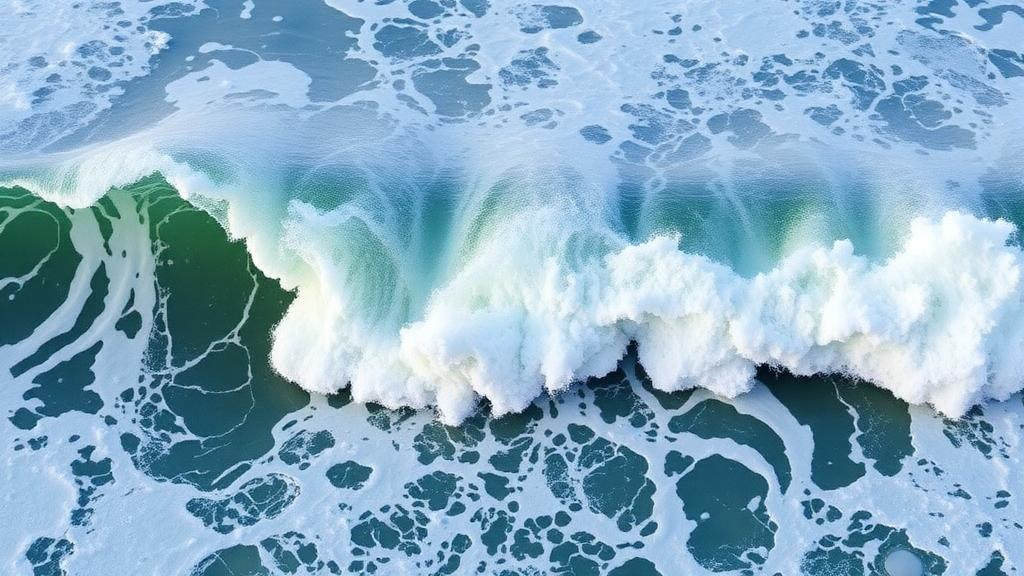
Every year, trillions of watts of energy are dissipated in the ocean as waves grow too steep and collapse into whitecaps, those fleeting patches of white foam that mark the most violent events on the sea surface. The process is central to how the ocean breathes and moves: breaking waves transfer momentum between air and water, entrain bubbles that drive gas exchange, and place a hard ceiling on how tall waves can grow. Yet despite its importance, wave breaking remains one of the most stubbornly difficult phenomena in fluid mechanics to measure, precisely because it is chaotic, intermittent, and over in seconds. A new laboratory study published in Ocean Dynamics by Zain Torres, Alexander Babanin, and Sannasi Annamalaisamy Sannasiraj has now tackled a particularly neglected corner of this problem: the direction in which breaking waves actually travel, and how that direction is written into the geometry of the foam they leave behind.
The directional character of wave breaking matters far beyond academic curiosity. Modern spectral wave models, the numerical workhorses behind shipping forecasts, coastal engineering, and climate projections, must decide how much energy to remove from waves traveling in every direction. In the classical formulation, the dissipation coefficient depends mainly on frequency, and the directional structure of energy loss is simply inherited from the directional wave spectrum. But recent theoretical work has suggested that breaking may possess directional characteristics of its own, meaning that the dissipation applied to waves heading one way might differ from that applied to waves of the same frequency heading another. Whether that is true, and how strongly, has been poorly constrained by observations, largely because measuring the direction of a breaking crest in the open ocean is extraordinarily hard.
The new study offers a fresh observational angle by treating whitecaps not merely as foam, but as geometric fingerprints of the breaking crests that produced them. Working in the 30 meter by 30 meter wave basin at IIT Madras, the team generated directional sea states using a flap-type wavemaker, following the standard JONSWAP spectrum combined with the Mitsuyasu spreading function, which controls how widely wave energy is distributed around the main propagation direction. Surface elevations were recorded with an array of wave gauges arranged in a pentagon, allowing the researchers to estimate the directional-frequency spectrum using the Wavelet Directional Method. Meanwhile, a camera mounted roughly three meters above the water, angled at about sixty degrees from vertical, filmed the incoming waves at high resolution and sixty frames per second.
Converting those videos into quantitative data required a careful image-processing pipeline. Because the camera views the surface obliquely, the images were rectified onto an orthogonal, equally spaced grid covering a calibrated analysis domain of eight by ten meters. Whitecaps were identified by applying a brightness threshold that isolates pixels significantly brighter than the surrounding water, but the team had to guard against false positives from specular reflections of the basin lighting. To do so, they imposed a series of filters: the largest bright cluster in each frame was treated as a candidate, its bounding box had to be longer than it was tall, matching the expected shape of a breaking crest, and the geometric criterion had to hold across at least three consecutive frames, reflecting the fact that breaking is not instantaneous. A proximity condition then tracked each whitecap across frames, and only whitecaps whose area increased over time were retained, restricting the analysis to actively breaking events.
The key geometric insight of the study lies in how direction is extracted. For each active whitecap, the lower boundary of the foam patch was used as a proxy for the local breaking-wave crest. Since a traveling wave propagates perpendicular to its crest, the orientation of that boundary yields a crest-normal direction, a geometry-based estimate of the direction in which the breaking wave was heading. Notably, the researchers deliberately avoided using the motion of the whitecap centroid for this purpose, because the centroid of an evolving foam patch can shift due to asymmetric growth, fragmentation, and merging rather than actual crest propagation. The method therefore characterizes the directional organization of breaking crests without attempting to measure their propagation speed or full kinematics, a limitation the authors are careful to acknowledge.
Across six experimental cases, combining two wave steepnesses with three levels of directional spreading, the team identified approximately 480 breaking events, with individual whitecaps persisting between one and four seconds. The central result is elegantly simple: the narrower the directional spectrum of the wave field, the more tightly the crest-normal directions of breaking whitecaps cluster around the mean wave direction. When the spreading parameter was small, indicating waves traveling across a wide range of angles, the breaking directions were broad and variable. When the spectrum was narrow, breaking events aligned sharply with the dominant wave direction. To quantify this, the researchers computed a breaking-crest spreading coefficient analogous to the spectral spreading coefficient, and found that the two are related by a nonlinear trend, well approximated by a cubic expression with a correlation coefficient of 0.74. Intriguingly, the breaking distributions tended to be more focused than the underlying wave energy distribution itself, echoing earlier field observations that breaking is directionally narrower than the spectrum that spawns it.
The geometric analysis added a second layer of insight. Short crests dominated the statistics, with more than half of all detected events measuring roughly one meter and 92 percent shorter than two meters. Longer crests were rarer but more disciplined: their crest-normal directions clustered more tightly around the dominant wave direction, with spreading coefficients increasing steadily from short to long crest categories. Most strikingly, whitecap area and crest length followed a power-law relationship, with area scaling as crest length to the power of about 1.57. This exponent is nonlinear, meaning that doubling the length of a breaking crest yields far more than twice the foamy footprint, and it sits intriguingly between the classical three-halves and five-thirds scalings associated with fractal surfaces and turbulence. The authors caution that no direct physical correspondence is implied, but the consistency of the scaling across both steepness conditions suggests a robust empirical pattern worth pursuing.
Wave steepness left subtler marks on the results. The lower-steepness cases produced marginally narrower breaking distributions, somewhat larger and more spatially extended whitecaps, and even some of the longest crests observed, hinting that less steep waves can support bigger coherent breaking events. However, the authors are explicit that these steepness-related differences were not statistically significant given the dataset size, and the fitted cubic relationship should be read as a constrained empirical approximation rather than a physically derived law. A possible hint of bimodality in the joint distribution of crest length and direction, with secondary peaks a few degrees off the mean propagation direction, was likewise judged too weak to be statistically robust. Such candor about limitations is a refreshing feature of the study, which also notes that the total event count, while sufficient for general trends, limits confidence in finer-scale directional features.
The broader significance of this work lies in what it could mean for wave modeling. If breaking dissipation does carry directional structure of its own, tied to but distinct from the spreading of wave energy, then next-generation spectral models may need dissipation terms whose intensity varies with direction, a possibility already being explored with observation-based directional dissipation functions. The whitecap-based method developed here provides exactly the kind of geometric and directional statistics that such parameterizations require, though the authors stress that their approach does not directly quantify energy dissipation. The natural next step is to connect these laboratory whitecap statistics with direct dissipation measurements, and to test whether the power-law scaling and the spectral-breaking spreading relationship hold across the much wider range of conditions found in the open ocean. For now, the study demonstrates something quietly profound: the direction a wave breaks in is not random, but is legibly encoded in the shape of the foam it leaves behind, waiting to be read frame by frame.
Subject of Research: Directional and geometric characteristics of breaking-wave whitecaps measured in a laboratory wave basin
Article Title: Directional and geometric characteristics of breaking-wave whitecaps in a laboratory wave basin
Article References: Torres, Z., Babanin, A., & Sannasiraj, S. A. (2026). Directional and geometric characteristics of breaking-wave whitecaps in a laboratory wave basin. Ocean Dynamics, 76(10), Article 105. https://doi.org/10.1007/s10236-026-01859-8
Image Credits: AI Generated
DOI: 10.1007/s10236-026-01859-8
Keywords: wave breaking, whitecaps, ocean waves, directional spectrum, wave basin, image processing, crest geometry, energy dissipation, physical oceanography, spectral wave models, laboratory experiments, Ocean Dynamics
Cite Scienmag News
Violet Maxwell. (September 30, 2026). Foamy Fingerprints: Lab Whitecaps Reveal How Breaking Waves Choose Their Direction. Scienmag. https://scienmag.com/foamy-fingerprints-lab-whitecaps-reveal-how-breaking-waves-choose-their-direction/
Violet Maxwell. "Foamy Fingerprints: Lab Whitecaps Reveal How Breaking Waves Choose Their Direction." Scienmag, 30 September 2026, https://scienmag.com/foamy-fingerprints-lab-whitecaps-reveal-how-breaking-waves-choose-their-direction/. Accessed 4 October 2026.
Violet Maxwell. "Foamy Fingerprints: Lab Whitecaps Reveal How Breaking Waves Choose Their Direction." Scienmag. September 30, 2026. https://scienmag.com/foamy-fingerprints-lab-whitecaps-reveal-how-breaking-waves-choose-their-direction/


